

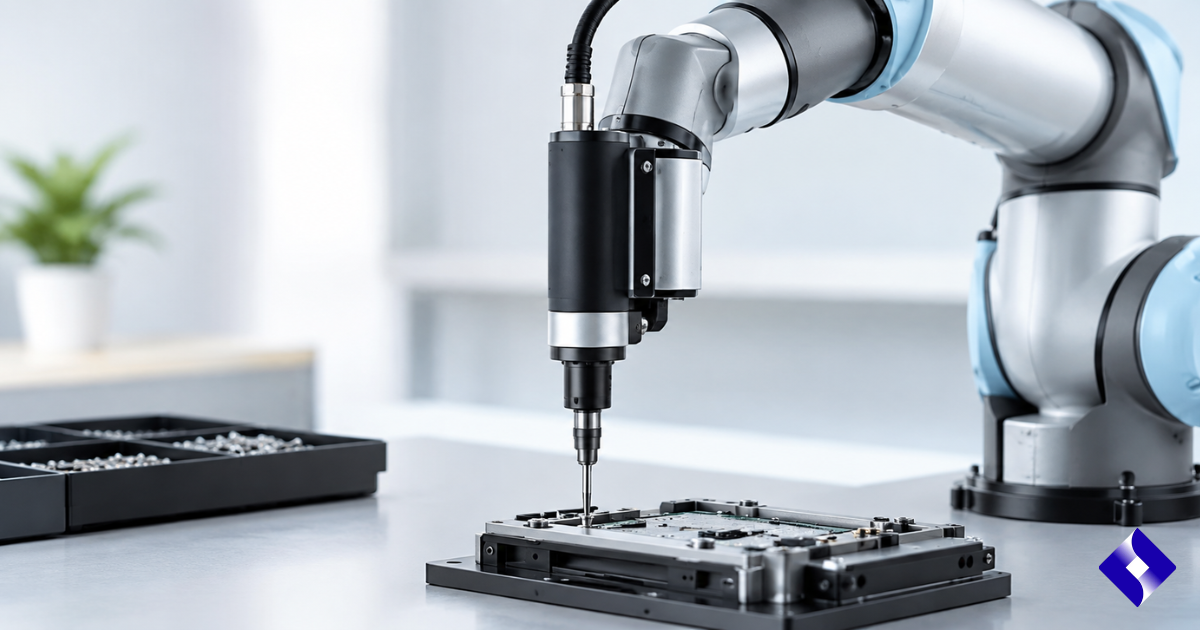

Automated assembly requires more than just tightening a screw. Manufacturers need repeatable torque, controlled speed, reliable fastening results, and equipment that can communicate with the rest of the production system.
The MDA3201-A robotic screwdriver is specifically designed for robotic and automated fastening environments where these factors are important. Instead of relying on manual tightening or separate tools for the various fastening stages, the system allows for the integration of controlled screwdriving parameters into an automated production process.
According to the manufacturer, the MDA3201-A uses a Swiss DC servo motor, operates with the MDC-32 controller, and provides programmable clamping control for automated applications. Its adjustable operating range spans from 150 to 2000 RPM, while its specified torque range is approximately 9.7 to 117.5 cN·m.
Understanding how this type of screwdriver works can help manufacturers determine where the automated screw-fixing system fits within a production line and what factors should be considered before its integration.
What is the MDA3201-A robotic screwdriver?
The MDA3201-A is an electric screwdriver developed for robotic, clamping, and automated screw fastening applications.
Unlike a conventional manual screwdriver, it is designed for integration into an automation system. It can be mounted on machinery or incorporated into a robotic assembly system where repeatable screw tightening is required.
The tool uses a 1/4-inch female hex drive and is designed to work specifically with the MDC-32 controller. The controller manages important operating functions such as fastening programs, process sequences, input/output communication, and fastening data collection.
This combination makes the system useful for operations where simply turning a fastener is not enough. Manufacturers may also need to monitor the screw’s rotation speed, the moment the screwdriver stops, how the different tightening stages are performed, and whether the tightening operation met the programmed conditions.
Key specifications of the MDA3201-A
Before selecting an automatic screwdriver, manufacturers must understand if its torque and speed ranges are suitable for the fastening application.
The following are the main published specifications of the MDA3201-A.
| Specification | MDA3201-A |
| Model | MDA3201-A |
| Item number | 310048 |
| Tool type | Robotic electric screwdriver |
| Unit size | 1/4 inch female hex |
| Torque range | 0.86–10.4 lbf·in |
| Torque range SI | 9.7–117.5 cN·m |
| Metric torque range | 1–12 kgf·cm |
| Adjustable speed | 150–2000 RPM |
| Tool weight | 1.7 pounds |
| Tool length | 11 in |
| Grip diameter | 1.5 inches |
| Driver required | MDC-32 |
| Published accuracy | Standard of ±10% clockwise/counterclockwise |
These specifications place the MDA3201-A in a relatively low torque range, making application compatibility especially important. Before selecting any automatic screwdriver, an engineer should confirm the screw size, joint characteristics, target torque, cycle time, material, and fastening requirements.
How does the MDA3201-A robotic screwdriver work?
The operating principle combines an electric servomotor, a torque control mechanism, a programmable controller, and an automation interface.
During an automated fastening cycle, the production system positions the screwdriver onto the fastener. The motor then rotates the tip according to the programmed speed and fastening conditions.
The manufacturer states that the screwdriver uses an automatic shut-off clutch that stops the tightening process once the preset torque is reached. This contributes to more consistent tightening results compared to processes that rely solely on the operator’s judgment.
The process can be understood through the following sequence.
| Fixation stage | What happens |
| Positioning | The automated system aligns the screwdriver with the screw or fixing point. |
| Start signal | The machine or controller starts the fixing cycle. |
| Screw rotation | The DC servomotor drives the screw at the programmed operating speed. |
| Pair development | The resistance increases as the screw approaches the joint. |
| Torque control | The system monitors the fixing process according to the configured parameters. |
| Automatic shut-off | The screwdriver stops when the preset tightening torque is reached. |
| Confirmation of the process | Information about the fasteners can be recorded and used for process control. |
| Next cycle | The robot or machine moves to the next attachment position. |
The final configuration will depend on the automation equipment, the controller programming, the screw feeding method, the workpiece, and the production requirements.
MDC-32 Controller Function
The screwdriver itself is only one part of the fastening system.
The MDA3201-A requires an MDC-32 controller , which provides the programming and communication functions necessary for automated production. Mountz states that the controller can store up to 30 process sequences with up to 20 program steps and save the fixing data to an SD memory card.
This allows a single clamping station to handle different procedures instead of relying on a single fixed tightening setting.
For example, a component might have multiple screw fixing points that require different tightening speeds or clamping sequences. A programmable controller can help manage these requirements within the same automated process.
The controller also provides digital I/O communication for connecting to external devices such as PLCs. This capability is important because a screwdriver operating on an automated assembly line often needs to exchange signals with robots, sensors, conveyor belts, clamping devices, and machine control systems.
Why is torque control important in automated screwdriving?
Tightening torque affects the clamping force created when a screw joins two components.
Insufficient tightening torque may leave the joint not properly secured. Excessive torque may damage the fastener, threads, housing, or assembled component.
Therefore, the correct tightening torque depends on the specific design of the gasket.
This is especially important in automated production, as the same operation can be repeated hundreds or thousands of times. A variation in clamping that seems insignificant during one cycle can become a major quality problem when repeated in large-scale production.
The MDA3201-A robotic screwdriver is designed to achieve repeatable torque-controlled tightening by using programmed settings and automatic shut-off, rather than relying entirely on manual judgment.
Where can the MDA3201-A robotic screwdriver be used?
The manufacturer describes the MDA3201-A as a tool for automated clamping and clamping applications. Its practical suitability depends primarily on whether the required torque, speed, mounting configuration, and control architecture match the tool’s operating capabilities.
Possible application categories include:
| Application environment | Why can automated screwdriving be useful? |
| Assembly of electronic components | The components may require repeatable tightening with low torque. |
| Small mechanical assemblies | Multiple screws can be tightened using programmed sequences. |
| Electrical equipment | Controlled fixation can help maintain process uniformity. |
| Automated production cells | The screwdriver can be integrated into robotic or machine-controlled stations. |
| Precision Assemblies | A controlled tightening torque can help reduce variation between tightening cycles. |
| Multi-stage assembly processes | The controller allows you to manage different fixing programs. |
| Repetitive manufacturing | Automation reduces reliance on repetitive manual screwing. |
These are application categories, not guarantees that the MDA3201-A is suitable for all products in these industries. The fastening connection should always be evaluated based on the tightening torque and operating specifications published by the tool manufacturer.
Advantages of using the MDA3201-A in automated assembly.
One of the main advantages of robotic screwing is the consistency of the process.
Human operators can perform fastening tasks effectively, but repetitive operations naturally introduce variations in speed, positioning, timing, and technique. Automated screw fastening allows for better control of these variables through programmed parameters.
The potential benefits can be viewed as follows.
| Benefit | Practical value |
| Repeatable torque control | It helps maintain more uniform fixing conditions. |
| Adjustable speed | It allows the process to be adapted to different fixing requirements. |
| Automatic shut-off | The tool stops when the programmed tightening torque is reached. |
| Programmable sequences | It supports more complex fixation strategies. |
| Production integration | Digital I/O enables communication with automation equipment. |
| Fixation data | Information about the process can support traceability and quality review. |
| Reconfiguration | Programs can be adjusted when production requirements change. |
| Reduction of tool duplication | A programmable system can perform tasks that would otherwise require multiple fixed-configuration tools. |
Mountz specifies that its controller supports real-time monitoring, storage of fastening data, and analysis of values such as mean, standard deviation, Cp, and Cpk. These capabilities can be useful for manufacturers who monitor fastening performance as part of their process control system.
How the MDA3201-A supports production traceability
Modern manufacturing increasingly demands proof that a process has been completed correctly.
In fastening operations, this may mean recording information about tightening torque, fastening status, or production sequences.
The MDC-32 system can collect tightening data and store the information on an SD memory card. The controller also provides analysis functions related to the tightening results.
This can be useful when manufacturers need to investigate quality problems.
Instead of only knowing that a screw was installed, production teams can have access to information showing how the fastening process performed during manufacturing.
Data collection does not automatically guarantee product quality, but it provides engineers with additional information for troubleshooting and process improvement.
MDA3201-A screwdriving versus manual screwdriving
The difference between automatic and manual screwing is not simply in the speed.
The most important distinction lies in the level of process control.
| Factor | Manual screwing | Automated configuration MDA3201-A |
| Operator participation | High | Lower during automated cycles |
| Pair consistency | It depends on the tool and the operator’s process. | Controlled by means of the fixing system |
| Speed programming | Generally limited | Adjustable from 150 to 2000 RPM |
| Production integration | Limited | Designed for automated systems |
| Data collection | It depends on the team | With the support of MDC-32 |
| Process sequences | Usually managed by an operator. | Programmable |
| Repetition | It depends on the operator. | Machine controlled |
| PLC communication | It is not usually available with basic tools. | compatible digital I/O through the controller |
Neither approach is automatically the right choice for all production environments.
Hand tools can still be practical for low-volume, frequently changing assembly tasks, repairs, or jobs requiring high flexibility. Automated fastening becomes more attractive when repeatability, throughput, data collection, and integration become increasingly important.
Factors to consider before using the MDA3201-A
When choosing an automatic screwdriver, it is best to start with the type of joint it uses, and not with the name of the tool.
The key question is whether the screwdriver’s operating range and control capabilities are suitable for the production process.
| Selection factor | Question for evaluation |
| Pair required | Is the joint within the torque range specified for the screwdriver? |
| Screw type | Is the drive and mounting configuration compatible with the application? |
| Bonding material | How does the material respond to tightening torque? |
| Production speed | Can the required cycle time be achieved? |
| Robot or accessory | How will the screwdriver be mounted and positioned? |
| Screw feed | How will the screws reach the fixing point? |
| Controller integration | Can the machine communicate with the MDC-32? |
| Traceability | What fixation data should be stored? |
| Product variation | Will the different products require different fixing programs? |
| Maintenance | How will the maintenance of the tools, drill bits, cables, and system components be carried out? |
Evaluating these aspects before installation can prevent a common mistake in automation: selecting equipment based solely on maximum torque or speed.
A fastening system works best when the screwdriver, driver, screw feeder, robot, fixture, fastener, and joining are considered as a single process.
Can a single MDA3201-A perform different fastening tasks?
A useful feature of programmable clamping systems is their ability to store multiple processes.
Mountz states that the MDC controller can support up to 30 process sequences with up to 20 program steps. The manufacturer also notes that a single programmable tool can potentially replace several conventional tools in suitable applications.
That doesn’t mean that a single screwdriver can meet all fastening requirements.
Each task must be kept within the limits of torque, speed, drive, and mechanical operation of the tool.
However, when multiple joints fall within those limits, programmable adjustments can provide greater production flexibility than maintaining a separate fixed tool for each clamping condition.
Does the MDA3201-A work without a driver?
No. The manufacturer’s documentation specifies that the MDA3201-A works with the MDC-32 controller .
This is an important aspect to consider when planning an automated fixing cell, as the screwdriver should not be treated as a separate component.
The complete installation may also require suitable cables, mounting hardware, screw presentation equipment, I/O connections, vacuum adapters, or other integration components, depending on how the production cell is designed.
Also Read: MDA3201-A Intelligent Robotic Screwdriver for Manufacturing Automation
Final reflections
The MDA3201-A robotic screwdriver is designed for manufacturers who need controlled screw tightening within robotic or automated assembly systems.
Its main features include programmable speed, controlled torque, automatic shutdown, automation communication, and fastening data capability when combined with the MDC-32 controller.
The system’s usefulness lies not simply in its automatic screwing capabilities. Its value lies in transforming screwing into a controlled production process that can be programmed, monitored, repeated, and integrated with other manufacturing equipment.
For engineers considering the MDA3201-A, the most important step is to compare the actual clamping application with the tool’s torque range, speed range, controller requirements, mounting needs, and desired level of process traceability.
When these factors coincide, robotic screwdriving can help create a more uniform and measurable fastening process without relying entirely on manual operation.