


Introduction
Artificial intelligence is transforming how people approach researching financial markets. Tasks that previously required traders to spend hours reviewing charts, technical patterns, support and resistance levels, and potential trading scenarios can increasingly be performed with the help of software.
This shift has also generated interest in AI-powered trading platforms, such as SnapTrader AI . Instead of presenting AI as a replacement for human decision-making, the platform is designed around chart analysis and tools that help traders organize potential investment ideas.
However, understanding what an AI trading platform actually does is more important than simply knowing its name. AI can identify patterns and process information quickly, but markets remain uncertain. Therefore, a useful approach is to consider AI trading software as an analytical tool, while maintaining independent judgment and disciplined risk management.
Table of Contents
- What is SnapTrader AI?
- How does SnapTrader’s AI work?
- Key features of SnapTrader AI
- Benefits of AI-assisted trading
- Why is risk awareness important?
- Advantages and disadvantages
- Is SnapTrader AI suitable for beginners?
- What AI-powered trading tools cannot do
- Frequently Asked Questions
- Key findings
- Conclusion
What is SnapTrader AI?
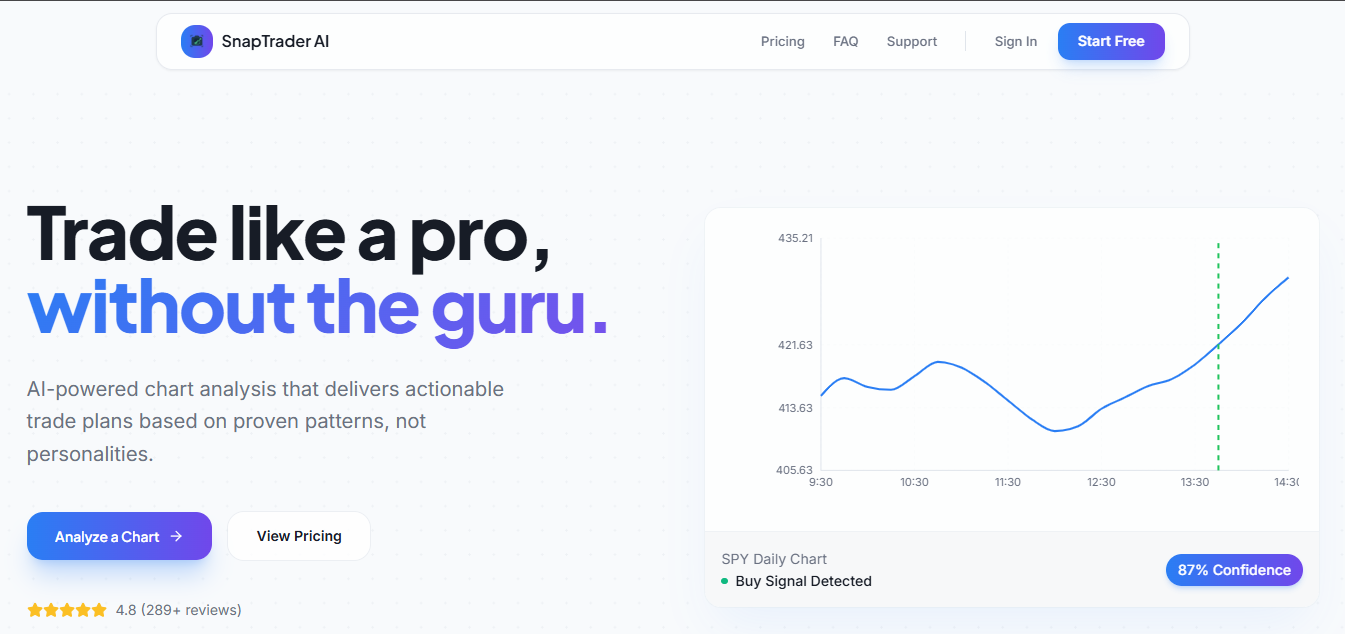
SnapTrader AI is an AI-assisted trading analysis platform focused on chart interpretation and helping users develop structured trading strategies. Information published about the platform describes features such as chart analysis, pattern recognition, potential entry and exit levels, risk management calculations, and trade logging.
The underlying idea is relatively simple: instead of relying entirely on manual inspection of charts, traders can use AI to process available market information and organize it into a more easily reviewed format.
That doesn’t mean technology can predict markets with certainty. SnapTrader’s own terms and conditions state that its information and analysis are for informational purposes only and should not be considered financial or investment advice.
This distinction is crucial for anyone researching AI-powered trading software. An analytical tool can support a decision, but it doesn’t eliminate the inherent uncertainty of trading in financial markets.
How does SnapTrader’s AI work?
Market analysis based on charts
The process begins with market information, such as a trading chart. Depending on the platform, users can upload charts or connect a trading platform to access its analytical features.
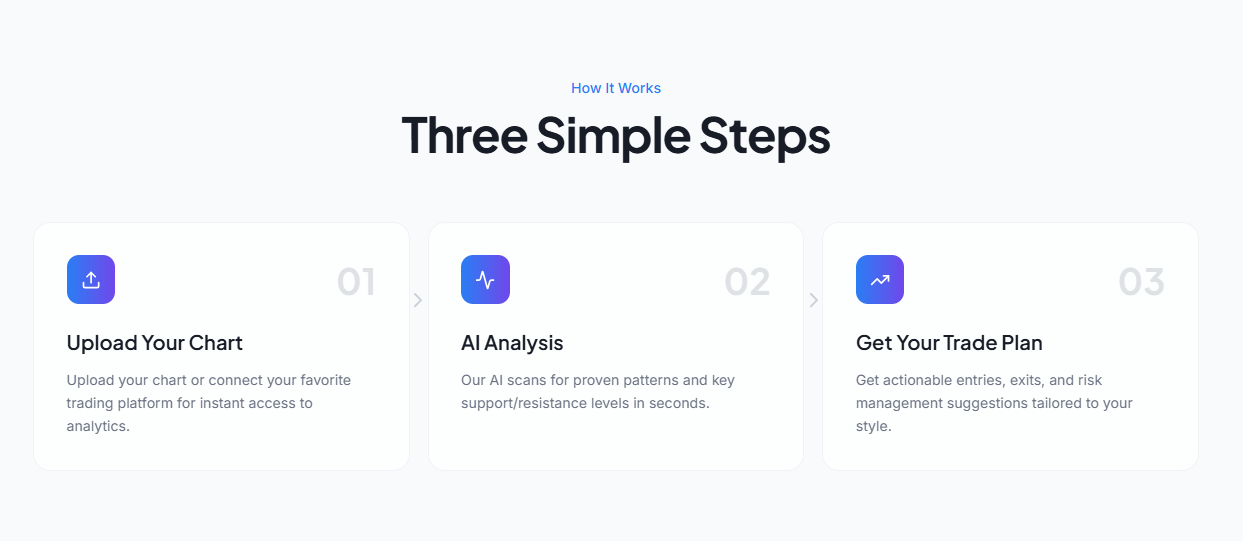
Once the chart is available, the AI can analyze visible price movements and technical structures. This can include identifying patterns, potential support and resistance areas, and other features relevant to technical analysis.
The goal is to better structure the initial research process. Instead of starting with a blank chart and manually searching for all possible configurations, a trader can use automated analysis as a starting point for deeper investigation.
Pattern recognition
Pattern recognition is a fundamental part of AI-assisted technical analysis. Trading charts can contain formations that traders often interpret as potential continuation or reversal signals.
AI systems can process these visual structures quickly, which can be especially useful when analyzing multiple markets or time periods. However, identifying a pattern does not guarantee that a specific price movement will follow.
Market conditions can change due to economic data, company announcements, geopolitical events, liquidity fluctuations, or other unforeseen circumstances. Therefore, technical patterns should be considered as evidence for evaluation, rather than guaranteed predictions.
Generating a potential business plan
After analyzing the available chart data, SnapTrader AI is designed to provide a potential trading plan. This plan may include possible entry and exit levels, as well as risk-related information.
A structured plan can encourage traders to think beyond simply deciding whether or not to open a position. It also raises practical questions: When would the trade be invalidated? How much capital should be risked? What happens if the market moves against you?
These questions are fundamental to responsible trade.
Key features of SnapTrader AI
AI-powered graph analysis
Chart analysis is fundamental to the platform. AI-assisted analysis allows users to review technical information without having to manually examine each element of a chart.
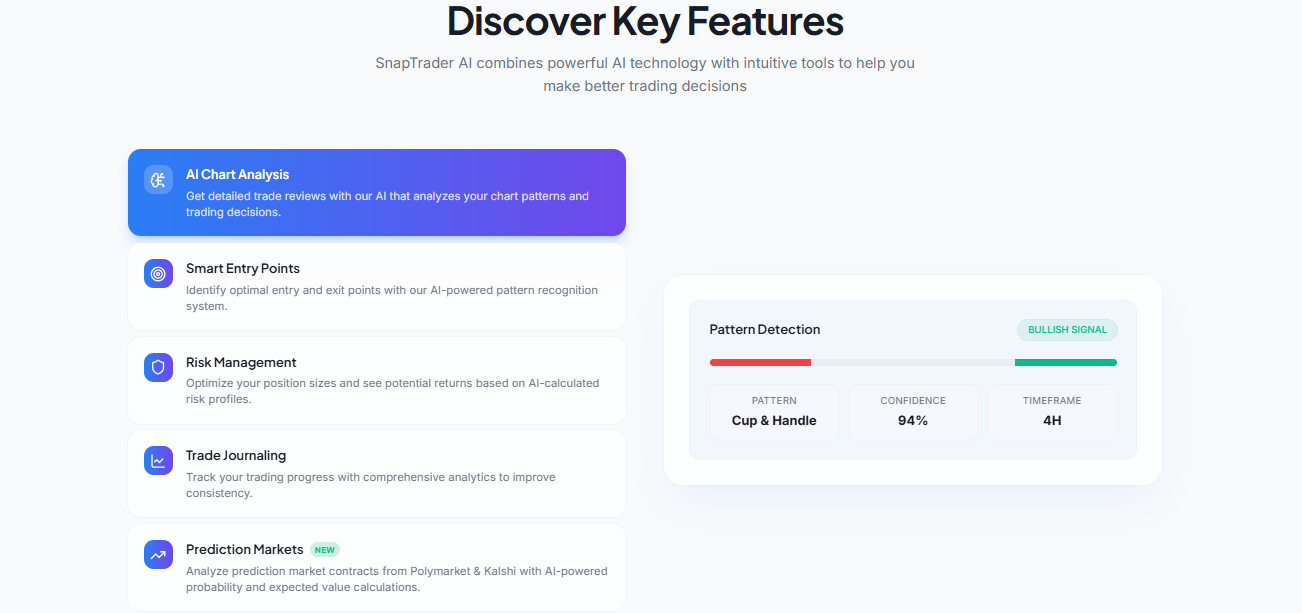
The potential advantage lies in efficiency. An operator can use automated analysis to identify areas that warrant investigation and then conduct their own research before making a decision.
Technical pattern recognition
SnapTrader AI identifies potential technical patterns as part of its analysis. Pattern recognition can be useful for traders who use technical analysis as a component of their strategy.
However, technical patterns should always be considered within their broader market context. The same pattern can behave differently depending on volatility, time horizon, liquidity, and market conditions.
Input and output levels
Another feature is the identification of potential entry and exit points. These levels can help traders define a trade more clearly before investing capital.
Planning your exit in advance can also reduce the influence of emotions on decision-making. However, the suggested levels should not automatically be considered optimal for all traders, as risk tolerance and investment objectives vary.
Risk and sizing of positions
Risk management is one of the most important aspects of trading. SnapTrader AI includes tools designed to help users consider position sizing and risk-related calculations.
Position size is particularly important, as the amount invested in a trade can influence the financial impact of a loss. A smaller position with a predefined risk limit may be more appropriate than a large position simply because an AI system identifies a potentially attractive setup.
Specialized magazine and analysis
Keeping a record of trades can help users evaluate their decisions over time. Instead of focusing solely on individual winning or losing trades, a record can reveal patterns in a trader’s behavior.
For example, a trader may discover that certain setups behave differently from others on a regular basis, or that poor results often result from trades made outside of their usual strategy.
This type of historical review can be valuable because improving business operations often involves evaluating the process, not just the results.
Benefits of AI-assisted trading
Faster preliminary investigation
One of the most obvious advantages of AI-assisted analysis is speed. The software can process chart information much faster than a person manually examining multiple assets. For active traders who monitor multiple markets, this can reduce the time spent on repetitive preliminary analysis.
More structured decision-making
AI tools can also foster a more organized approach. Analyzing potential entries, exits, patterns, and risks together provides a broader framework than focusing on a single technical indicator.
This structure can help traders avoid making decisions based solely on impulse.
Reduction of manual labor
Traditional technical analysis can involve repeatedly reviewing charts, identifying levels, identifying patterns, and recording trades. Automation can reduce some of these repetitive tasks.
The advantage doesn’t necessarily lie in AI making better decisions than humans. Instead, it can give traders more time to focus on interpreting information and assessing whether a trade fits their strategy.
Best business review
A well-maintained transaction log can transform past transactions into valuable insights. Combining AI-assisted analysis with historical transaction records can help users identify recurring strengths and weaknesses in their strategy.
Why is risk awareness important?
AI does not eliminate financial risk.
Every investment strategy can result in losses, even those supported by sophisticated analytical software. Historical patterns do not guarantee future results, and an algorithm can misinterpret market conditions or operate with incomplete information.
Therefore, risk management remains critical. Traders must consider factors such as position size, stop-loss planning, diversification, volatility, liquidity, and the amount of capital they can afford to lose.
It is equally important to avoid confusing a confidence score or an AI-generated trading signal with certainty. A numerical evaluation can make a result appear precise, but market outcomes remain probabilistic.
Advantages and disadvantages of AI-assisted trading
Advantages
- It can speed up the preliminary analysis of graphs.
- It helps to organize technical market information.
- You can identify potential patterns in the charts.
- It can encourage predefined planning of inputs and outputs.
- Risk management tools can contribute to a more rigorous determination of position sizes.
- Specialized journals can help users review historical decisions.
Disadvantages
- AI-powered analysis cannot guarantee profitable operations.
- Technical patterns can fail.
- Unexpected market events can change conditions rapidly.
- Users can become overly dependent on automated signals.
- The analysis generated by AI still requires human interpretation.
- Trading in the stock market carries the possibility of losing money.
Is SnapTrader AI suitable for beginners?
It can be useful as an educational or analytical tool, but beginners should not assume that using AI automatically makes trading in the markets safer or easier.
Those starting out in trading must first understand basic concepts such as market orders, limit orders, stop loss, leverage, volatility, position sizing, and the risk-reward relationship.
AI-generated analysis should be considered just one contribution among many. Beginners should also learn how markets work and understand why a particular strategy might succeed or fail, rather than blindly following automated recommendations.
What AI-powered trading tools cannot do
AI-based trading software has significant limitations.
You cannot know for sure what will happen tomorrow in a financial market. Nor can you fully anticipate unexpected events such as sudden economic announcements, regulatory decisions, political developments, corporate news, or drastic changes in market sentiment.
Furthermore, the outcome of an AI system depends on the available information and methodology. If the underlying data is incomplete or market conditions deviate from the patterns represented in its analysis, the resulting interpretation may be less useful.
For this reason, human supervision remains important even when sophisticated automation is involved.
Frequently Asked Questions
Is SnapTrader AI free?
SnapTrader AI may offer access to certain features under its available plans, but pricing and feature availability can change. Users should check the platform’s current pricing information before signing up.
Do AI trading really work?
AI trading tools can help analyze market data, identify patterns, and support trading decisions. However, they cannot guarantee accurate predictions or consistent profits because financial markets remain unpredictable.
Is Trader AI real or fake?
AI trading platforms can be legitimate software tools, but legitimacy depends on the specific service, its transparency, and how it operates. Always verify the platform, fees, terms, and risk disclosures before using it.
Can I make money on AI trading?
AI tools may assist with market research and trade planning, but they do not guarantee profits. Any money earned or lost depends on market conditions, strategy, risk management, and individual trading decisions.
Which AI is best for trading?
There is no single AI trading tool that is best for everyone. The right choice depends on factors such as market coverage, analysis features, risk-management tools, transparency, usability, and your trading strategy.
Key findings
- SnapTrader AI is designed to provide support for chart-based trading analysis using artificial intelligence.
- Its published functions include chart analysis, pattern recognition, potential trading levels, risk-related calculations, and trade recording.
- AI can make preliminary market research faster and more structured.
- Pattern recognition does not guarantee future price movements.
- Risk management remains essential, regardless of the technology used.
- Information generated by AI should be evaluated rather than blindly followed.
- Beginners should understand the fundamental concepts of trading before relying on automated analysis.
- Trading in financial markets involves economic risks, and no AI platform can guarantee profits.
Conclusion
The increasing use of artificial intelligence in financial markets reflects a broader trend toward automated research and data-driven decision-making. SnapTrader AI exemplifies this approach by combining AI-powered chart analysis with tools designed to help traders examine patterns, potential trading levels, risk considerations, and historical performance.
Its true value shouldn’t be measured by whether AI can eliminate uncertainty in stock trading; it can’t. Instead, the more practical question is whether an AI-assisted workflow can help traders analyze information more efficiently, organize potential setups, and maintain greater discipline.
Ultimately, technology is only one part of the process. Making sound investment decisions requires market knowledge, proper risk management, independent thinking, and the understanding that even the most sophisticated analysis can be wrong.