



Introduction
Teachers spend more time preparing for instruction than many people realize. In addition to delivering lessons, teachers may need to understand curriculum goals, assess misunderstandings, create practice activities, adapt materials for different learners, and decide how to respond when students struggle.
Artificial intelligence is increasingly being sought to alleviate this workload. However, the usefulness of an education-focused AI tool depends on more than its ability to generate text. Teachers need support that understands the curriculum, preserves instructional goals, and still leaves professional judgment in human hands.
Coteach AI is designed around this idea. Coteach is an AI-powered teaching assistant focused on helping K–12 teachers work with curriculum content, differentiate instruction, create scaffolds, develop practice activities, and prepare for classroom instruction. Its current platform is specifically tied to Illustrative Mathematics (IM) v.360.
Table of contents
- What is Coteach AI?
- How Coteach AI works
- Key Features
- How it can help with common teaching challenges.
- Benefits for educators
- Limitations and precautions
- Advantages and disadvantages
- Frequently Asked Questions
- Key Takeaways
- Conclusion
What is Coteach AI?
Coteach AI is an education-focused artificial intelligence assistant designed to help teachers implement and adapt high-quality teaching materials. Rather than just acting as a general-purpose chatbot, Coteach is designed to be contextualized and tailored to the needs of the curriculum.
The platform describes its approach as teacher-led, meaning that AI aims to support teachers’ professional judgment rather than replace it. Its tools can help teachers create customized scaffolds, practice problems, lesson modifications, outlines, and other teaching resources.
Coteach originally started as an AI assistant for Illustrative Mathematics and has since expanded its curriculum support capabilities. In February 2026, the platform announced that it had become IM Certified , meaning that Illustrative Mathematics had reviewed it to align with the structure and pedagogical approach of IM v.360.
How Coteach AI works
The basic idea is to provide AI assistance to teachers while maintaining the context of the curriculum they are already using.
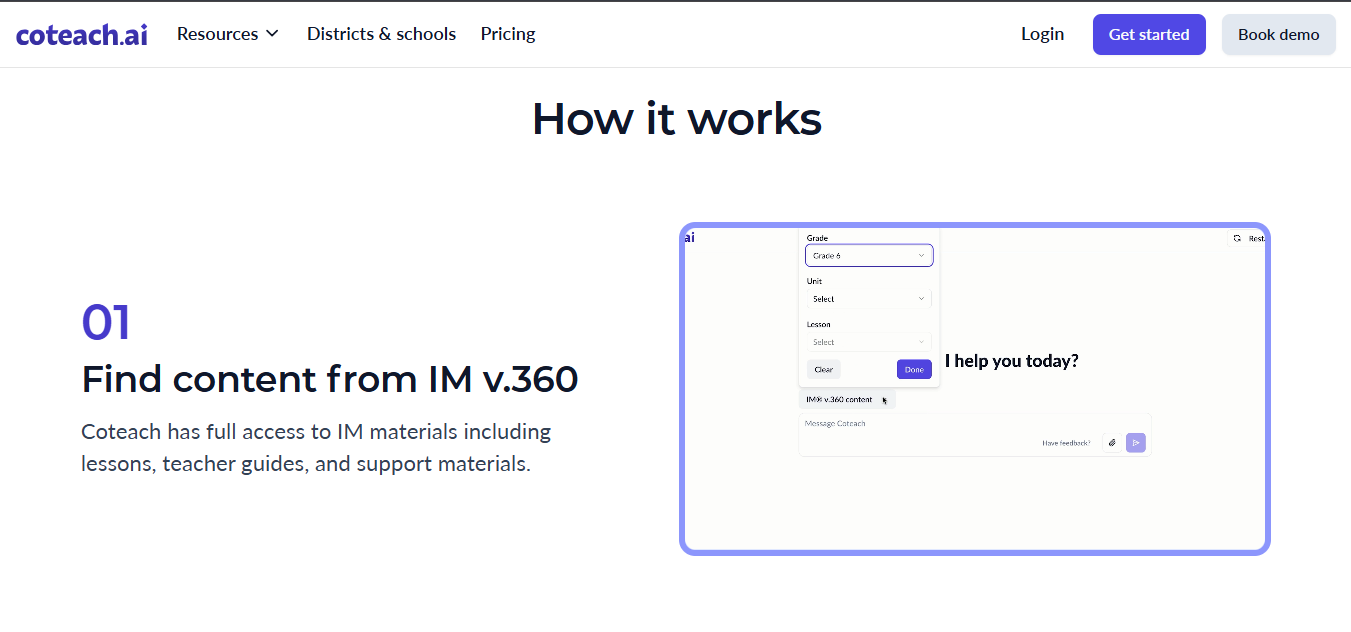 Instead of starting with a blank prompt and asking a generic AI system to invent lessons, teachers can work from existing curriculum materials. Coteach can then help modify or expand those materials to meet specific instructional needs.
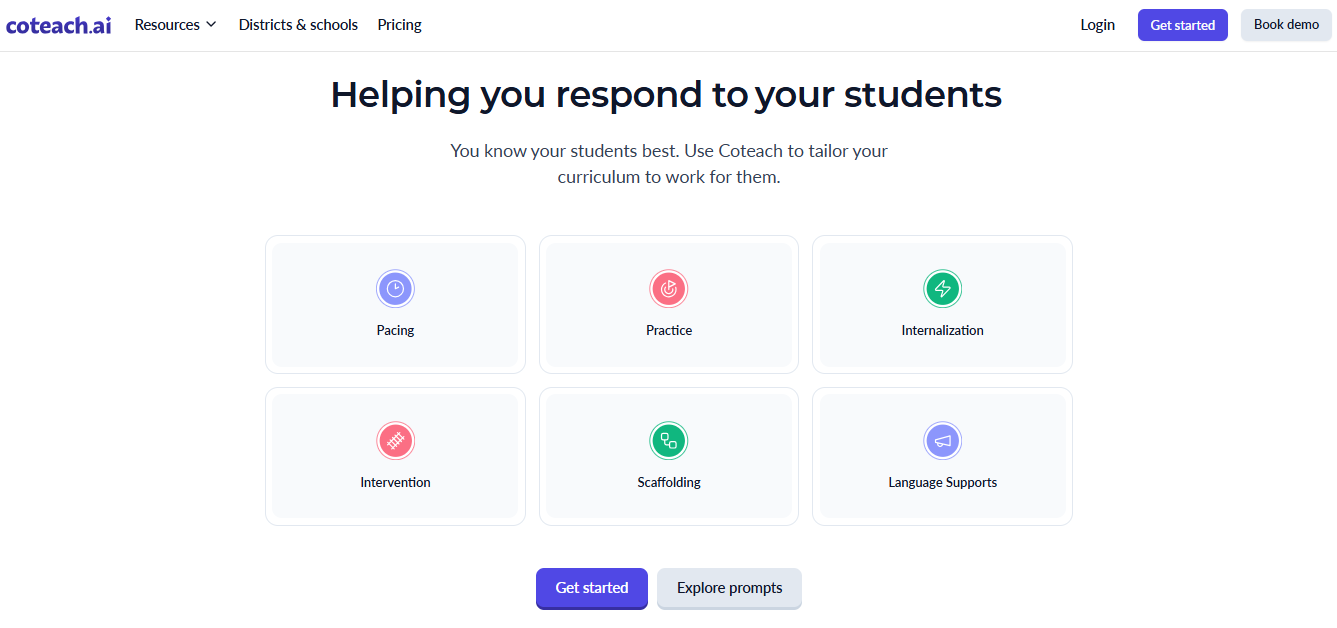
For example, one teacher may need additional practice for students who have not mastered a required skill. Another teacher may want scaffolding for multilingual learners or an extension activity for students ready for an additional challenge.
Coteach’s prompt library includes examples of differentiation practice, prior skill review, extension activities, student misconceptions, and lesson internalization.
Key Features of Coteach AI
Support for curriculum-linked lessons
A key difference between a specialized educational AI tool and a typical chatbot is context.
Coteach is designed to work with curriculum content and instructional objectives rather than presenting each lesson as a stand-alone application. This can help teachers adapt existing lessons while preserving key learning goals and the overall instructional approach.
Differentiated instructions
There are rarely students with identical learning needs in a classroom. Some learners may need additional explanation or guided practice, while others may benefit from more challenging activities.
Coteach can help teachers create different materials, scaffolds, and practice opportunities. This can reduce some of the repetitive preparation involved in adapting a common lesson for different groups of students.
Practice problems and activities
Teachers often need more practice questions than are included in the actual lesson. Manually creating multiple variations can waste valuable preparation time.
Coteach tools can generate additional practice activities that are linked to lesson objectives. Teachers can then review, edit, and decide which content is appropriate for their students.
Visual and diagram support
Visual representations can be especially important when teaching math concepts. Coteach supports the creation of diagrams and representations linked to the curriculum, including number lines, tape diagrams, arrays, area models, coordinate planes, and fraction models.
The goal of this capability is to help teachers create visual aids without having to design each representation from scratch.
Reusable teaching instructions
Coteach introduced Skills in 2026 , allowing teachers to create reusable instructions that impact how the system responds to recurring instructional needs.
For example, a teacher who regularly uses a specific scaffold format for multilingual learners can establish this approach once and reuse it in related lesson preparation tasks.
How Coteach AI can tackle common teaching challenges.
Reducing preparation time
Lesson preparation can involve many small tasks: creating practice questions, editing explanations, preparing scaffolds, developing visuals, and reviewing the instructional sequence.
AI can help with some of these repetitive activities, giving teachers more time to focus on decisions that require classroom knowledge and professional judgment.
Supporting diverse learning needs
Differentiation is difficult when teachers have limited preparation time. A lesson may require extra support for some students and more complexity for others.
Coteach is designed to help teachers make these adaptations while staying connected to the core curriculum. This approach can be useful when teachers need multiple versions or additional support without having to rebuild the entire lesson.
Understanding the purpose of the lesson
Sometimes the challenge is not just creating the content, but understanding why the lesson is structured in a certain way.
Coteach’s internalization prompts can help teachers examine the purpose of activities, anticipate potential student responses, identify misunderstandings, and understand how different parts of lessons are connected.
Supporting incomplete learning
Students may enter a lesson without mastering the essential concepts. Rather than abandoning the grade-level objective, teachers often need targeted activities that address specific gaps.
Coteach was designed to assist teachers in creating additional practice and scaffolding for incomplete learning while maintaining connections to grade-level curriculum.
Benefits of Coteach AI for Teachers
The potential value of Coteach AI is not just that it can produce content quickly. Its more important advantage is the combination of AI assistance with curriculum context.
Potential benefits include:
- Less repetitive preparation: Teachers can use AI for some time-consuming preparation tasks.
- More accessible instruction: Scaffolds can help teachers adapt content for different learners.
- Curriculum consistency: The content produced can remain aligned with the curriculum being taught.
- More practice options: Teachers can create additional activities when students need reinforcement.
- Visual learning support: Curriculum-related diagrams can be created for selected teaching needs.
- Teacher Control: Teachers can review, edit, and adjust AI-generated content before using it.
- Support for internalizing lessons: Teachers can explore lesson objectives, activities, misunderstandings, and student responses.
These benefits should be seen as areas where AI can assist with professional work rather than where AI can independently make instructional decisions.
Important limitations and considerations
AI-generated educational content should not be automatically considered accurate.
Teachers still need to check generated explanations, examples, questions, diagrams, and suggested activities before using them with students. Even curriculum-focused systems can produce materials that require adjustments for a particular classroom.
Another important consideration is student privacy. Coteach’s privacy policy states that the platform is designed to work with minimal to no student data and says that teachers should avoid entering personally identifiable student information unless given appropriate permission. It also states that teacher and student data is not used to train AI models.
Schools and educators must still follow their district policies and applicable privacy requirements when using any AI-powered educational platform.
Advantages and disadvantages
Profession
- Specifically designed for educational workflows.
- Supports curriculum-based lesson adaptation.
- Can help with various instructions
- Creates additional practice and teaching support.
- Provides diagramming and visual support capabilities.
- Keeps teachers involved in reviewing and editing output.
- Offers tools for finding lesson objectives and student misunderstandings.
Cons
- Its strongest curricular integration currently focuses on Illustrative Mathematics.
- AI-generated content still requires teacher review.
- The results depend on the quality and specificity of the teacher’s instructions.
- AI should not replace professional judgment.
- Schools need to consider privacy and technology policies before broader implementation.
Frequently Asked Questions
Is Coteach AI free?
Coteach AI offers a free option with usage limitations, along with paid plans that provide additional features and capabilities. Pricing and plan details may change, so users should check its current official pricing page.
What is Coteach AI?
Coteach AI is an education-focused AI assistant designed to help teachers with lesson preparation, differentiation, scaffolding, practice activities, and curriculum implementation. It is particularly connected with Illustrative Mathematics curriculum materials.
What does Coteach mean?
“Coteach” generally refers to co-teaching, where two or more educators work together to support students and deliver instruction. In the context of Coteach AI, the name reflects the idea of AI working alongside teachers as a support tool.
Who is the most famous AI teacher?
There is no universally recognized “most famous AI teacher,” as several AI-powered teaching tools and virtual educators have gained attention in different areas. The leading option depends on factors such as subject, educational level, and intended use.
Who is No. 1 in AI?
There is no single universally accepted No. 1 company, model, or person in AI because rankings depend on the criteria being measured. Organizations such as OpenAI, Google, Anthropic, and others are leading different areas of AI research and development.
Key Takeaways
- Coteach AI is designed as an education-focused AI assistant for curriculum implementation and instructional preparation.
- Its strongest current connection is with Illustrative Mathematics v.360 .
- Teachers can use it for differentiation, scaffolding, practice activities, lesson internalization, and visual support.
- The platform is designed to support rather than replace teachers’ decisions.
- AI-generated content should always be reviewed before classroom use.
- Privacy concerns remain important when working with student information.
- The most useful role for Coteach AI is to reduce repetitive preparation while allowing teachers to focus more on students and instructional decisions.
Conclusion
Coteach AI illustrates a broader shift in how artificial intelligence can be used in education. Rather than asking AI to replace the teacher or independently design the entire learning experience, a more practical approach is to use it as a supportive layer around the educator’s existing curriculum and expertise.
For teachers, this distinction matters. Effective instruction still requires understanding students, recognizing misconceptions, making professional judgments, and responding to what happens in the classroom. AI can help with some of the preparation behind these decisions, but the teacher remains responsible for deciding what ultimately matters in the lesson.
Used thoughtfully, Coteach AI can therefore be seen as a tool to reduce repetitive and repetitive work, create teaching options, and help teachers adapt curriculum to the needs of real classrooms as an alternative to traditional teaching.