


Introduction
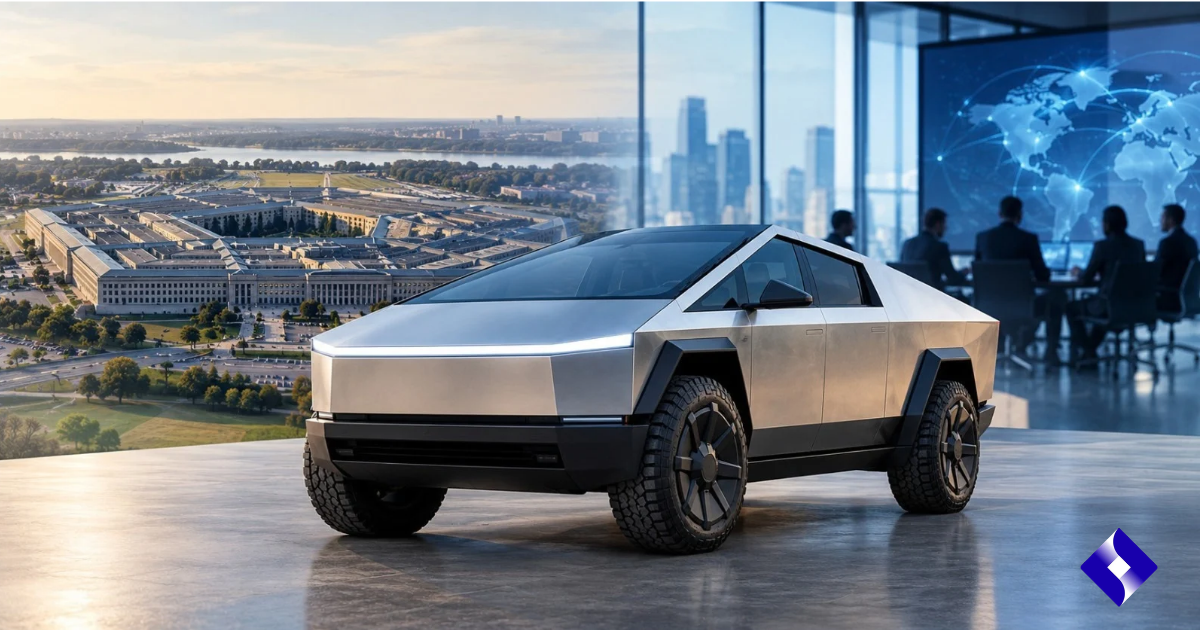
The Tesla Cybertruck was designed as an unconventional electric pickup, but its story is quickly moving beyond ordinary consumer transportation.
The vehicle has surfaced in US military procurement documents, while companies linked to Elon Musk – including SpaceX – have also acquired a significant number of Cybertrucks. These developments have helped place the truck at the intersection of electric vehicles, defense testing, advanced technology and corporate strategy.
However, some headlines may over-dramatize this relationship than the evidence supports. The Pentagon is not currently adopting the Cybertruck as a standard combat vehicle. Instead, the US Air Force has sought the Cybertruck for highly specific testing purposes, while SpaceX and other Musk-affiliated businesses have separately used Tesla vehicles commercially.
Understanding this difference explains why the Cybertruck continues to appear in conversations involving both defense and technology.
Table of contents
- Why is the Pentagon interested in the Tesla Cybertruck?
- Is the US military buying Cybertrucks for war?
- Why is the Cybertruck important for military testing?
- How is Big Tech connected to Cybertruck?
- Why did SpaceX buy so many Cybertrucks?
- What makes the Cybertruck technologically extraordinary?
- How does this reflect the Pentagon’s growing interest in commercial technology?
- Key Features
- Potential benefits
- Advantages and disadvantages
- Frequently Asked Questions
- Key Takeaways
- Conclusion
Why is the Pentagon interested in the Tesla Cybertruck?
The clearest connection between the Pentagon and the Cybertruck came through the US Air Force’s purchase in August 2025.
The Air Force Test Center issued a request for towable target vehicles for live missile fire testing . The major requirement covered several categories of vehicles, but reporting based on procurement documents shows that two Tesla Cybertrucks were specifically requested. This is an important detail because the Army was not looking for the Cybertrucks to serve as troop transport or battlefield patrol vehicles.
Instead, the trucks were expected to be targeted.
Why Cybertruck in particular?
Most vehicles in the purchase were identified only by category, such as sedans, SUVs and pickup trucks.
The Cybertruck stood out because the Air Force identified a specific make and model.
Procurement reporting cited the vehicle’s unusual angular shape and stainless steel exterior as reasons it attracted military interest. The documents also raised the possibility that unconventional commercial vehicles could eventually appear in an operational environment.
This makes the Cybertruck relevant from a military testing perspective even if the US armed forces never operate it as a combat vehicle.
Is the US military buying Cybertrucks for war?
This purchase provides no evidence that the Pentagon is adopting the Cybertruck as a frontline military vehicle.
The Air Force request describes a broader purchase as target vehicles for live missile fire testing .
This difference matters.
The vehicle selected as the target is being evaluated because military planners believe something similar could potentially appear in an operational environment. This does not mean that the military considers the vehicle suitable for its fleet.
Where will the testing take place?
Reporting on the purchase linked the target vehicles to U.S. Special Operations Command’s standoff precision-guided warfare activities and testing associated with the White Sands Missile Range in New Mexico.
Real vehicles allow weapons testers to evaluate impacts against actual materials, shapes, and structures, rather than relying entirely on simulated or generic targets.
Why is the Cybertruck important for military testing?
The modern battlefield often involves civilian technology.
Commercial pickup trucks, SUVs, consumer drones, communications equipment, and other readily available products can be reused during conflicts. For military planners, this means that realistic testing may require accounting for equipment that was never originally designed for military use.
The Cybertruck represents a particularly unusual example.
Its construction is different from a traditional pickup.
The vehicle’s highly recognizable exterior utilizes stainless steel body panels instead of the traditional painted body construction seen in much of the pickup market.
Its appearance is also dramatically different from a Ford F-150, Chevrolet Silverado or Toyota pickup.
For a precision weapons program, those physical characteristics can make a real vehicle more useful than if every pickup responded the same way to an attack.
Military testing is about preparing for possibilities.
Military testing often assesses potential risks rather than just the risks involved in widespread use.
Therefore, the Air Force’s request for Cybertruck targets should be interpreted primarily as a preparatory measure.
This does not prove that hostile forces are operating the Cybertruck on a large scale or that Tesla has developed a military version of the vehicle.
How is Big Tech connected to Cybertruck?
The phrase “Big Tech” requires some caution here because companies like Apple, Microsoft, Amazon, Meta, and Google have not collectively adopted Cybertruck.
The strong connection comes from Elon Musk’s extensive technology and aerospace business network—specifically SpaceX.
Bloomberg reported in April 2026 that SpaceX accounted for 1,279 of the 7,071 Cybertrucks registered in the United States during the fourth quarter of 2025 , based on S&P Global Mobility registration data. Other projects controlled by Musk acquired another 60 during the same period.
This means that more than 18% of Cybertruck registrations during this quarter went to SpaceX alone.
SpaceX later revealed the costs of the Cybertruck.
This connection became even clearer in financial disclosures related to SpaceX.
Reuters reported in May 2026 that SpaceX and xAI spent hundreds of millions of dollars on Tesla products and services in 2025, including about $131 million on the Cybertruck .
Tesla’s own disclosures also document extensive commercial relationships with Musk-linked companies like SpaceX and xAI, although each filing does not break down those relationships by individual vehicle model.
So the visibility of the Cybertruck technology sector is not purely a social media phenomenon. There are documented business transactions behind it.
Why did SpaceX buy so many Cybertrucks?
The available disclosures establish the purchases more clearly than they explain every operational reason behind them.
Cybertrucks have been spotted around SpaceX facilities, and a company that operates large industrial, aerospace, and infrastructure sites has obvious transportation needs.
However, it would be speculative to claim that all vehicles were acquired for a specific technological or strategic purpose unless SpaceX directly provides an explanation.
What can be said with confidence is that the purchases strengthened the connection between Tesla’s automotive business and Musk’s broader technology ecosystem.
The purchases also attracted business attention.
An unusually large number of related-company purchases drew scrutiny as Cybertruck retail demand became a key topic for Tesla investors.
A Bloomberg analysis of registrations found that nearly one in five US Cybertrucks registered during the fourth quarter of 2025 went to SpaceX.
That doesn’t make the transaction itself wrong. Tesla’s policies cover related-party transactions, and its filings disclose commercial activity involving businesses affiliated with Musk.
Still, the scale of the purchase made them important in discussions about Cybertruck demand and growing commercial ties between Musk’s companies.
What makes the Tesla Cybertruck technologically extraordinary?
The Cybertruck attracts attention in part because it challenges several conventions of automobile design.
Instead of looking like a traditional pickup with curved body panels and a distinct visual identity for the cab and bed, the Cybertruck uses a highly angular shape and exposed stainless steel exterior.
Its electrical architecture, steer-by-wire technology and software-heavy approach also place it closer to the technology industry’s idea of a programmable platform than a traditional mechanical truck.
Stainless steel exterior
The exterior is one of the defining features of the Cybertruck.
This creates a distinctive look, giving military testers a structure that differs from many conventional vehicles.
However, stainless steel body panels should not be confused with military armor. A consumer Cybertruck is not the same as a purpose-built armored tactical vehicle.
Steer-by-wire
The Cybertruck uses steer-by-wire technology, rather than relying solely on the traditional mechanical steering architecture found in most passenger vehicles.
This allows software and electronic control to play a larger role in steering response.
48 Volt Electrical Architecture
Another notable feature is its 48-volt low-voltage electrical system.
High-voltage low-voltage architectures can reduce the amount of copper required for some vehicle electrical systems and support increasingly electronics-heavy automobiles.
This kind of engineering helps explain why the Cybertruck garners attention beyond just styling.
Software-defined vehicle functions
Like other Tesla products, the Cybertruck relies heavily on software for vehicle controls, displays, updates, and connected functions.
This reflects a broader shift in the automotive industry toward vehicles that behave like connected computing platforms.
How does this reflect the Pentagon’s growing interest in commercial technology?
The Cybertruck story is part of a much larger shift in defense technology.
The Pentagon is increasingly operating in a world where some fast-moving technologies outpace traditional defense contractors.
Artificial intelligence, commercial satellite communications, cloud computing, autonomous systems, cybersecurity, drones and advanced manufacturing all demonstrate how urban innovations can be strategically relevant.
Commercial technology can reach the battlefield quickly.
Civilian technology does not need to be designed for combat to be useful in conflict.
Commercial drones are perhaps the most modern example. Relatively inexpensive systems originally designed for photography, surveying, or entertainment, they can also be adapted for reconnaissance and other battlefield roles.
Vehicles can also operate in the same way.
A commercially available pickup can transport personnel, equipment, or supplies even if its manufacturer never intended it for military operations.
Testing should reflect real-world devices.
This creates a practical challenge for soldiers.
Weapons testing cannot assume that every future target will resemble a conventional military truck or armored vehicle.
If commercially available vehicles become relevant to a potential conflict, military planners want realistic examples in a test environment.
This provides a broader context for the Air Force’s interest in Cybertruck targets.
Key features to boost interest in Cybertruck
| Feature | Why does this attract attention? |
| Stainless steel exterior | Unusual construction compared to traditional pickups |
| Angular body design | Highly specific target geometry |
| Electric drive train | Represents growing EV adoption. |
| 48-volt electrical system | Reflects the electrical engineering of modern vehicles. |
| Steer-by-wire | Reduces dependence on traditional mechanical steering connections. |
| Software integration | Supports connected and electronically controlled vehicle functions. |
| Pickup configuration | Practical form that could have civilian or utility applications. |
| High public visibility | Makes the vehicle culturally and technically recognizable. |
Potential Benefits of Studying Commercial Vehicles
The Pentagon’s interest in the Cybertruck highlights several potential benefits, including civilian technologies, in military analysis.
More realistic testing: Real vehicles provide physical characteristics that common targets cannot accurately reproduce.
Understanding emerging technology: Examining unusual commercial designs can help researchers understand how new materials and vehicle architectures behave.
Better scenario preparation: Soldiers can prepare for equipment that adversaries can obtain commercially rather than just purpose-built military hardware.
Faster technology awareness: Monitoring consumer markets allows defense organizations to identify potentially relevant technologies without waiting for military versions.
Advantages and disadvantages of Cybertruck as a technology platform
| Profession | Cons |
| Special stainless steel construction | Not designed as a military armored vehicle. |
| Advanced electronic architecture | Charging infrastructure can limit EV flexibility. |
| Software-centric design | Complex electronics create different maintenance demands. |
| The electric drivetrain offers strong torque. | The weight of the battery can be considerable. |
| Large cargo-oriented body | The size can make maneuverability difficult in some environments. |
| Highly recognizable technology platform | Civilian specifications do not automatically meet military requirements. |
These factors explain why the Cybertruck may be interesting for testing without automatically making it suitable for battlefield adoption.
Does the Cybertruck have military capability?
In theory, almost any sufficiently capable urban utility vehicle can be adapted for specialized roles.
But military vehicles face requirements that consumer trucks typically don’t.
A purpose-built tactical platform may require ballistic protection, secure communications, electronic warfare compatibility, field repair, extreme weather capability, standard logistical support and reliable operation far from charging infrastructure.
Incorporating these systems into a consumer EV will involve engineering compromises including weight, range, and reliability.
For this reason, interest in testing the Cybertruck should not be confused with evidence that it is ready to replace traditional military vehicles.
Why does the Cybertruck keep making headlines?
Few vehicles, like the Cybertruck, combine technology, visual design, and corporate symbolism.
Its unusual shape guarantees attention. Its connection to Tesla links it to discussions of electric vehicles, artificial intelligence, and autonomous driving. Elon Musk’s leadership at Tesla and SpaceX adds another layer connecting automobiles, aerospace, energy, and advanced technology.
Then the Air Force purchase added a defense angle.
As a result, a single pickup now appears in conversations involving consumer EVs, military weapons testing, aerospace operations, technology company spending and corporate governance.
This collection is so unusual that it continues to make headlines even when the individual stories are unrelated.
Frequently Asked Questions
How much does a Tesla Cybertruck cost?
In the US, the 2026 Tesla Cybertruck currently starts at around $74,990 , while higher trims like the CyberBeast cost around $99,990 before taxes and options.
Prices may change depending on configuration, incentives, destination fees, and current Tesla offers.
How much does a mini Tesla Cybertruck cost?
Tesla’s official Cybertruck for kids , often called the Mini Cybertruck, costs $1,500 in the US, plus a $150 shipping fee.
This is a two-seat electric ride-on toy with a top speed of 10 mph and a range of up to 12 miles.
Which celebrity owns a Cybertruck?
Several celebrities have been associated with the Cybertruck, including Kim Kardashian , who publicly showed off a Cybertruck and even gifted it to a friend.
Ownership claims by other celebrities should be checked individually as appearances on social media do not always prove ownership.
Did Sanjay Dutt buy a Cybertruck?
There is no credible, widely documented evidence to confirm that Sanjay Dutt personally purchased a Tesla Cybertruck .
Therefore, photos or social media claims should not be construed as confirmation unless the actor or a credible source confirms the purchase.
How much does Elon Musk’s new car cost?
referring to the upcoming Tesla Roadster , Tesla has not yet confirmed its final purchase price, although reservations currently require a down payment of $50,000 .
Earlier estimates had put the Roadster above $200,000, but Tesla says the final price will be confirmed closer to ordering and production.
Key Takeaways
| Key point | Which shows evidence. |
| Pentagon Connection | The Air Force sought Cybertrucks as targets for missile tests. |
| Asked for the number. | Two Cybertrucks in one big vehicle purchase |
| Military adoption | No evidence found from Frontline Cybertruck adoption purchase |
| Big Tech Connection | Mainly associated with technology companies associated with SpaceX and Musk. |
| SpaceX purchase | More than 1,200 Cybertruck registrations were associated with SpaceX in Q4 2025. |
| Technical interest | Stainless steel, electronics and unusual architecture distinguish the vehicle. |
| Big trend | Commercial technologies are becoming increasingly relevant to defense planning. |
| Important misconception. | Military testing should not be confused with military deployment. |
Conclusion
The Tesla Cybertruck has appeared in Pentagon and Big Tech conversations is less mysterious than headlines sometimes suggest.
On the military side, the US Air Force has sought out two Cybertrucks as realistic targets for live missile fire testing. This reflects an effort to prepare for a world in which unusual commercial vehicles may appear in operational environments — not an announcement that Cybertrucks are becoming standard US military equipment.
On the technology side, SpaceX has become a major customer of the Cybertruck, while Tesla’s financial filings reveal increasingly extensive commercial links between companies affiliated with Elon Musk.
Together, those developments represent a major shift.
The boundaries separating consumer technology, aerospace, artificial intelligence, transportation, and defense are increasingly blurred. A vehicle designed for civilian roads could be suitable for military testing, corporate infrastructure, and advanced technology interactions without becoming a traditional military vehicle.
That’s the real significance of the Cybertruck story: not that the Pentagon and Big Tech have secretly chosen the same truck, but that modern commercial technology is becoming increasingly difficult for governments, militaries, and technology companies to test in isolation.