

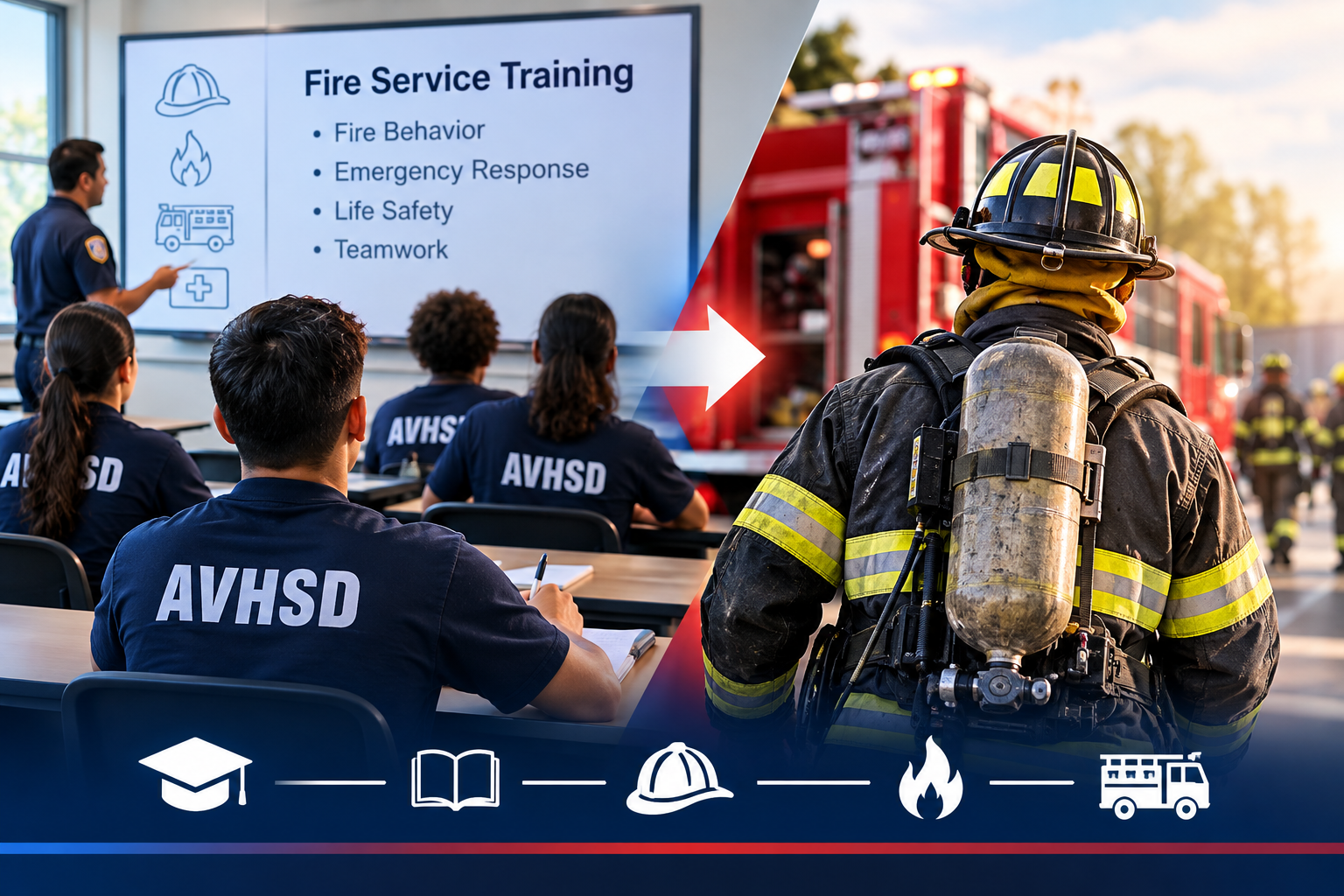

For students interested in firefighting, emergency response, and public safety, traditional classroom learning is only part of the preparation. Fire service careers require technical knowledge, physical readiness, teamwork, discipline, and the ability to respond appropriately when situations become difficult.
The AVHSD Fire Technology pathway helps connect education with practical career preparation. Through Career Technical Education, students can explore fire service fundamentals while developing skills that may support future college, academy, certification, and public safety career opportunities.
Antelope Valley Union High School District describes its career pathways as structured programs combining rigorous academic and technical courses designed to prepare students for postsecondary education and the workforce.
What Is AVHSD Fire Technology?
AVHSD Fire Technology is a career-focused educational opportunity associated with the Antelope Valley Union High School District.
Published district course materials describe Fire Technology as a program designed to expose students to the knowledge, skills, and abilities needed for a career in the fire service. The curriculum goes beyond simply learning about fires. Students are introduced to multiple aspects of emergency response and firefighter operations.
This type of Career Technical Education can help students understand what working in public safety actually involves before they commit to additional education or professional training.
How Does Classroom Learning Connect With Real Fire Service Skills?
One of the strongest features of career-focused education is the connection between theory and practical application.
According to the published AVUHSD Fire Technology syllabus, course content has included topics such as:
-
Firefighter safety
-
Personal protective equipment
-
Self-contained breathing apparatus
-
Ropes and knots
-
Water supply
-
Hose lays
-
Engine operations
-
Ground ladders
-
Fire behavior
-
Ventilation operations
-
Tactical firefighting operations
-
Automobile extrication
-
Incident Command System fundamentals
-
Basic wildland fire operations
-
First responder operations
These subjects reflect the broad range of skills that students may encounter as they explore the fire and emergency services field.
Rather than viewing firefighting as simply responding to burning buildings, students can develop a better understanding of how safety procedures, communication, equipment, incident management, teamwork, and emergency decision-making work together.
Why Is Hands-On Fire Technology Training Important?
Fire service careers are highly practical.
Knowing what a piece of equipment does is different from understanding how it fits into an emergency response operation. Career-based education can therefore give students valuable exposure to the procedures, terminology, expectations, and working environment associated with the profession.
AVUHSD’s broader Career Technical Education model is designed around coherent sequences of academic and technical instruction. The district states that these pathways are intended to prepare students for advanced postsecondary coursework and entry into the workforce.
For students considering firefighting, this early exposure can also help answer an important question:
Is this career actually right for me?
Learning that answer during high school can be valuable in itself.
What Professional Training Resources Are Used?
A strong indicator of E-E-A-T in career education is whether instruction connects students with recognized professional standards and training resources.
The published AVUHSD Fire Technology syllabus references curriculum and materials associated with organizations including:
-
International Fire Service Training Association
-
American Heart Association
-
Federal Emergency Management Agency
-
National Wildfire Coordinating Group
-
Occupational Safety and Health Administration
The syllabus also lists fire service reference materials covering firefighter essentials and vehicle extrication.
Using established professional resources can help students become familiar with concepts and terminology they may encounter during future firefighter, EMT, wildland fire, or emergency-response training.
Can Students Earn Certifications Through AVHSD Fire Technology?
Published course materials indicate that successful students have historically had opportunities to earn or work toward several credentials.
The 2021–22 syllabus listed outcomes including CPR certification, introductory Incident Command System training, wildland fire coursework, hazardous-material awareness training, and college articulation credit with Antelope Valley College, subject to specified course-grade requirements.
Because certification requirements and course offerings may change over time, students should confirm current opportunities directly with AVUHSD before enrolling.
Still, the structure demonstrates how Fire Technology can bridge high school education with the next stage of professional development.
How Does AVHSD Prepare Students for Public Safety Careers?
Fire Technology is part of a wider emphasis on career preparation within AVUHSD.
Highland High School’s Public Service Academy, for example, is described by the district as preparing students with skills and knowledge needed to provide emergency services to the community. AVUHSD also uses a Linked Learning approach within its career academies, combining academics with career-focused learning.
This approach matters because firefighters need much more than technical ability.
Students entering public safety careers also benefit from developing:
Communication
Emergency personnel must communicate clearly with teammates, supervisors, other agencies, and members of the public.
Teamwork
Fire service operations depend heavily on coordinated teams rather than individual action.
Discipline
Following established procedures can be essential when safety is involved.
Problem-Solving
Emergency situations can change quickly, requiring responders to assess conditions and adapt.
Responsibility
Public safety professionals are entrusted with equipment, information, and responsibilities that can affect other people’s safety.
These transferable skills are valuable even for students who ultimately choose another career.
What Careers Can Fire Technology Lead To?
Fire Technology can be an early step toward several fields within public safety and emergency services.
Students may eventually explore careers such as:
-
Firefighter
-
Fire engineer
-
Wildland firefighter
-
Emergency medical technician
-
Paramedic
-
Fire prevention specialist
-
Fire inspector
-
Hazardous materials specialist
-
Emergency management professional
-
Health and safety professional
The specific education, academy training, certification, physical testing, licensing, and hiring requirements vary by career and employer.
For example, Antelope Valley College’s Fire Technology curriculum identifies career possibilities including firefighting, fire protection services, hazardous materials, industrial safety, and health and safety inspection while noting that some careers require education beyond the college level.
Read more: Peter Orszag Bald Look Explained: Facts About His Changing Appearance
Does Completing AVHSD Fire Technology Guarantee a Firefighter Job?
No educational program can guarantee employment in the fire service.
Fire departments commonly have their own hiring standards, physical requirements, examinations, background procedures, medical requirements, certifications, and academy expectations.
The value of AVHSD Fire Technology is therefore better understood as career preparation.
Students can gain early exposure to the profession, build foundational knowledge, experience career-focused instruction, and make more informed decisions about what training they want to pursue after high school.
How Can Students Continue Their Fire Service Education?
High school Fire Technology can serve as a starting point rather than the end of the pathway.
After graduation, students interested in pursuing the profession may consider college Fire Technology programs, EMT education, wildland fire training, firefighter academies, paramedic pathways, or other public safety programs depending on their career goals.
Antelope Valley College, for example, offers Fire Technology education and related career preparation, providing one potential postsecondary pathway for students in the region.
Building the Next Generation of Fire Service Professionals
A successful transition from school to career rarely happens through textbooks alone.
Students need opportunities to understand how classroom knowledge applies to real professions.
That is where AVHSD’s approach to Career Technical Education becomes especially relevant. By combining academic education with technical learning and exposure to professional fire-service practices, students can begin developing a clearer understanding of what emergency-response careers require.
AVHSD Fire Technology does not simply introduce students to firefighting. It can help them explore the responsibilities, training standards, safety practices, teamwork, and professional expectations behind the uniform.
For a student considering a future in fire and emergency services, that early experience may provide an important foundation for the education and training that comes next.