



Introduction
Studying can be overwhelming when classes, textbooks, presentations, online videos, and assignments all compete for your attention. Students often spend hours organizing information and taking notes before they even begin reviewing the material. The challenge isn’t always finding the information, but understanding it, identifying key points, and recalling them when needed.
Mindgrasp AI is an AI-powered learning platform designed to help users process educational materials and create study resources from them. Depending on the available tools and the information entered, it can generate notes, summaries, flashcards, quizzes, study guides, and answers to questions about the uploaded content.
However, to effectively use an AI-powered study tool, more is needed than simply uploading a file and reading the results. Students still need to verify the information, understand the concepts, and practice recalling what they’ve learned.
This guide explains how Mindgrasp AI works, its main features, its potential benefits and limitations, and practical ways to incorporate it into a study routine.
Table of Contents
- What is Mindgrasp AI?
- How does Mindgrasp’s AI work?
- Main features of Mindgrasp AI
- How to use Mindgrasp AI for studying
- Benefits of using Mindgrasp AI
- Advantages and disadvantages of Mindgrasp AI
- Is Mindgrasp’s AI useful for different types of students?
- How to get better results with AI-generated study materials
- Frequently Asked Questions
- Key findings
- Conclusion
What is Mindgrasp AI?
Mindgrasp AI is an AI-powered learning platform that helps users transform educational content into organized study materials. Instead of manually creating each summary, review note, or practice question, users can provide the source material and select the type of learning resource they need.
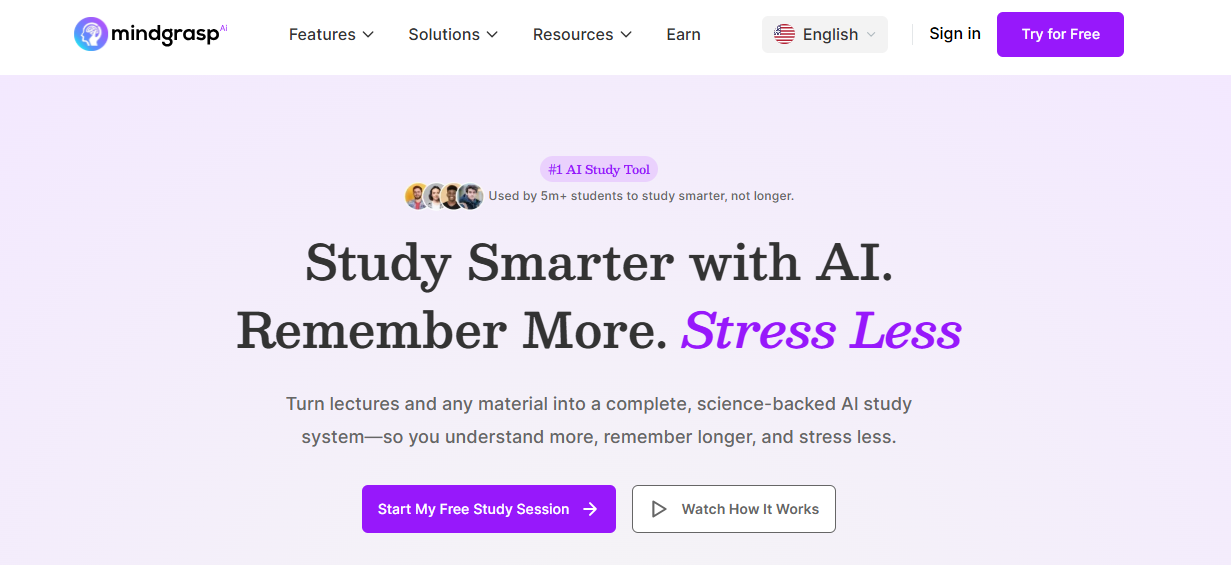
According to its official website, the platform supports a variety of educational resources, including documents, PDFs, presentation slides, audio, videos, web content, and YouTube links. Its tools include note-taking, summarizing, flashcard creation, quizzes, study guides, and question-and-answer features.
The platform can be useful for university students, high school students, self-taught individuals, educators, and professionals who regularly work with large amounts of information.
For example, a student preparing for a biology exam could use a lecture transcript to create concise notes and practice questions. Someone taking an online course could summarize a lesson and use flashcards to review important terminology.
The main objective is to reduce some of the manual work involved in preparing study materials, leaving more time to understand and review the subject matter.
How does Mindgrasp’s AI work?
Mindgrasp AI follows a simple process: it provides learning materials, you select a study tool, and you review the generated results. The exact workflow depends on the feature used and the platform’s interface.
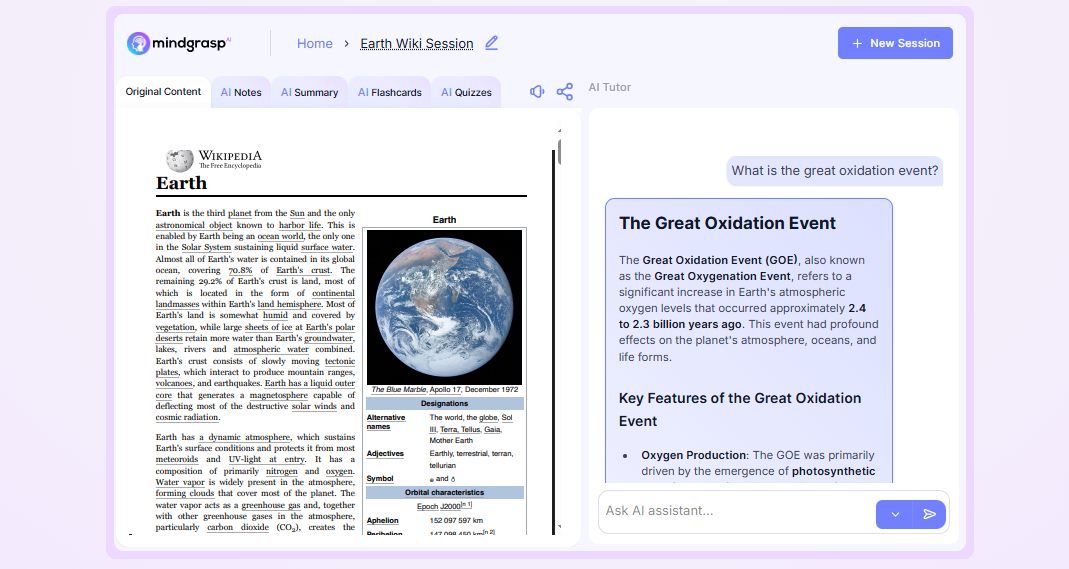
Step 1: Upload your study material
Start by selecting the material you want to study. This could be a PDF chapter, a PowerPoint presentation, a lecture recording, a document, or a link to a video.
For best results, choose material relevant to a specific topic or learning objective. For example, uploading a chapter on cell division is often more helpful for a specific review session than combining unrelated chapters into one large collection.
Step 2: Choose the required study resource
After entering the material, select the output format that best suits your immediate objective.
- Notes: Organize key information in a structured format.
- Summary: Identify the main ideas in a longer document or lesson.
- Flashcards: Create questions and answers for review.
- Quizzes: Generates practice questions to assess understanding.
- Study guides: They organize important concepts into a broader review resource.
- Answering questions: Ask questions about the material to clarify specific points.
These tools are listed on Mindgrasp’s official study tools page. Availability and specific limits may depend on your current account plan and features.
Step 3: Review the generated content.
AI-generated content should be considered a starting point, not a set of automatically verified notes. Read the output and compare important data, definitions, dates, formulas, and technical explanations with the original source.
If a summary omits an important exception or a quiz contains an incorrect answer, correct it before using the material for exam preparation.
Step 4: Practice and review
Once you’ve reviewed the material, use it for active review. Answer the flashcards without looking at the answers, complete the quizzes before checking the solutions, and review any concepts you find difficult.
This last step is essential because generating notes does not necessarily mean that you have learned or retained the information.
Main features of Mindgrasp AI
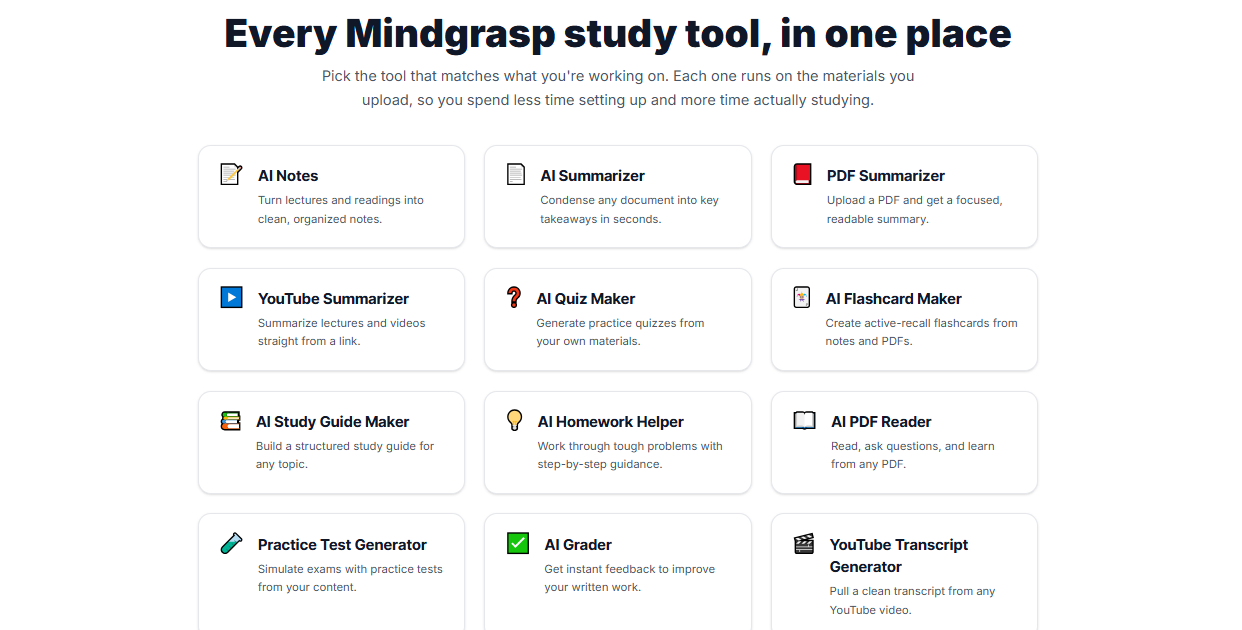
Mindgrasp AI brings together several study tools on a single platform. Each feature addresses a different challenge, from organizing class content to checking comprehension of a topic.
1. Note-taking with AI
Taking notes during a fast-paced class can be difficult. Students may miss important explanations while trying to jot down every sentence.
Mindgrasp AI offers tools to generate organized notes from compatible learning materials, such as lecture recordings and documents. These notes can serve as a useful basis for review, although students should check that no essential details or explanations have been omitted.
Ideal for: Students who need to organize class information and review lengthy texts.
2. AI Summarizer
A lengthy chapter or research paper may contain several pages of background information before reaching its main argument. An abstract can help identify the central ideas and provide a more concise overview.
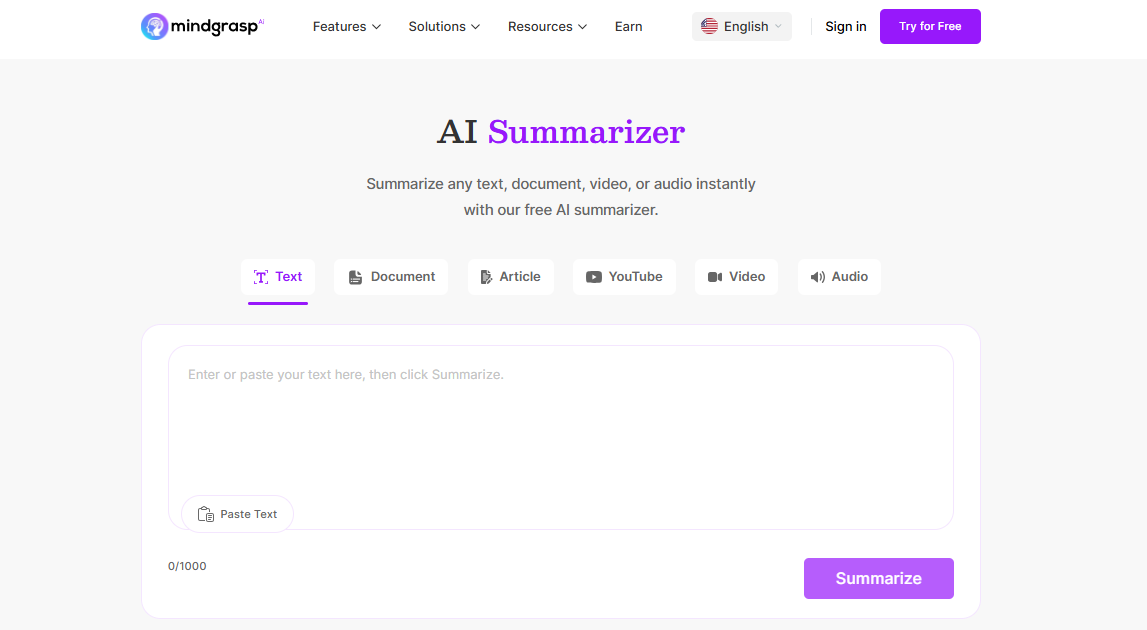
Mindgrasp AI includes document and PDF summarization tools, along with a YouTube summarizer for compatible video content.
Summaries are especially useful when you need an initial understanding of a topic or want to identify which sections deserve further attention. However, they should not replace reading the original material when a detailed understanding is required.
Ideal for: Reviewing extensive readings, preparing for debates, and getting an overview before studying a chapter in depth.
3. AI-powered flashcard creator
Flashcards help students practice retrieving information from memory, rather than simply recognizing it on a page.
Mindgrasp AI can generate flashcards from uploaded study materials. Students can use these flashcards to review definitions, formulas, terminology, historical events, and other data suitable for question-and-answer practice.
For example, a chemistry student could convert a set of notes on chemical bonds into questions about ionic bonds, covalent bonds, and their properties.
The most effective strategy is to try to answer each question before revealing or checking the answer. If a card is ambiguous or contains an incorrect answer, edit it before continuing.
Ideal for: Memorizing terminology, reviewing important facts, and preparing for exams.
4. AI-powered quiz creator and practice tests
Reading notes repeatedly can create a false sense of familiarity. You might recognize a concept when you see it, but be unable to explain it yourself.
Mindgrasp AI offers quiz and practice test generation tools that create questions from learning materials. These can help students identify areas that require further review.
A useful routine is to complete a questionnaire without consulting your notes, check your answers, and return to the original source for any questions you answered incorrectly.
The quality of quizzes depends on the source material and the questions generated. For important exams, check the key answers and practice with official questions or those provided by the instructor, when available.
Ideal for: Self-assessment, reviewing topics, and identifying knowledge gaps before an exam.
5. AI Study Guide Creator
A study guide brings together information in a format that facilitates its systematic review.
MindGrass AI includes a study guide tool that can help organize material around a topic or subject. This can be useful when multiple lessons contribute to the same exam or assignment.
For example, a marketing student might organize the material into sections covering consumer behavior, segmentation, brand building, and market research.
A good study guide should preserve the important relationships between concepts, rather than reducing each topic to a disconnected list of facts.
Ideal for: Exam review, course summaries, and organizing information from multiple lessons.
6. AI assistant for tasks and answering questions
Sometimes, the main difficulty lies not in summarizing a lesson, but in understanding a specific explanation or in solving a complex problem.
Mindgrasp AI includes homework help and question-answering tools among its study features. Users can request clarification on the material and use the answers as a starting point for deeper learning.
For example, instead of asking for a complete answer to a math problem, a student could ask for an explanation of the method, follow the steps, and then solve a similar question independently.
This approach encourages understanding rather than reliance on pre-packaged answers. AI-generated explanations can still be incorrect or incomplete, so it’s advisable to verify technical or topic-specific information.
7. PDF reader and video summary
Learning materials are not always presented as traditional textbook chapters. Students may need to work with digital documents, lecture recordings, or educational videos.
Mindgrasp AI includes a PDF reader that supports querying documents, along with tools for summarizing YouTube content and generating transcripts.
These features can help users locate important ideas without having to repeatedly search through an entire document or play a long video.
However, the quality of the result may depend on factors such as the clarity of the source, the accuracy of the transcription, and the complexity of the subject matter.
Benefits of using Mindgrasp AI
The value of an AI-powered learning platform depends on its ability to integrate seamlessly into a student’s daily routine. Here are some practical ways Mindgrasp AI can help.
Less manual work when preparing notes
Writing summaries, formatting review notes, and creating flashcards can be time-consuming. Automating some of these tasks can reduce preparation time and help students review material more quickly.
The time saved will vary depending on the length and complexity of the original text, the quality of the generated result, and the amount of editing required.
Easier access to main ideas
Longer documents often contain background information, examples, and details that complement the core concepts. Summaries can help students identify the main points before returning to sections that require more attention.
This is especially useful when tackling an unfamiliar topic or reviewing a large amount of reading material.
More opportunities for active recovery
Active retrieval involves trying to retrieve information from memory rather than immediately looking up the answer. Flashcards and quizzes can facilitate this process, giving students the opportunity to self-assess.
Instead of treating the generated questions as a final product, use them for practice. Review the incorrect answers and try to explain the underlying concept in your own words.
A more organized study routine
Using different apps for note-taking, summarizing, and quizzing can make review feel fragmented. Mindgrasp AI brings together several of these tools, allowing users to create different study resources from their learning materials.
A coherent structure can facilitate the separation of subjects, the tracking of review tasks, and the return to difficult topics.
Support for different learning situations
Students learn from a variety of sources, such as recorded lectures, textbooks, presentation slides, and online lessons. A platform that supports multiple content formats can help integrate these different resources into a more coherent learning process.
The benefit depends on whether the file type, font, and function required by the user are compatible with the current platform.
Advantages and disadvantages of Mindgrasp AI
Before incorporating any AI-powered study tool into your routine, consider both the convenience it offers and the limitations you might encounter.
| Advantages | Disadvantages |
| Generate notes and summaries from compatible learning materials. | The information generated may contain errors or omit important details. |
| Create flashcards and self-assessment quizzes. | The questions may be too simple, ambiguous, or inaccurate. |
| It supports multiple types of educational content. | Some content formats or features may have limitations. |
| It combines several study tools into a single platform. | Users may still need to edit and organize the result. |
| It can help reduce repetitive preparation work. | Time savings are not guaranteed for all tasks. |
| It supports question-based learning and review. | Over-reliance can reduce independent problem-solving practice. |
Is Mindgrasp’s AI accurate?
Accuracy is one of the most important considerations when using AI to prepare for exams or complete academic work.
A tool can generate a readable summary that nevertheless omits clarification, misinterprets a technical term, or provides an incorrect answer. The risk can be greater when the source material is unclear, incomplete, or highly specialized.
To improve reliability, compare the generated notes with the original document, verify important claims with authoritative sources, and independently check formulas, quotations, and numerical answers.
Is Mindgrass AI free to use?
The official Mindgrasp website has announced access to a free account or an initial study session. However, this does not mean that all features are free or that the same access conditions will remain available indefinitely.
Before using a specific feature, check the current pricing and plan details. Review the usage limits, recording restrictions, file upload conditions, and subscription terms that apply to your account.
Is Mindgrasp’s AI useful for different types of students?
Mindgrasp AI is not limited to a single type of student. Its usefulness depends on the material being studied, the student’s objectives, and how the generated resources are used.
University students
University courses typically include extensive readings, lecture slides, recordings, and complex topics. Students can use AI-generated notes and summaries to organize these materials and then use quizzes and flashcards to practice the concepts.
In demanding fields such as medicine, engineering, or law, the material produced must be reviewed with particular care. Small errors in terminology, calculations, or exceptions can alter the meaning of an explanation.
Students preparing for exams
Preparing for exams involves more than just reviewing all the chapters. Students also need to identify their weaknesses, recall information accurately, and practice applying concepts under time pressure.
Mindgrasp AI’s flashcards, quizzes, and practice tests can help you review. A practical method involves using summaries to identify key concepts, testing yourself with questions, and referring back to the original source whenever you make a mistake.
Online students
Online courses typically rely on recorded lectures, videos, digital reading materials, and downloadable presentations. Mindgrasp AI’s compatibility with several of these formats can help students combine disparate resources into more structured review materials.
Self-directed learners should follow the course objectives and complete the original exercises. AI-generated notes can supplement the course, but do not guarantee that all learning objectives have been met.
Researchers and active professionals
Researchers and practitioners may encounter lengthy reports, training documents, technical articles, and presentations. Document summarization and question-answering tools can help them locate key ideas and identify sections that warrant further review.
However, AI-generated summaries should not be considered a substitute for thorough analysis when decisions depend on precise wording, legal requirements, scientific evidence, or financial figures. Important statements should be referred to the original document.
How to get better results with AI-generated study materials
The quality of your study routine depends on what you do before and after using an AI tool. These practices can make Mindgrasp AI more useful while also reducing the risk of learning incorrect information.
Start with a clear learning objective.
Before uploading a document, decide what you want to achieve. Do you need a summary of a chapter you’re unfamiliar with, help understanding a difficult concept, or practice questions for an upcoming exam?
A clear objective helps you select the right function and judge whether the resulting outcome truly meets your needs.
Use specific instructions
When you ask questions about the study material, specify the explanation you need.
For example, instead of asking, “Explain biology to us,” you could ask, “Explain the stages of mitosis using the uploaded class notes and distinguish each stage by its main characteristics.”
A specific question is more likely to generate an answer relevant to your immediate learning goal. Even so, double-check the explanation with the course materials.
Consult the original source
Don’t assume that all generated notes or answers are correct. Verify definitions, calculations, technical terms, important dates, and any statements that might affect your understanding of the topic.
For research tasks, distinguish between the information presented in the source and the additional explanations provided by AI. Never rely on an AI-generated reference without verifying that the cited publication exists and supports the claim.
Combine summaries with active retrieval
A summary is useful for reviewing information, but reading it repeatedly does not guarantee that you will be able to remember or apply its content.
After reviewing a topic, close your notes and try to explain the main ideas from memory. Use flashcards and quizzes to test yourself, then go back to the material to correct any mistakes.
Review difficult topics more than once.
Learning often requires several review sessions. Instead of trying to memorize everything at once, review the more difficult concepts over several sessions.
You can use flashcards to identify your weak points and create a simple review list. Prioritize the concepts you frequently struggle to remember or explain.
Protect your academic integrity and your privacy.
Follow your institution’s guidelines on AI use, especially when completing assignments, exams, or research projects. Using AI to understand a topic may be permitted, even if submitting AI-generated work is not.
You should also avoid uploading confidential records, personal information, unpublished research, or restricted course materials unless you are authorized to do so and have reviewed the platform’s applicable privacy and data handling terms.
Frequently Asked Questions
1. What is Mindgrasp AI used for?
Mindgrasp AI is used to convert compatible educational materials into study resources such as notes, summaries, flashcards, quizzes, and study guides. It also provides tools for querying documents and getting help with learning tasks.
2. Can Mindgrasp AI summarize PDF files and lecture videos?
Yes. Their official study tools page lists PDF and YouTube summarization features, along with tools for working with other compatible documents and media. Results may vary depending on the source quality and the feature used.
3. Can Mindgrasp’s AI create flashcards and quizzes?
Yes. Mindgrasp AI includes flashcard generation, quiz generation, and practice test features that help users create questions from their learning materials. Review the generated questions and answers before using them for important exams.
4. Is Mindgrasp AI suitable for exam preparation?
It can be useful for exam preparation, as it helps students organize material, summarize chapters, and practice memorizing information. However, it should complement, not replace, studying textbooks, teacher guidance, official practice exams, and independent problem-solving.
5. Is Mindgrasp AI free?
Mindgrasp has announced free account access and an initial study session, but features available without payment and usage restrictions may change. Please check the official pricing page for the latest plan information before signing up.
6. Can the Mindgrasp AI make mistakes?
Yes. Like other generative AI systems, it can produce incorrect, incomplete, or misleading information. Compare important answers with the original source and reliable references, especially for highly relevant technical topics and academic work.
7. How can students use Mindgrasp’s AI effectively?
Students can begin by uploading course materials, creating notes or a summary, and checking the accuracy of the result. Then, they can use flashcards and quizzes to practice memorization, review incorrect answers, and revisit difficult topics over time.
Key findings
- Mindgrasp AI is a study platform that converts compatible learning materials into notes, summaries, flashcards, quizzes, and other review resources.
- Its main practical value lies in reducing some of the manual work involved in organizing educational content.
- Flashcards and quizzes can help students check their understanding instead of relying solely on rereading.
- AI-generated content should be reviewed to ensure its accuracy, comprehensiveness, and relevance to the course.
- Before registering, it is advisable to consult the official website for information on free access, paid features, and terms of use.
- The best results are obtained by combining AI assistance with independent thinking, source verification, and periodic review.
Conclusion
Mindgrasp AI offers a practical way to organize learning materials and create study resources from documents, lectures, and online content. Its combination of tools for note-taking, summarizing, creating flashcards, taking quizzes, and answering questions can be helpful for students who struggle to manage large volumes of information.
However, convenience should not be confused with understanding. An automatically generated summary does not guarantee mastery of a topic, and a set of flashcards is no substitute for the ability to explain or apply a concept independently.
The most effective strategy is to use Mindgrasp AI as a study assistant: it organizes material, reviews results, assesses your knowledge, and helps you review difficult concepts. Combined with reliable reference materials and a consistent review routine, it can become a valuable tool within a more structured learning process.