


Artificial intelligence is transforming the way people write, publish, and consume information. From blog posts and academic assignments to business reports and marketing campaigns, AI writing tools can produce polished content in seconds. While this technology improves productivity, it also raises an important question: how can readers, educators, publishers, and businesses determine whether content was written by a human or generated with artificial intelligence?
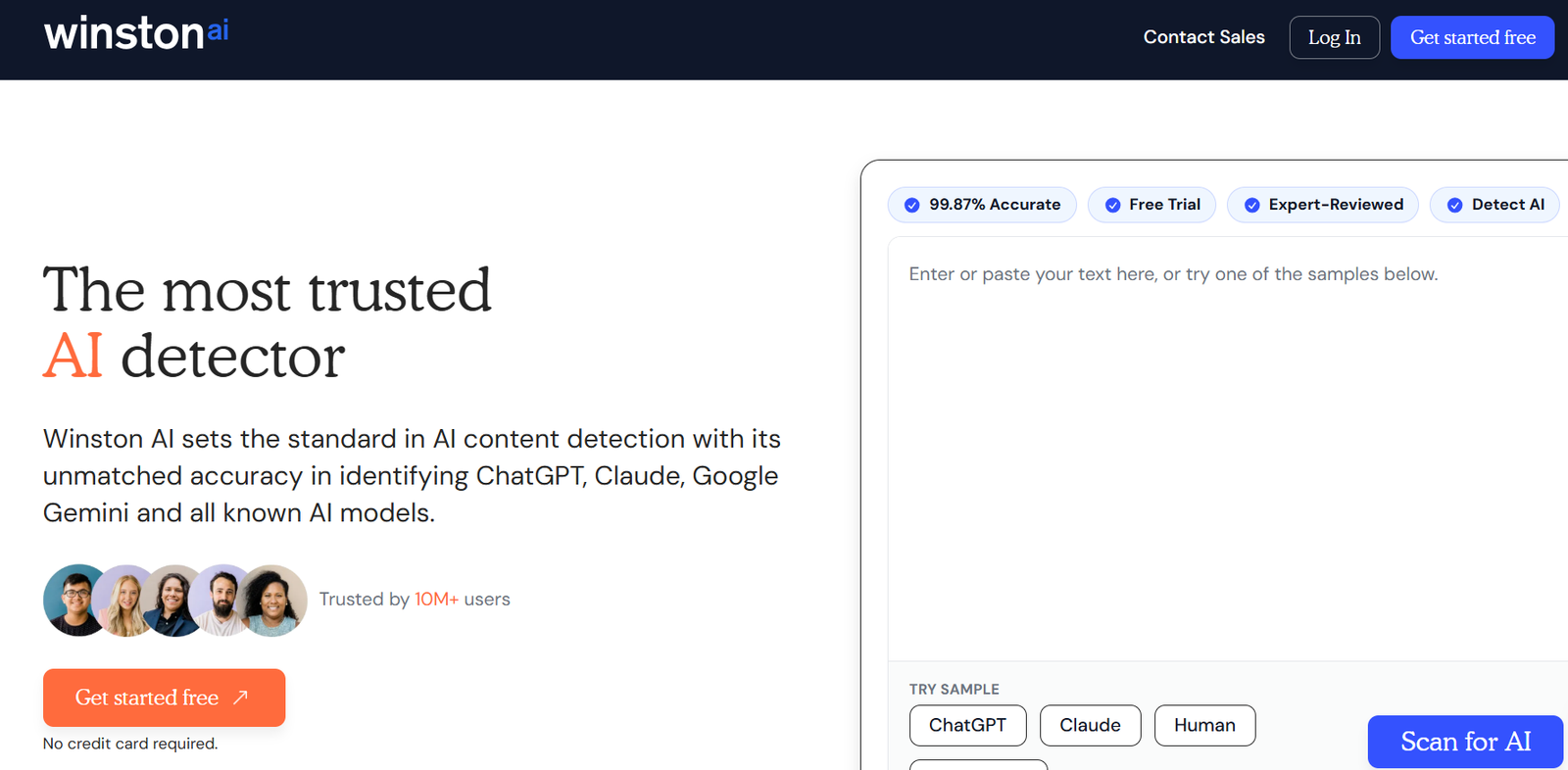
Winston AI is one of the tools designed to address this challenge. It analyzes written content and estimates whether the text resembles AI-generated writing. Its results can help users decide which passages deserve closer examination, particularly when content authenticity matters.
However, AI content verification involves more than identifying text that sounds machine-written. It requires understanding how detection technology works, where it can fail, and how its results should be interpreted. As AI writing tools continue to improve, verification systems must also evolve to handle increasingly sophisticated writing techniques.
The future of content verification will depend not only on detection accuracy but also on transparency, responsible use, and the ability to distinguish useful evidence from unsupported assumptions.
What Is Winston AI?
Winston AI is an AI content detection platform that helps users assess whether written material is likely to have been generated by artificial intelligence. It is designed for a range of users, including teachers, students, writers, publishers, content marketers, and businesses.
The platform analyzes submitted text and produces a prediction based on linguistic patterns and other characteristics learned during model training. Depending on the available features, users can also examine highlighted passages and access additional content-checking tools.
For example, an editor reviewing a freelance article may use Winston AI to identify passages that warrant further examination. The editor can then review the writer’s research, check the supporting sources, and ask questions about the development of the article.
The detector does not independently establish who wrote the text. Instead, it provides an assessment that can contribute to a broader editorial decision.
How Is an AI Checker Different From a Plagiarism Checker?
Although AI detection and plagiarism detection are often discussed together, they serve different purposes.
An AI checker estimates whether a document resembles writing produced by generative AI systems. A plagiarism checker looks for matching or substantially similar material in the sources available to its database or search process.
A piece of writing can be original but AI-generated. Similarly, human-written content can contain copied passages. A document may also combine original writing, AI-assisted editing, quotations, and material from external sources.
This distinction is important for anyone responsible for reviewing content. A plagiarism report does not establish whether AI was used, and an AI detection score does not establish whether the content is original.
For a more complete evaluation, users should consider authorship, originality, factual accuracy, source quality, and compliance with the relevant content policy.
How Does Winston AI Work?
AI detectors rely on patterns found in language. Large language models learn relationships between words, phrases, sentences, and contexts. Their outputs can display recurring characteristics in sentence construction, vocabulary, and organization.
Detection systems are trained to recognize patterns that may be associated with human-written or AI-generated material. When a user submits text, the detector evaluates the document and produces a prediction based on its learned model.
1. Analyzing Language Patterns
One part of AI detection involves examining how language is used. This may include the predictability of word choices, sentence structures, and variations in writing style.
Consider two hypothetical passages. The first uses consistently structured sentences, predictable transitions, and repeated explanatory patterns. The second combines short observations with detailed explanations, specific examples, and varied sentence lengths.
A detector may interpret these passages differently because their linguistic characteristics differ.
However, these differences do not prove authorship. Human writers can produce highly predictable text, particularly in technical or educational writing. AI systems can also generate varied, conversational, and creative content.
2. Comparing Text With Learned Examples
AI detectors learn from examples of human-written and AI-generated content. During training, a model identifies statistical relationships that help it distinguish between the categories represented in its training material.
When new content is submitted, the detector applies those learned patterns to produce a prediction.
The quality of this prediction depends on several factors, including the training data, the AI models represented during development, the document’s language, and the characteristics of the submitted text.
A detector may perform well on familiar types of writing but struggle with content that differs significantly from its training examples.
3. Producing Detection Scores
Winston AI provides users with an assessment of the submitted content. Its interface has included a Human Score and an AI Prediction Map, which help users examine the overall result and the passages identified by the system.
These outputs should be interpreted carefully. A score is an estimate, not a direct measurement of how much AI contributed to a document.
For example, an article might contain a human-written introduction, an AI-assisted outline, and paragraphs that a writer substantially revised. A single document-level result cannot fully explain this writing process.
Reviewing individual passages and considering the context can provide a more useful understanding of the result.
4. Recognizing the Limits of Detection
Two common errors affect AI detection systems.
A false positive occurs when human-written content is incorrectly identified as AI-generated. A false negative occurs when AI-generated content is incorrectly identified as human-written.
These errors arise partly because human and AI writing overlap. Both can use similar vocabulary, sentence structures, and organizational patterns.
Editing, translation, paraphrasing, and changes in writing style can also affect detection results. Consequently, no single score should be treated as conclusive evidence of authorship.
Why AI Content Verification Is Becoming More Important
The growing availability of AI writing tools has made content creation faster and more accessible. At the same time, it has increased the need for reliable editorial standards and transparent content policies.
The Challenge for Digital Publishers
Publishers must ensure that their content is accurate, original, useful, and suitable for their audience. AI detection can support this process, but it cannot replace editorial judgment.
Consider a website publishing an article about personal finance. Even if an AI checker classifies the article as human-written, the content may still contain outdated figures, unsupported claims, or misleading advice.
Conversely, an AI-assisted article may be original, thoroughly researched, factually accurate, and genuinely helpful to readers.
This demonstrates why authorship and quality should be evaluated separately. Content verification can help investigate how material may have been produced, while fact-checking and editorial review establish whether it deserves publication.
The Challenge for Education
Educational institutions need to determine whether submitted work reflects a student’s learning and whether the use of AI follows assignment rules.
An AI checker can help identify work that deserves further examination. However, relying on a detection score alone to accuse a student of misconduct can lead to unfair outcomes.
Students may use AI for brainstorming, grammar correction, translation, or other forms of assistance that an institution permits. A detection tool cannot automatically determine whether that assistance violated a particular policy.
A responsible approach combines transparent rules, discussions with students, examination of drafts, and opportunities to explain the writing process.
The Challenge for Businesses
Businesses increasingly use AI to prepare reports, product descriptions, customer communications, and marketing materials. Their concerns often involve accuracy, confidentiality, brand consistency, and compliance with internal policies.
For example, a business might permit employees to use AI to generate initial marketing ideas while requiring human review before publication.
In this situation, an AI checker is only one potential part of the workflow. It cannot independently confirm that confidential information was handled properly or that a report meets the company’s requirements.
Clear guidelines, approved software, human oversight, and secure data-handling practices remain essential.
Winston AI Features and Their Practical Applications
Winston AI’s broader feature offering has included AI text detection, passage-level analysis, plagiarism checking, and AI image detection. The tools available to individual users may depend on the product and subscription plan.
AI Text Detection
The primary function is to estimate whether submitted writing resembles AI-generated content.
A publisher, for example, may use an AI checker as an initial screening step when reviewing a freelance submission. If the result raises questions, the editor can examine the article’s sources, verify important claims, and discuss the writer’s research process.
The value comes from directing attention toward material that may need review, rather than automatically accepting or rejecting the submission.
Sentence-Level Analysis
Passage-level analysis can help users identify specific portions of a document that contribute to a detection result.
Imagine an article containing ten paragraphs. An overall prediction may suggest that some text resembles AI-generated writing, while a passage-level view helps the editor identify which paragraphs to examine more closely.
The editor should consider the surrounding context before reaching a conclusion. Standard definitions, technical explanations, frequently used phrases, and formal academic language may resemble AI-generated writing without proving that AI was involved.
Plagiarism Checking
Plagiarism checking addresses originality and textual similarity rather than the likely source of the writing.
A writer might use AI to create entirely new wording that does not closely match an existing source. Alternatively, a human writer might copy material from a published article without proper attribution.
Using plagiarism detection alongside AI detection can therefore provide a broader assessment of content. Neither tool replaces source verification, appropriate citations, or editorial judgment.
AI Image Detection
AI-generated images create a related challenge for publishers and businesses. A photograph-like image may be produced by a generative model, while an authentic photograph may be heavily edited.
Image detection tools attempt to assess whether an image displays characteristics associated with AI generation. Their results should be interpreted cautiously because editing, compression, resizing, and other transformations can affect the available evidence.
Text detection and image detection address different types of content and should not be treated as interchangeable forms of verification.
How Accurate Is Winston AI?
Accuracy is one of the most important factors to consider when choosing an AI checker. However, a single accuracy percentage does not provide a complete picture of performance.
Detection results depend on the language, length, subject, writing style, AI model, and dataset used during testing. They can also vary depending on whether the text is original, edited, translated, or substantially rewritten.
Understanding Accuracy Measurements
Several measurements can help users evaluate an AI detector.
| Measurement | What it means |
|---|---|
| Overall accuracy | The proportion of all tested documents classified correctly |
| False-positive rate | The proportion of human-written samples incorrectly flagged as AI-generated |
| Detection rate | The proportion of AI-generated samples correctly identified |
| Precision | The proportion of flagged samples that genuinely belong to the AI-generated category in the tested dataset |
| Dataset coverage | The languages, writing styles, models, and document types included in the evaluation |
These measurements answer different questions. A detector might identify a large proportion of AI-generated text but also incorrectly flag too many human-written documents.
For schools, the false-positive rate is particularly important because incorrect classifications can affect students. For publishers, missed AI-generated text may matter, but so may the unnecessary rejection of legitimate human work.
Why False Positives Matter
Imagine a school reviewing 1,000 assignments written entirely by students. If a detector incorrectly flags 2% of those assignments, 20 students could face unnecessary scrutiny.
This is a hypothetical example, not a claim about Winston AI’s actual performance.
The consequences depend on how the results are used. A flag that prompts a teacher to review drafts and discuss the assignment may be manageable. An automatic disciplinary decision based solely on the same flag could have serious consequences.
This is why detection results should be treated as preliminary evidence rather than definitive proof.
Why False Negatives Matter
False negatives occur when AI-generated writing is classified as human-written.
For a publisher, this might mean that a document receives less scrutiny than intended. For an organization with explicit disclosure requirements, it might create a compliance problem.
However, identifying AI involvement does not automatically mean the content is poor or inappropriate. The significance depends on the applicable rules and the purpose of the document.
A useful verification process should therefore focus on whether the content meets the relevant standards, not simply on whether a detector assigns it to one category.
How Winston AI Compares With Other AI Checkers
Winston AI operates in a competitive market that includes other AI content detection tools. Products such as GPTZero, Originality.ai, and Copyleaks also offer AI detection capabilities, although their features, pricing, integrations, and intended audiences differ.
Choosing between these tools requires more than comparing their advertised accuracy figures.
| Evaluation factor | What users should examine |
|---|---|
| Detection performance | Results on relevant, independently evaluated datasets |
| False positives | How often genuine human writing is incorrectly flagged |
| Supported languages | Whether the languages used by your organization are covered |
| Document length | Minimum and maximum text requirements |
| Reporting features | Whether results include passage-level explanations |
| Additional checks | Availability of plagiarism or other verification tools |
| Privacy | Data retention, processing, access, and deletion policies |
| Cost | Subscription limits, document allowances, and available features |
A university may prioritize academic workflows and institutional integrations. A publisher may care more about batch processing and editorial reporting. A small business may prioritize affordability, ease of use, and privacy.
The best choice is the tool that performs reliably on the organization’s own representative content and supports a fair, transparent review process.
How to Use Winston AI Responsibly
AI detection is most useful when it forms part of a structured verification process.
Step 1: Establish the Purpose of the Review
Before submitting content, identify what needs to be verified. Is the concern undisclosed AI assistance, plagiarism, factual accuracy, or compliance with a writing policy?
Different concerns require different evidence. A detector cannot answer every question about a document.
Step 2: Prepare the Text
Use a meaningful, representative passage rather than drawing conclusions from an extremely short fragment. Follow the tool’s current text-length requirements.
Where possible, retain the original formatting and surrounding context. Removing context can make it harder to interpret the result accurately.
Step 3: Review the Result
Examine the overall prediction and any highlighted passages. Avoid interpreting the score as a direct measurement of the percentage of text written by AI.
Consider whether the writing contains technical terminology, standard definitions, quotations, translated material, or other characteristics that might influence the prediction.
Step 4: Seek Independent Evidence
If the result raises concerns, investigate further.
For student assignments, this might involve reviewing drafts, notes, and the student’s explanation of the work. For publishing, it might mean checking references, verifying factual claims, and discussing the research process with the author.
No single piece of evidence needs to carry the entire decision.
Step 5: Apply a Fair and Consistent Policy
Organizations should establish clear expectations about acceptable AI use before evaluating submissions.
A policy might distinguish between AI used for brainstorming, grammar correction, outlining, and generating substantial portions of a final document. These activities are not necessarily equivalent.
Reviewers should apply the same standards consistently and provide an opportunity to explain disputed results.
Step 6: Protect Confidential Information
Before submitting documents to an external checking service, review its privacy policy and data-handling terms.
Avoid uploading confidential client information, unpublished research, personal data, or sensitive business documents unless the service and the organization’s policies permit that use.
Content verification should not create a separate privacy or security risk.
The Future of AI Content Verification
AI content verification is likely to evolve alongside generative AI. As writing models become more capable, the differences between human and machine-generated text may become harder to identify through language patterns alone.
The next stage of verification will therefore require broader approaches that go beyond conventional text classification.
More Transparent Detection Results
Users need to understand what a detection result means and what it does not mean.
Future tools may place greater emphasis on explaining uncertainty, reporting false-positive rates for relevant groups, and showing how performance changes across different types of content.
Clear reporting could help organizations avoid treating a numerical score as unquestionable evidence.
Stronger Independent Evaluation
Detector developers can publish benchmark results, but independent evaluation is also important.
Researchers and organizations should test systems using representative samples, including different languages, subject areas, writing styles, and AI models. Evaluations should include both AI-generated and human-written material.
Regular testing is necessary because new generative models and editing techniques can change the conditions under which a detector operates.
Content Provenance and Digital Credentials
An important future direction is content provenance: recording information about where content originated and how it changed.
For example, digital credentials or cryptographically signed records may help establish that a document or image came from a particular source or underwent a documented editing process.
These methods address a different problem from AI detection. A detector estimates likely authorship from the content itself, while provenance systems can provide evidence about its history.
However, provenance is not a universal solution. Records may be missing, credentials can be stripped during distribution, and a verified source does not guarantee factual accuracy. A human-written document can contain misinformation, just as an AI-generated document can contain correct information.
Better Handling of Human-AI Collaboration
The future of writing is unlikely to involve only two categories: completely human-written or completely AI-generated.
A writer may use AI to organize research, suggest alternative headings, correct grammar, or improve clarity before revising the final article. Another writer may generate an initial draft and then substantially rewrite it.
Verification systems and organizational policies will need to account for these different workflows.
Rather than asking only whether AI was involved, some organizations may need to determine what kind of assistance was used, whether disclosure was required, and whether the author remains responsible for the final work.
Integration With Editorial Workflows
AI verification may increasingly become one component of broader content-management systems.
For example, a publishing workflow could combine source verification, plagiarism checking, factual review, AI detection, and editorial approval. Each component would address a separate concern, with the final decision remaining subject to appropriate human oversight.
This approach is more useful than expecting one detector to determine whether an entire article is trustworthy.
Does AI Detection Affect SEO and Content Quality?
For website owners and digital marketers, AI detection is often connected to concerns about search engine rankings.
The important distinction is between how content was produced and whether it provides genuine value to readers.
Using AI to assist with writing does not, by itself, establish that a page is useful or unhelpful. Similarly, a page that passes an AI detector is not automatically suitable for publication.
A strong SEO strategy should focus on satisfying search intent, demonstrating relevant expertise, providing accurate information, supporting claims with reliable sources, and offering a better experience than competing pages.
AI-assisted content should undergo the same quality checks as any other material. Writers should verify facts, remove repetition, add meaningful examples, and ensure the final article reflects the needs of its intended audience.
An AI checker can contribute to a broader quality-control process, but it should not be treated as a shortcut to search rankings or as proof that content meets editorial standards.
Common Myths About Winston AI and AI Detection
Myth 1: A High AI Score Proves That AI Wrote the Content
A high score represents the detector’s prediction, not direct evidence of authorship. A responsible reviewer should consider additional evidence before making a decision.
Myth 2: Human-Written Content Always Passes AI Checkers
Human writing can sometimes resemble the linguistic patterns associated with AI-generated text. Formal language, repeated structures, and standardized explanations may influence detection results.
Myth 3: Passing an AI Checker Guarantees Content Quality
Detection tools do not independently verify every fact, source, argument, or recommendation in a document. A page can receive a favorable detection result and still contain substantial errors.
Myth 4: AI Detection and Plagiarism Detection Are the Same
They are different technologies. One estimates whether writing resembles AI output, while the other identifies textual similarities that may require investigation.
Myth 5: Every Use of AI Is Inappropriate
Acceptable AI use depends on the context and the relevant rules. Some institutions permit grammar assistance and brainstorming, while others restrict particular uses. Transparency and compliance with the applicable policy are more meaningful than blanket assumptions.
Who Should Consider Using Winston AI?
Winston AI may be useful for people who need an additional way to assess written content, provided they understand its limitations.
Educators and academic institutions may use AI detection as one part of a broader process for discussing authorship and academic integrity.
Publishers and editors may use it as an initial screening tool before conducting their normal editorial checks.
Content marketers and agencies may incorporate it into internal review procedures when clients have explicit requirements about AI assistance or disclosure.
Students and writers may use it to understand how a detector evaluates their writing, but should not interpret the result as a definitive judgment of their abilities or originality.
Businesses may consider it when developing content review policies, provided it fits their security, privacy, and operational requirements.
In every case, the value of the tool depends on how the results are interpreted and what action follows.
Final Thoughts
AI content verification is becoming an important part of the wider discussion about trust in digital information. As generative AI makes it easier to produce text at scale, publishers, educators, and businesses need practical ways to assess content while avoiding unfair or unsupported conclusions.
Winston AI offers one approach by analyzing written material and providing predictions that can guide further review. Its potential value lies in helping users identify passages that deserve attention, rather than replacing human judgment.
The technology still faces important challenges. Human and AI writing can overlap, detection performance varies across contexts, and a numerical score cannot fully reconstruct the process through which a document was created.
The future of reliable verification will depend on combining detection technology with transparent policies, independent evaluation, source checking, content provenance, and responsible human oversight.