
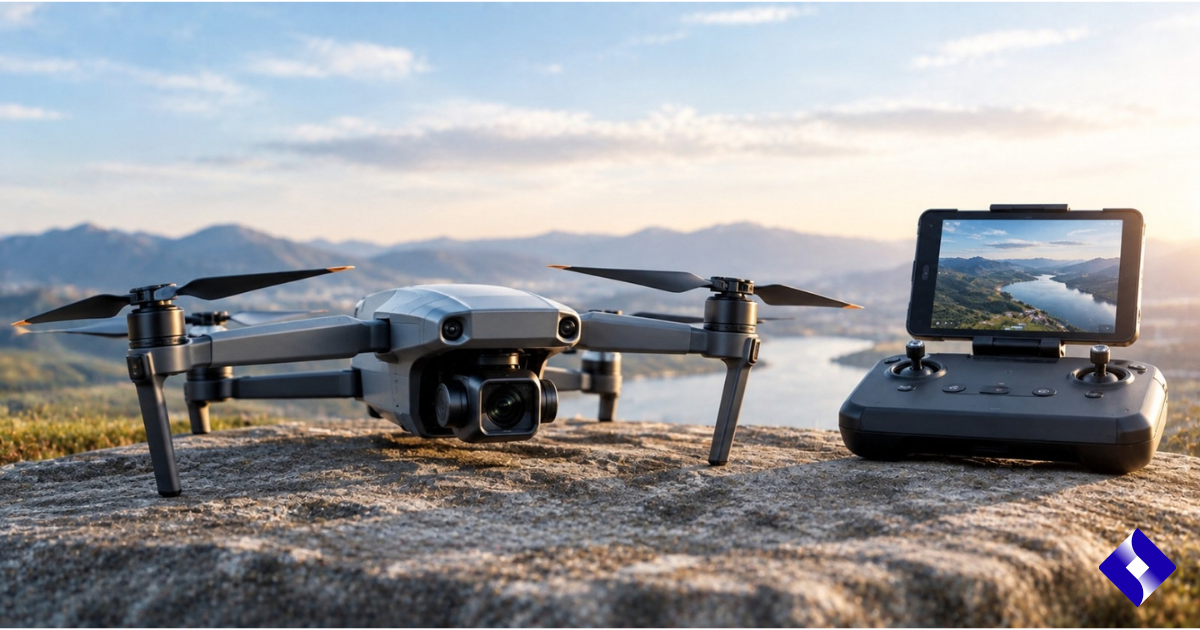

Professional drone photography requires more than just a high-resolution camera. A drone can capture detailed photographs, but if its camera moves during flight, the resulting images can suffer from unwanted vibrations, inconsistent framing, or a reduction in useful detail.
The Autel Robotics EVO Lite Enterprise 6K gimbal is designed to solve this problem by combining a three-axis stabilization system with the EVO Lite 6K Enterprise camera. According to Autel’s specifications, the gimbal has an angular vibration range of ±0.003° , while the camera uses a 1-inch CMOS sensor with 20 million pixels .
But what does this mean in practice for a professional image? And more importantly, to what extent can operators rely on the system for inspections, documentation, aerial photography, and other tasks requiring meticulous attention to detail?
This guide examines the specifications, the practical factors that affect accuracy, and the situations in which gimbal stability is most important.
What is the Autel Robotics EVO Lite Enterprise 6K stabilizer?
The gimbal is the motorized platform that holds and stabilizes the drone’s camera. Its function is to compensate for the aircraft’s movement so that the camera maintains a more controlled orientation while the drone is flying, hovering, rotating, or encountering moderate disturbances.
Autel describes the EVO Lite 6K Enterprise as a system that uses a three-axis stabilized gimbal with a high-precision motor structure . The three axes compensate for pitch, roll, and yaw motion.
These are the key official specifications.
| Cardan specifications | EVO Lite 6K Enterprise |
| Stabilization | 3 axes |
| Mechanical pitch range | -135° to +45° |
| Range of mechanical rollers | -45° to +45° |
| Mechanical yaw range | -90° to +90° |
| Controllable tone range | -90° to +30° |
| Maximum tilt control speed | 100°/s |
| Angular vibration range | ±0.003° |
Autel publishes these figures for the Enterprise model. They indicate the gimbal’s stabilization capability, but should not be interpreted as a universal measure of image, mapping, or survey accuracy.
How accurate is the Autel Robotics EVO Lite Enterprise 6K gimbal?
For camera stabilization , the most relevant specification is the angular vibration range of ±0.003° . A smaller residual angular movement can help the camera maintain a more stable viewing direction during capture.
However, there is an important distinction between gimbal accuracy and measurement accuracy .
The gimbal is primarily responsible for camera orientation and stabilization. The accuracy of a professional image result can also depend on the aircraft’s position, altitude, shutter speed, focus, lighting, wind, flight speed, distance to the subject, processing software, and workflow used.
Therefore, it would be misleading to say that the specification of ±0.003° means that photographs or measurements are automatically accurate to a certain number of centimeters.
A better way to understand the system is to separate its different forms of precision.
| Type of precision | Main contributing factors |
| Image stability | Gimbal stabilization and aircraft movement |
| Image detail | Sensor, lens, focus, exposure, and subject distance |
| Coherence in the framing | Gimbal control, flight path, and pilot technique |
| Position accuracy | GNSS, visual positioning and flight conditions |
| Mapping accuracy | Flight planning, overlay, positioning, and processing |
| Inspection reliability | Resolution, viewing angle, distance, and environmental conditions |
This distinction is especially important for professionals who intend to use drone imagery for technical decision-making.
Why is three-axis stabilization important?
A drone constantly makes small adjustments during flight. Even while hovering in the air, its motors respond to wind, positioning commands, and changes in orientation.
Without stabilization, some of these movements could be transmitted directly to the camera.
A three-axis gimbal compensates for three directions of rotation. Pitch is primarily related to the camera’s vertical movement, roll to lateral tilt, and yaw to horizontal rotation.
In the field of professional image, this can make the framing more consistent and the video easier to interpret.
It is especially useful when an operator needs to repeatedly capture the same structure, roof section, tower component, construction area, or other point of interest.
The quality of the camera is just as important as the stability of the stabilizer.
A stable camera does not automatically produce a detailed image. Imaging hardware remains equally important.
The EVO Lite 6K Enterprise uses a 1-inch CMOS sensor with 20 million pixels . Autel specifies an 82° diagonal field of view, a 29mm full-frame equivalent focal length, an adjustable aperture of f/2.8 to f/11 , and a focus range starting at 0.5m.
The camera specifications include:
| Camera function | Specification |
| Sensor | 1-inch CMOS |
| effective pixels | 20 MP |
| Field of view | 82° field of view |
| Equivalent focal length | 29 mm |
| Opening | f/2.8–f/11 |
| Focus range | 0.5 m to infinity |
| ISO | 100–6400 |
| Digital zoom | 1–16× |
| Maximum size of still image | 5472 × 3648 |
| Image formats | JPG, DNG, JPG+DNG |
| Listed enterprise video resolution | 3840 × 2160 at 30p |
| Video formats | MP4/MOV |
These specifications come from the current Autel EVO Lite 6K Enterprise camera page.
One detail in the naming convention deserves attention. Although “6K” appears in the model name , Autel’s current Enterprise specification indicates that the maximum video resolution is 3840 × 2160 P30 , or 4K. Therefore, buyers and operators should verify the exact model, firmware, recording mode, and current documentation, rather than assuming that the product name guarantees 6K video recording.
How does image stabilization improve professional image quality?
Gimbal stabilization is especially valuable when camera movement would hinder the capture or evaluation of images.
Imagine an operator documenting the facade of a building. The aircraft may need to move slowly along the structure while maintaining a constant camera angle.
A gimbal stabilizer helps to decouple the camera’s orientation from some of the aircraft’s movements. Instead of every tiny aircraft correction being visible in the image, the stabilizer works to keep the camera more stable.
That can improve several aspects of the professional workflow.
| Image acquisition task | How stabilization can help |
| Building inspection | It keeps the structural areas framed more uniformly. |
| Roof documentation | Reduces unwanted camera movement during passes. |
| Construction supervision | It helps to produce more repeatable visual records. |
| Infrastructure inspection | It facilitates the observation of specific components. |
| Aerial photograph | It promotes a smoother composition. |
| Video documentation | It reduces visible vibrations and sudden movements. |
| Asset inspection | It helps maintain the desired viewing angle. |
The key here lies in the phrase “can help.” Stabilization improves the capture platform, but it cannot compensate for all environmental or operational problems.
Does wind affect the accuracy of the gimbal?
Yes. Wind is one of the most important variables in aerial photography.
The aircraft constantly adjusts its attitude to maintain its position when exposed to the wind. The stabilizer must compensate for some of these movements to keep the camera steady.
Autel states that the EVO Lite 6K Enterprise has a maximum wind resistance of 10.7 m/s . However, a maximum operating specification should not be considered the ideal condition for precision photography.
To obtain detailed images, calmer conditions generally make it easier to maintain consistent position, camera angles, distance to the subject, and flight paths.
The fact that a drone is able to stay airborne in certain wind conditions does not necessarily mean that those conditions are desirable for obtaining a professional capture of the highest quality.
The aircraft’s positioning also influences the results.
The gimbal controls the camera’s orientation, while the aircraft’s positioning systems determine the camera’s physical location.
Autel states that the EVO Lite 6K Enterprise is compatible with GPS, Galileo, BDS, and GLONASS. The company specifies a hover accuracy of ±0.15 m horizontally and ±0.1 m vertically when visual positioning is functioning normally , and ±0.3 m horizontally and vertically with the GNSS system operating normally .
This is important when distinguishing photography from precision measurement.
A highly stable gimbal can keep a camera constantly pointing at an object, but that doesn’t transform standard GNSS positioning into topographic precision positioning.
For repeated inspections, mapping, or applications requiring precise measurements, professionals should evaluate the entire positioning and processing workflow, rather than judging accuracy based solely on gimbal specifications.
What can reduce the accuracy and detail of an image?
Several factors can reduce the practical usefulness of even a well-stabilized gimbal.
| Factor | Possible effect | Practical answer |
| Strong wind | More aircraft corrections | Capture in calmer conditions whenever possible. |
| Fast flight | Increased risk of motion blur | Slow down for detailed topics. |
| Slow shutter speed | Motion blur | Adjust the exposure for the aircraft’s movement. |
| Poor concentration | Loss of fine details | Confirm the focus before capturing critical images. |
| High ISO | Increased image noise | Use the appropriate exposure settings. |
| Excessive digital zoom | Reduced usable details | Approach only when it is safe and permitted. |
| Glimmer | More severe exposure conditions | Plan according to the available light. |
| Rapid movement of the gimbal | Less coherence in the framing | Use controlled camera movements |
| Long subject distance | Fewer details in the target | Select the appropriate altitude and distance. |
Therefore, professional drone image capture is ultimately a combination of equipment capability and operating technique.
Is 16x digital zoom useful for professional photography?
The EVO Lite 6K Enterprise specification lists a 1-16x digital zoom . This can be useful when an operator needs a closer view without immediately changing the aircraft’s position.
However, digital zoom should not be confused with optical magnification.
Digital zoom works by enlarging or cropping the information captured by the sensor. As the magnification increases, fine details may become less useful than the operator expects.
Therefore, for inspection work, zooming can be valuable for initial observation and framing , whereas capturing the subject at a suitable physical distance may be preferable when maximum image detail is required and safe operation allows.
Is the cardan shaft suitable for inspection work?
The system has features that allow for visual inspection, such as three-axis stabilization, a relatively large 1-inch sensor, adjustable aperture, manual image options, and a controllable wide camera angle.
The gimbal’s controllable tilt range extends from -90° to +30° . This allows the camera to point straight down, as well as slightly above the horizontal plane.
This flexibility can be useful when documenting structures from different perspectives.
For example, an operator inspecting a building may need a view from above the roof during one pass and a more horizontal view of the exterior structures during another.
Can it be used for mapping and surveying?
The EVO Lite 6K Enterprise can capture aerial images, but capturing cartographic images and producing topographic-quality measurements are not the same task .
Professional photogrammetry depends on more factors than camera resolution. Image overlap, flight altitude, camera calibration, terrain sampling distance, positioning accuracy, control points, processing software, terrain, and workflow all influence the final result.
For general aerial documentation, site visualization, and image collection, stable images can be very valuable.
For engineering, cadastral, construction measurement, or other work requiring defined position tolerances, operators should verify whether the aircraft and workflow meet the required accuracy standard, rather than assuming that the gimbal’s ±0.003° vibration figure establishes the survey accuracy.
How to get more consistent results with the EVO Lite 6K Enterprise
Good equipment works best when the capture process is controlled.
Before a professional flight, inspect the stabilizer and lens to ensure nothing interferes with free movement. Confirm that the camera is focusing correctly and select appropriate exposure settings based on the amount of movement and available light.
During capture, avoid sudden and unnecessary movements of the aircraft or gimbal. A slower, repeatable flight path is usually more useful for technical documentation than aggressive maneuvers.
Consistency becomes even more important in periodic inspections. If a site is photographed monthly, using similar altitude, distance, viewing angle, lighting conditions, and flight path makes it easier to compare the resulting image sets.
Gimbal stability versus overall image accuracy
Perhaps the most important conclusion is that these terms should not be used interchangeably.
| Ask | Practical answer |
| Does the camera have mechanical stabilization? | Yes, with a three-axis cardan joint. |
| What angular vibration range does Autel specify? | ±0.003° |
| Does that equate to measurement accuracy? | No |
| Does the stabilizer improve image stability? | Yes, that is its main purpose. |
| Can the wind still affect the results? | Yeah |
| Does the camera settings matter? | Yeah |
| Does GNSS accuracy affect mapping? | Yeah |
| Is a 16x digital zoom equivalent to an optical zoom? | No |
| Are stable images automatically of topographic quality? | No |
| Can it accept professional visual documentation? | Its specifications are designed to support enterprise imaging workflows. |
So, how accurate is the Autel Robotics EVO Lite Enterprise 6K gimbal?
The Autel Robotics EVO Lite Enterprise 6K gimbal has a manufacturer-specified angular vibration range of ±0.003° , combined with three-axis stabilization and a 1-inch, 20MP camera. These specifications make stabilization an important part of the aircraft’s professional imaging capabilities.
The main limitation is that gimbal stability is not the same as positional, mapping, or measurement accuracy . Results in real-world conditions depend on flight stability, wind, exposure, focus, distance to the subject, aircraft position, operator technique, and post-processing.
For inspections, aerial documentation, construction supervision, and other visual workflows, the stabilizer provides a stable imaging platform. When precise measurements are required, professionals should evaluate the complete capture and positioning system based on the project’s accuracy requirements.
Frequently Asked Questions
Is Autel a Chinese brand?
Yes. Autel Robotics is a Chinese drone manufacturer known for its consumer and business UAV systems, including the EVO series. The company competes internationally in aerial imaging, inspection, and other professional drone applications.
Are Autel drones as good as DJI drones?
Both Autel and DJI offer drones with high-capacity cameras, but their models differ in camera systems, flight functions, software ecosystems, transmission technology, and business features. The choice will depend on the specific model and whether the drone is intended for photography, inspection, mapping, or other professional work.
Has the Autel EVO II been discontinued?
The EVO II family hasn’t disappeared entirely: the official Autel store still offers the EVO II Pro, Enterprise, RTK, and Dual variants, although several configurations and accessories are out of stock. Therefore, availability depends on the specific EVO II version and region.
What is the price of the Autel EVO II drone in India?
There is no single, current price for the Autel EVO II in India, as it varies considerably depending on the model, seller, import costs, and availability. Buyers are advised to check with a reputable and authorized Indian drone supplier for the most up-to-date price in Indian rupees (INR), rather than relying on outdated listings.
What are the three best drone brands?
DJI, Autel Robotics, and Skydio are three prominent names in the professional drone sector, although there isn’t a universal top three list for every use case. DJI boasts a broad drone ecosystem, Autel offers multiple imaging and enterprise platforms, while Skydio focuses primarily on autonomous and enterprise applications.
Also Read:Robot for painting lacrosse fields: configuration, accuracy, costs and daily use.