

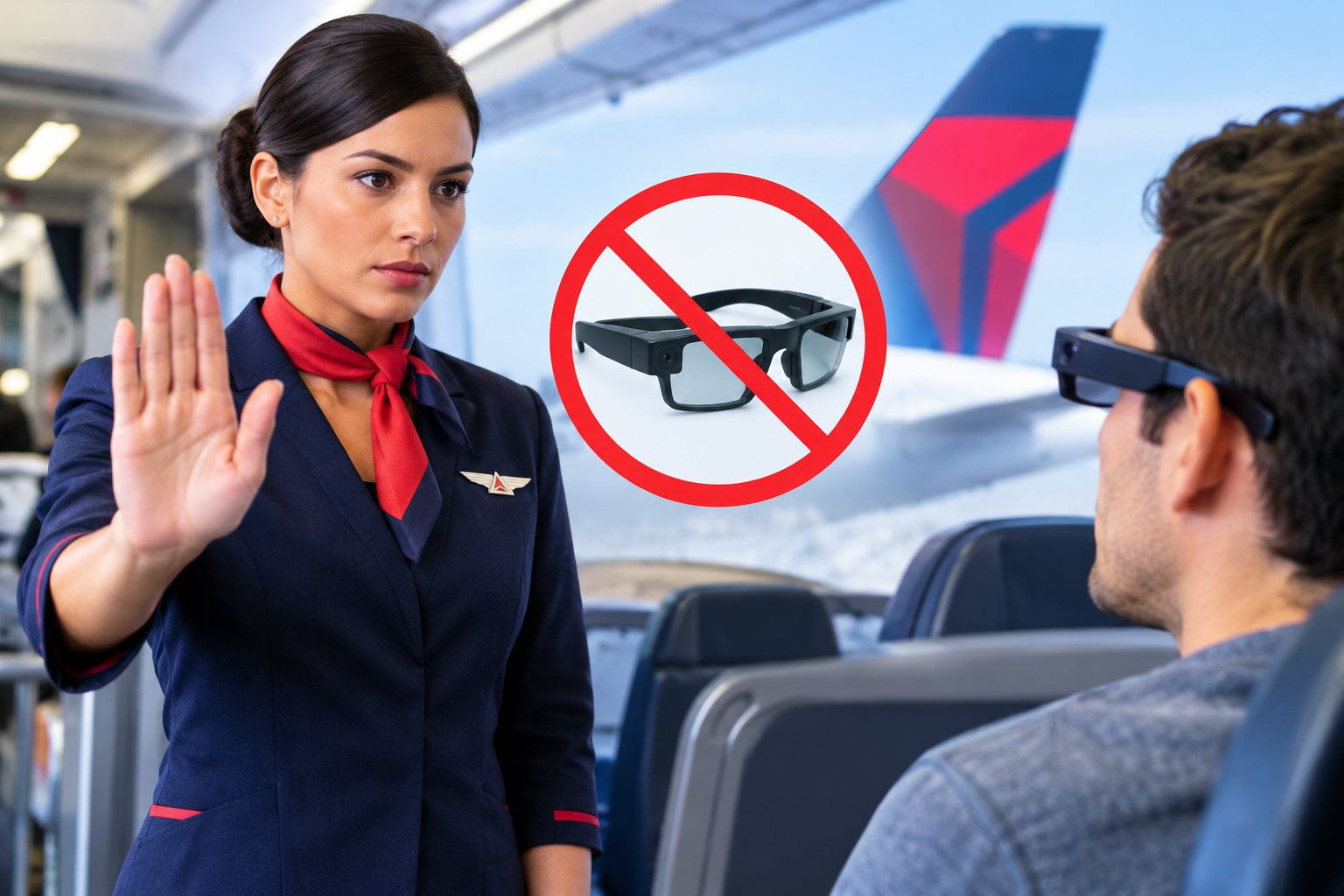

Artificial intelligence is moving beyond phones and laptops. AI-powered smart glasses can now take photos, record video, respond to voice commands, play audio, and provide real-time AI assistance.
That technology is raising new questions inside aircraft cabins, especially when smart glasses include cameras and microphones.
Recent online discussion around Delta Air Lines and AI glasses has led some travelers to ask whether Delta has banned the devices, whether flight attendants can wear them while working, and whether passengers are still allowed to bring smart glasses onboard.
The situation is more nuanced than the phrase “Delta AI glasses ban” may suggest.
Has Delta Air Lines Banned AI Glasses?
There does not currently appear to be a publicly announced, airline-wide Delta policy stating that passengers are completely prohibited from carrying or wearing AI smart glasses.
Delta’s published prohibited and restricted items guidance covers electronic devices, batteries, and other potentially hazardous equipment. Smart glasses are not specifically identified as a category that passengers cannot bring onboard.
That means travelers should be careful about interpreting reports concerning employee rules as a general passenger ban.
Workplace restrictions applying to flight attendants can also be very different from rules applying to customers.
Why Are AI Glasses an Issue for Flight Attendants?
The biggest concern is not simply artificial intelligence. It is what modern smart glasses can do.
Devices such as AI-powered smart glasses may include cameras, microphones, voice controls, speakers, and recording capabilities.
Those features can create additional concerns when used by an airline employee while performing official duties.
Flight attendants work around passengers, private conversations, airline procedures, and safety-related activities. Their main responsibility is passenger safety and service.
Because smart glasses can resemble ordinary eyewear, passengers may not always immediately know that a device is capable of taking photos, recording video, or capturing audio.
That makes privacy, professionalism, and workplace recording policies especially important.
Can Delta Flight Attendants Wear AI Glasses While Working?
Travelers should distinguish between what an employee can personally own and what an airline allows an employee to use while on duty.
Airlines commonly maintain internal appearance, uniform, electronic-device, and workplace-conduct policies that may go beyond public passenger rules.
If Delta restricts flight attendants from wearing camera-equipped AI glasses during active duty, such a restriction would function as an employee workplace rule rather than necessarily being a ban on the technology throughout the airline.
Employees may also be required to follow specific appearance standards and rules regarding personal electronic devices during work.
However, passenger policies and employee policies should not automatically be treated as the same thing.
Can Passengers Wear AI Glasses on Delta Flights?
Passengers may generally travel with many types of portable electronic devices as long as they comply with battery, safety, and onboard operating requirements.
AI glasses may therefore be treated similarly to other wearable or portable electronic devices unless a specific restriction applies.
However, being allowed to carry a device does not automatically mean every feature should be used during the flight.
Passengers should avoid using smart glasses in a way that interferes with safety instructions, passenger comfort, privacy, or crew responsibilities.
If a crew member asks a traveler to stop using a particular feature or device, the passenger should follow that instruction.
Can Passengers Record With AI Glasses?
This is where smart glasses become more complicated than traditional eyewear.
Many AI glasses can capture photos and record videos using built-in cameras. Some models also include microphones and voice assistants.
Passengers should use caution when using these features inside an aircraft.
Recording another person without their knowledge may create privacy concerns. It may also make other travelers uncomfortable, particularly in the confined environment of an airplane cabin.
Passengers should avoid secretly recording other travelers or airline employees.
They should also respect any instructions provided by the flight crew regarding recording or electronic-device use.
Why Privacy Is a Major Concern
Traditional glasses do not normally contain cameras or microphones.
AI glasses can.
That difference matters inside an aircraft cabin.
A camera-equipped pair of glasses could potentially capture:
-
Other passengers
-
Children traveling nearby
-
Flight attendants performing their duties
-
Private conversations
-
Seat or travel information
-
Airline operational procedures
-
Safety-related activity
Because smart glasses can look similar to ordinary eyewear, people around the wearer may not immediately realize that recording is taking place.
This creates an important privacy question for airlines, employees, and travelers.
Are AI Glasses Dangerous on an Aircraft?
AI software itself is not necessarily the main aviation-safety concern.
The hardware and battery inside the device may be more relevant.
Smart glasses often use rechargeable lithium-ion batteries, similar to smartphones, wireless headphones, and other portable electronics.
Passengers should make sure their devices are in good condition and should not travel with damaged, defective, or recalled batteries.
Travelers should also follow crew instructions regarding electronic-device use during different stages of the flight.
Does Delta Use Artificial Intelligence?
Yes, Delta uses digital and AI-based technology in parts of its operations and recruitment processes.
That is an important distinction.
Concerns about AI glasses do not necessarily mean the airline is against artificial intelligence in general.
The issue is more likely to involve how wearable devices are used, particularly when they include cameras, microphones, or recording features.
In other words, the debate is about the context in which AI technology is being used rather than simply the existence of AI itself.
What Should Delta Passengers Know Before Wearing Smart Glasses?
Travelers using AI glasses should follow several basic rules.
Keep the device in good condition.
Do not use damaged batteries or electronics.
Avoid secretly recording passengers or airline employees.
Pay attention to safety announcements.
Follow crew instructions regarding electronic devices.
Use cameras and microphones responsibly.
Be aware that other passengers may feel uncomfortable around wearable recording devices.
Passengers should also remember that airline crews may issue instructions based on the circumstances of a particular flight.
Could Airlines Introduce More AI Glasses Rules?
Yes, more specific policies may appear as wearable AI technology becomes more common.
Smart glasses are becoming increasingly advanced.
Some devices can:
-
Recognize objects
-
Take photographs
-
Record videos
-
Translate conversations
-
Answer questions
-
Play music
-
Provide directions
-
Connect with AI assistants
These capabilities may encourage airlines to develop clearer rules regarding wearable cameras, microphones, and artificial intelligence.
Airlines will likely need to balance innovation with passenger privacy, employee professionalism, and aviation safety.
What Is the Difference Between an Employee Restriction and Passenger Ban?
This distinction is important.
An employee restriction determines what workers may use while performing their jobs.
A passenger ban determines what customers may bring onto or use aboard an aircraft.
These are not automatically the same thing.
An airline may prevent employees from wearing camera-equipped glasses while working without preventing passengers from carrying the same device.
That is why reports about a “Delta AI glasses ban” should be examined carefully before assuming that every traveler is affected.
Frequently Asked Questions
Did Delta ban AI glasses?
There does not currently appear to be a clearly published blanket ban prohibiting all Delta passengers from carrying AI glasses. Employee workplace rules and passenger policies may be different.
Can passengers bring AI glasses on Delta?
Passengers may generally travel with portable electronic devices as long as they comply with battery, safety, and onboard rules. Specific instructions from the flight crew should always be followed.
Can you record people using AI glasses on a plane?
The technology may allow recording, but travelers should respect passenger privacy and avoid secretly recording other people. They should also follow any instructions from airline staff.
Why would flight attendants face stricter rules?
Flight attendants are working employees responsible for safety, service, and passenger interactions. Airlines may apply stricter workplace, appearance, and electronic-device rules to employees.
Are AI glasses allowed during takeoff and landing?
Passengers should follow airline instructions regarding electronic-device use during different phases of the flight. If crew members ask passengers to stop using a device, they should comply.
Conclusion
The phrase “Delta AI glasses ban” can make the situation sound broader than it may actually be.
AI glasses create new questions for airlines because they combine ordinary eyewear with cameras, microphones, recording tools, and artificial intelligence.
Those features may create different concerns for flight attendants who are performing official duties and passengers who are simply traveling.
For passengers, the most important issues are likely to involve battery safety, privacy, respectful recording, and following crew instructions.
As wearable AI becomes more common, airline policies may continue to evolve. Travelers using smart glasses should check the latest airline guidance before flying and use the devices responsibly while onboard.