

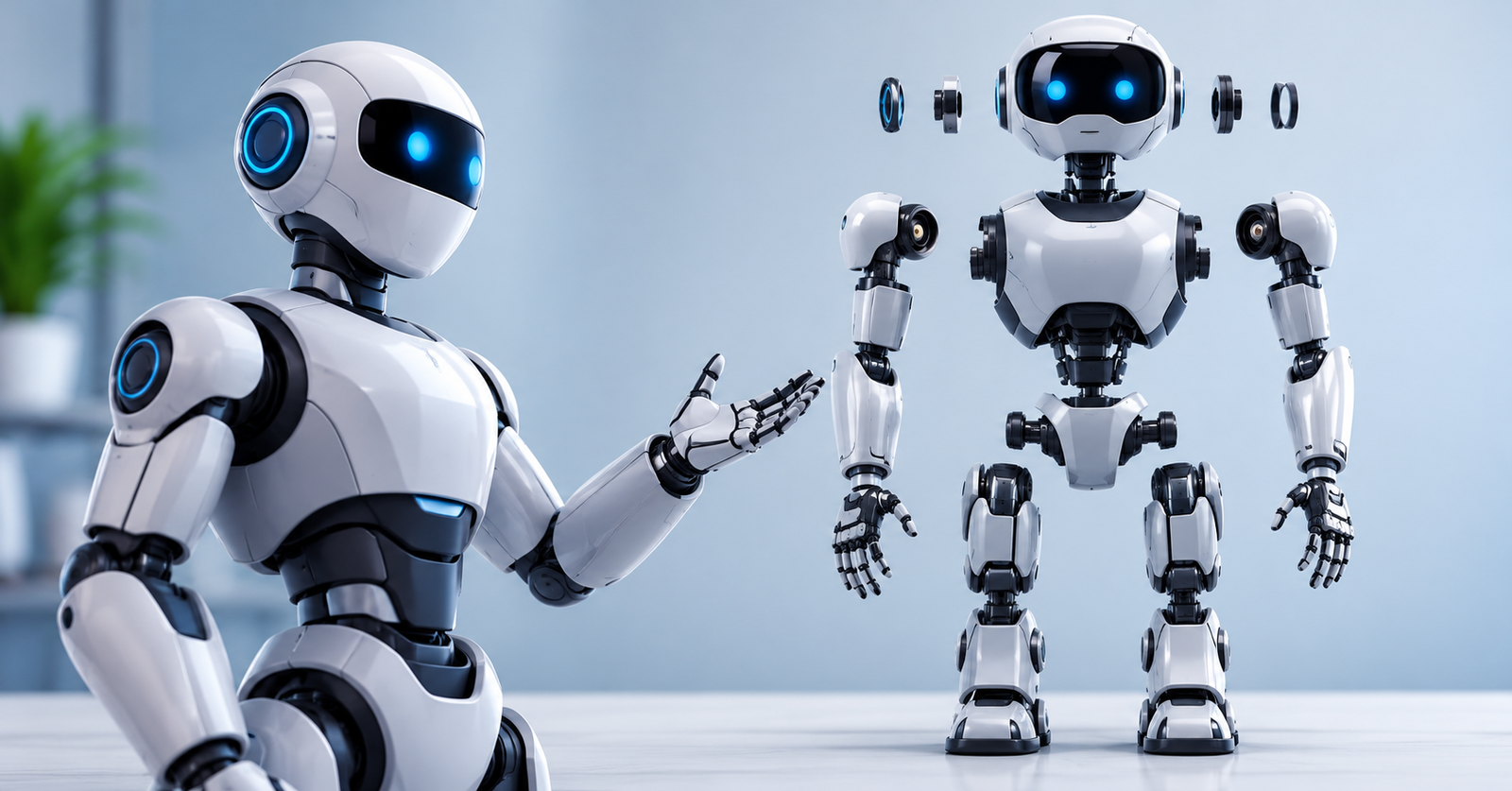

Robots may look different depending on their purpose, but most rely on a combination of mechanical, electrical, and electronic components to perform tasks. From industrial robotic arms and warehouse automation systems to medical robots and household cleaning machines, every robot needs specific parts to move, sense its surroundings, process information, and complete instructions.
Understanding the different robot parts helps explain how robotic systems function as a whole. A motor, for example, creates movement, while sensors collect information about the environment. Controllers process that information and coordinate the actions of other components.
Whether you are learning about robotics for the first time, studying engineering, or simply curious about how machines work, knowing the main components provides a useful starting point.
In this guide, we explore the essential parts of a robot, explain what each component does, and show how they work together to perform automated tasks.
Table of Contents
-
What Are Robot Parts?
-
How Do the Main Robot Components Work Together?
-
Different Types of Robot Parts and Their Functions
-
Mechanical Components of a Robot
-
Electrical and Electronic Components
-
Software and Control Systems
-
How Robot Parts Work Together in Real Applications
-
Why Are Different Robot Parts Important?
-
Frequently Asked Questions
-
Conclusion
1. What Are Robot Parts?
Robot parts are the individual mechanical, electrical, and electronic components that allow a robot to operate. Each component has a particular responsibility, such as supporting the robot’s structure, producing movement, detecting objects, processing information, or supplying power.
A robot does not depend on a single component to complete its work. Instead, several parts operate together as an integrated system. For example, a warehouse robot may use wheels for movement, sensors to detect obstacles, a controller to process instructions, and a battery to supply electricity.
The exact components depend on the robot’s design and intended application. A robotic arm requires joints and actuators for precise movement, while a mobile robot needs a suitable drive system and navigation sensors.
2. How Do the Main Robot Components Work Together?
Most robots follow a basic process: they receive information, process it, and perform an action. This process allows them to respond to instructions or changes in their surroundings.
The interaction between components can be understood through four main stages.
| Stage | Main Components | Function |
|---|---|---|
| Input | Sensors and cameras | Collect information from the environment |
| Processing | Controller and processor | Interpret information and make decisions based on programming |
| Action | Motors and actuators | Produce movement or operate mechanical parts |
| Power | Batteries or external supplies | Provide energy to the robot’s systems |
For example, when an autonomous robot approaches an obstacle, its sensors detect the object and send information to the controller. The controller processes the data and instructs the motors to slow down, stop, or change direction.
This coordination is what allows a robot to perform tasks with limited or no direct human control.
3. Different Types of Robot Parts and Their Functions
Robots contain several essential components, and each one contributes to their overall performance. Some parts are responsible for movement, while others help robots understand their surroundings or carry out programmed instructions.
The following table explains the most common robot parts and their primary functions.
| Robot Part | Main Function | How It Works |
|---|---|---|
| Controller | Controls robot operations | Processes instructions and coordinates components |
| Sensors | Detect environmental information | Measure distance, light, temperature, or other conditions |
| Motors | Produce movement | Convert electrical energy into mechanical motion |
| Actuators | Move mechanical components | Create linear or rotational movement |
| Power Supply | Provides energy | Supplies electricity to different systems |
| Robotic Frame | Supports the structure | Holds components in their correct positions |
| End Effector | Performs specific tasks | Grips, holds, welds, or handles objects |
| Wheels and Tracks | Enable mobility | Allow robots to travel across surfaces |
| Communication Module | Exchanges information | Connects robots with computers or other devices |
| Software | Provides operating instructions | Determines how the robot responds and performs tasks |
These components are commonly found in many robotic systems, although their designs and configurations vary according to the application.
4. Mechanical Components of a Robot
Mechanical components form the physical structure of a robot. They support its weight, provide stability, and allow different sections to move.
Unlike software or electronic systems, these parts are directly involved in physical operations.
4.1 Robotic Frame and Chassis
The frame is the main supporting structure of a robot. It holds important components such as motors, sensors, batteries, controllers, and mechanical joints.
The chassis is particularly important in mobile robots because it supports the wheels, tracks, and other movement systems. Frames are commonly made from materials such as aluminium, steel, and engineering plastics.
A well-designed frame helps maintain balance, protect internal components, and support the robot during operation.
4.2 Joints and Links
Joints and links allow robotic arms and other articulated machines to move in different directions.
A link is a rigid section that connects different parts of a robot, while a joint creates movement between connected links. Together, they form the mechanical structure of many robotic arms.
Common robotic joint types include:
| Joint Type | Movement | Common Application |
|---|---|---|
| Revolute Joint | Rotational movement | Robotic arms and articulated robots |
| Prismatic Joint | Straight-line movement | Industrial positioning systems |
| Spherical Joint | Movement in multiple rotational directions | Advanced robotic mechanisms |
| Cylindrical Joint | Rotation and linear movement | Specialized mechanical systems |
The arrangement of joints determines how much movement a robot can perform and which positions it can reach.
4.3 Wheels, Tracks, and Gears
Wheels and tracks are important components in mobile robots. They allow machines to travel across floors, roads, warehouses, and other surfaces.
Wheeled robots are commonly used in delivery systems and warehouse automation because they can move efficiently on relatively smooth surfaces. Tracked robots are useful in environments where additional traction is needed.
Gears transfer motion and adjust speed or torque between mechanical components. For example, a gear system can help a small motor generate enough torque to move a heavier robotic mechanism.
4.4 End Effectors and Grippers
An end effector is the device attached to the end of a robotic arm that interacts directly with objects or performs a particular task.
Grippers are one of the most common types of end effectors. They can hold, pick up, move, and release objects.
Different end effectors are designed for different purposes. A manufacturing robot may use a welding tool, while a packaging robot may use a vacuum suction attachment to lift products.
5. Electrical and Electronic Components of a Robot
Electrical and electronic components provide the energy, control, and information processing required for robotic operations. Without these systems, a robot’s mechanical parts would not be able to operate as intended.
5.1 Motors
Motors convert electrical energy into mechanical movement. They are among the most important components in robots because they drive wheels, rotate joints, and operate mechanical attachments.
Different motor types are suitable for different applications.
| Motor Type | How It Works | Typical Use |
|---|---|---|
| DC Motor | Produces continuous rotational movement | Small mobile robots |
| Servo Motor | Provides controlled position, speed, or torque | Robotic arms |
| Stepper Motor | Moves in controlled angular steps | Precision positioning |
| Brushless DC Motor | Uses electronic commutation instead of mechanical brushes | Drones and advanced robots |
Choosing a suitable motor depends on factors such as required speed, torque, accuracy, power consumption, and operating conditions.
5.2 Sensors
Sensors help robots collect information about their surroundings and internal operating conditions. They act as input devices, allowing a robot to detect changes and respond accordingly.
For example, a distance sensor can help a mobile robot avoid obstacles, while a temperature sensor can monitor heat in industrial equipment.
Common robot sensors include:
| Sensor Type | What It Detects | Example Application |
|---|---|---|
| Ultrasonic Sensor | Distance using sound waves | Obstacle detection |
| Infrared Sensor | Infrared radiation | Object detection |
| LiDAR Sensor | Distance using laser light | Robot navigation and mapping |
| Camera Sensor | Visual information | Object recognition |
| Temperature Sensor | Heat and temperature | Industrial monitoring |
| Gyroscope | Rotational movement | Robot orientation |
| Accelerometer | Acceleration and changes in movement | Balance and motion tracking |
| Force Sensor | Applied force | Robotic gripping |
The information collected by sensors is sent to the controller, which uses it to determine the robot’s next action.
5.3 Controllers and Microprocessors
The controller is often described as the brain of a robot because it coordinates the activities of different components.
It receives information from sensors, processes programmed instructions, and sends commands to motors and actuators.
Microcontrollers are commonly used in smaller robotic projects, while more complex robots may rely on powerful processors and dedicated control systems.
For example, an educational robot might use an Arduino-compatible controller, while an advanced autonomous robot may use a computer capable of processing camera images, navigation data, and artificial intelligence models.
5.4 Batteries and Power Supply
Every electrically operated robot needs a reliable source of energy. Batteries are common in mobile robots because they allow machines to operate without remaining connected to a power outlet.
Lithium-ion and lithium-polymer batteries are frequently used in portable robotic applications. Industrial robots may receive power directly through electrical connections.
Power management circuits also help distribute electricity to different components at suitable voltage and current levels.
The battery capacity, energy requirements, and operating time are important considerations when designing a robot.
6. Software and Control Systems
Although software is not a physical robot part, it is essential to how modern robotic systems function. It provides the instructions that determine how hardware components should operate.
Robot software can control movement, process sensor information, manage communication, and support autonomous decision-making.
6.1 Robot Operating Systems
A robot operating system provides software tools and frameworks for developing robotic applications. One widely used example is ROS 2 (Robot Operating System 2).
It helps developers manage communication between different software components, work with sensor data, and build navigation or control applications.
6.2 Motion Control Software
Motion control software determines how motors and actuators should operate. It helps control speed, direction, position, and movement accuracy.
For instance, an industrial robotic arm may follow a programmed sequence to pick up a component and place it at a specific location. The control software coordinates the movement of multiple joints to complete the task.
6.3 Artificial Intelligence and Computer Vision
Some advanced robots use artificial intelligence and computer vision to understand visual information and make more complex decisions.
Computer vision helps robots identify objects, recognize patterns, and interpret images. AI-based systems can use this information to support navigation, inspection, sorting, and other automated activities.
However, not every robot requires artificial intelligence. Many machines perform their tasks through predefined instructions and conventional control systems.
7. How Do Robot Parts Work Together in Real Applications?
Understanding individual components is useful, but their combined operation explains what makes a robot effective. Different robotic applications demonstrate how mechanical, electrical, and software systems interact to complete specific tasks.
Example 1: Industrial Robotic Arm
Industrial robotic arms are widely used in manufacturing facilities for welding, assembling, painting, and material handling.
Their motors move individual joints, while sensors provide information about position and surrounding objects. The controller processes instructions and coordinates the arm’s movements. An end effector performs the actual task, such as holding a component or operating a welding tool.
Example 2: Autonomous Mobile Robot
Autonomous mobile robots are commonly used in warehouses, factories, and distribution centres. They transport materials between different locations with limited human intervention.
Their wheels provide movement, LiDAR and other sensors help detect obstacles, and navigation software calculates suitable routes. The controller sends commands to the motors to adjust speed and direction.
Example 3: Robotic Vacuum Cleaner
A robotic vacuum cleaner combines several relatively simple components to perform household cleaning tasks.
Its wheels allow it to move around rooms, while brushes and suction systems collect dirt. Sensors help detect walls, furniture, and stairs. Its controller manages movement and cleaning patterns according to its programming.
These examples show that robots may use different combinations of components, but the basic principle remains similar: hardware collects information and performs physical actions under the direction of a control system.
8. Why Are Different Robot Parts Important?
Every robotic component contributes to the machine’s overall functionality. Selecting suitable parts is important because the wrong combination can affect performance, reliability, safety, and operating efficiency.
The importance of different components can be understood through the following comparison.
| Component | Why It Matters | What Happens Without It? |
|---|---|---|
| Motors | Provide mechanical movement | Powered movement may not be possible |
| Sensors | Detect environmental conditions | The robot has limited awareness of its surroundings |
| Controller | Coordinates operations | Components cannot follow coordinated instructions |
| Power Supply | Provides electrical energy | Electronic systems cannot operate |
| Frame | Supports physical components | The structure may lack stability |
| Actuators | Produce controlled physical actions | Specific mechanical operations cannot be performed |
| Software | Defines operating instructions | Automated behaviour cannot be properly managed |
The right combination also depends on the working environment. A robot designed for a hospital may need quiet motors, precise movement, and reliable obstacle detection. In contrast, an industrial robot may require high torque, durable mechanical parts, and specialised safety systems.
For this reason, robot design involves balancing performance, cost, size, power consumption, and intended functionality.
9. Frequently Asked Questions (FAQs)
1. What are the main parts of a robot?
The main parts of a robot include a frame, motors, actuators, sensors, a controller, a power supply, and software. Depending on its purpose, a robot may also contain wheels, robotic joints, cameras, and specialised end effectors.
2. What is the most important part of a robot?
The controller is one of the most important components because it coordinates the robot’s operations. However, no single part can perform every function, as successful robotic operation depends on several components working together.
3. What do sensors do in a robot?
Sensors collect information about the robot’s surroundings and internal conditions. They help detect objects, measure distances, monitor temperature, and identify movement, allowing the robot to respond to different situations.
4. What is the difference between a motor and an actuator in robotics?
A motor converts energy into mechanical movement, usually rotational movement. An actuator is a broader device that produces physical action and may use an electric motor, hydraulic pressure, or pneumatic power.
5. Do all robots have the same parts?
No. Robot components vary according to the machine’s design and purpose. A robotic arm, an autonomous vehicle, and a household cleaning robot require different mechanical structures, sensors, and movement systems.
6. What materials are commonly used to make robot parts?
Robot components can be manufactured using aluminium, steel, plastics, carbon fibre, and other engineering materials. The choice depends on factors such as strength, weight, flexibility, durability, and environmental conditions.
7. Can a robot work without sensors?
Some robots can operate using predefined instructions without external sensors. However, sensors are important for machines that need to detect objects, monitor their position, navigate environments, or respond to changing conditions.
10. Conclusion
Robot parts work together to transform programmed instructions into physical actions. Mechanical components provide structure and movement, electrical systems supply energy, sensors collect information, and controllers coordinate the entire operation.
Understanding these components makes it easier to see how different robotic systems are designed for specific purposes. Whether a robot is used in manufacturing, healthcare, transportation, or household applications, its performance depends on selecting suitable parts and integrating them effectively.
As robotics continues to develop, improvements in motors, sensors, processors, batteries, and control software will create opportunities for more capable and efficient machines. Learning how these components work is a valuable first step toward understanding modern robotics.