


Introduction
Industrial robotic arms play a vital role in modern manufacturing, helping companies perform tasks such as welding, assembly, packaging, painting, and material handling. These machines are designed to complete repetitive operations with speed, accuracy, and consistency.
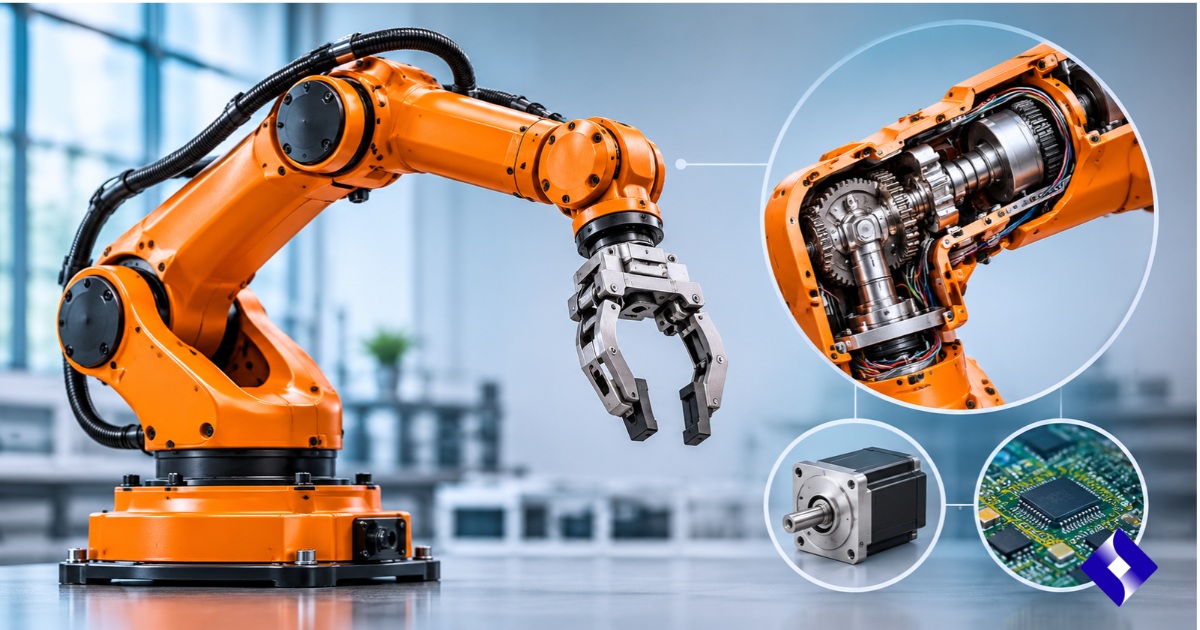
However, its movement involves much more than simply turning a motor on and off. Inside an industrial robotic arm, mechanical joints, electric motors, sensors, gear systems, and computer controllers work together to produce controlled motion.
Understanding these internal components makes it easier to understand how robotic arms work and why they are widely used in automated production. Let’s explore the mechanism, movement, and control systems that make these machines function.
Table of Contents
- What is an industrial robotic arm?
- Main components within an industrial robotic arm
- How does an industrial robotic arm work?
- Understanding the movement and control of the robotic arm
- Different types of industrial robotic arms
- Main features of industrial robotic arms
- Advantages of industrial robotic arms
- Advantages and disadvantages
- Frequently Asked Questions
- Conclusion
- Key findings
What is an industrial robotic arm?
An industrial robotic arm is a programmable mechanical device designed to automatically perform physical tasks in industrial and manufacturing environments. Its structure consists of connected sections and joints that allow it to move tools or objects through different positions.
Unlike a human arm, which uses muscles and biological signals, a robotic arm relies on motors, actuators, mechanical transmissions, and electronic control systems. These components work together to follow programmed instructions and perform specific operations.
Industrial robotic arms are commonly found in car factories, electronics manufacturing plants, warehouses, food processing facilities, and packaging plants.
Main components within an industrial robotic arm
Several important components work together to control the movement and operation of an industrial robotic arm. Each part has a specific function, from providing structural support to generating precise movements.
1. Base and mechanical links
The base provides the foundation for the robotic arm and connects it to the floor or mounting platform. It supports the weight of the machine and helps maintain structural stability during operation.
Mechanical links are the rigid sections that connect the different joints. Their length, arrangement, and material determine the robot’s reach, strength, and overall movement capabilities.
2. Joints and actuators
The joints allow the different sections of the robotic arm to move relative to each other. Rotary joints create a rotational movement, while linear joints allow movement along a straight path.
Actuators generate the mechanical force needed to move these joints. Modern industrial robots typically use electric servomotors, although hydraulic and pneumatic systems are also used in certain applications.
3. Motors and gearboxes
Servomotors are responsible for controlling the position, speed, and movement of robotic joints. They receive commands from variable frequency drives connected to the robot controller.
Gearboxes reduce the motor speed while increasing the available torque. This allows the robotic arm to handle heavier loads and perform controlled movements without requiring extremely large motors.
4. Sensors and encoders
Sensors help the robotic arm control its movement and operating conditions. Encoders measure the position of motors or joints, providing information that helps the controller determine if the arm is following programmed instructions.
Other sensors can detect force, torque, temperature, pressure, and nearby objects. These measurements enable precise operation and help identify certain operational problems.
5. End effector
The end effector is the tool attached to the end of the robotic arm. It interacts directly with objects or performs the necessary industrial operation.
Depending on the application, this could be a mechanical gripper, a welding torch, a suction cup, a spray gun, or a cutting tool. Selecting the right end effector is important, as it directly impacts how effectively the robot performs its task.
How does an industrial robotic arm work?
An industrial robotic arm follows a coordinated process that includes programming, motion calculations, motor activation, and sensor feedback.
While the exact operation depends on the robot model, the general process comprises the following steps.
Step 1: Receive instructions
The robot controller receives commands from a programmed sequence, a programming panel, or a connected production system. These instructions define the necessary movements and actions.
Step 2: Calculate the movement
The controller determines the joint position, movement speed, and trajectory required to complete the task. It calculates how individual joints must move to correctly position the end effector.
Step 3: Activating the motors
The controller sends commands to the variable frequency drives, which regulate the power supplied to the motors. The motors then move the corresponding joints according to the programmed requirements.
Step 4: Tracking the movement
Encoders and other sensors provide information about the robot’s actual movement. The controller compares this information with the planned movement and adjusts the motor commands as needed.
Step 5: Completion of the operation
Once the robotic arm reaches its target position, the end effector performs the assigned task. The robot then moves to its next programmed position or waits for further instructions.
Understanding the movement and control of the robotic arm
One of the most important characteristics of industrial robotic arms is their ability to move in multiple directions. This ability is determined by their degrees of freedom (DOF).
Many articulated industrial robots have six degrees of freedom. These typically include base rotation, shoulder movement, elbow movement, and three wrist movements. Together, these axes allow the end effector to achieve different positions and orientations in three-dimensional space.
Two mathematical concepts are particularly important in robotic motion:
- Forward kinematics: Calculates the position and orientation of the end effector using the known positions of the robot’s joints.
- Inverse kinematics: Determines the joint positions needed to move the end effector to a specific target location and orientation.
These calculations help the controller coordinate multiple joints and guide the robotic arm along the intended path.
Different types of industrial robotic arms
Industrial robotic arms come in different designs, each developed to meet specific manufacturing requirements.
Articulated robots: These robots use multiple rotating joints and are commonly used for welding, painting, assembling, and handling materials.
Cartesian robots: These robots move along three perpendicular linear axes (X, Y, and Z). Their simple movement makes them ideal for positioning, packaging, and loading machines.
SCARA robots: These systems are designed for rapid horizontal movement and are frequently used in the assembly of electronic components and in pick and place applications.
Delta robots: Their lightweight parallel linkage structure allows for very fast movements, making them useful in food processing, sorting, and packaging.
Collaborative robots: Also known as cobots, these robots are designed for applications where humans and robots can share a workspace. Even so, safety assessments and appropriate protective measures are necessary.
Main features of industrial robotic arms
Industrial robotic arms offer a variety of technical capabilities that support automated manufacturing operations.
- Multi-axis movement: Allows movement in different directions and angles.
- Programmable operation: Allows robots to perform different tasks through programmed instructions.
- High repeatability: Helps maintain consistency when repeating specific movements.
- Positioning accuracy: Uses feedback and motion control systems to achieve the required positions.
- Payload capacity: Supports different weights of objects depending on the robot’s design.
- Flexible tools: They allow the installation of different end effectors for specific applications.
- System integration: Enables communication with sensors, conveyor belts, PLCs, and other production equipment.
Advantages of industrial robotic arms
Industrial robotic arms offer several advantages when properly selected and integrated into manufacturing processes.
Increased productivity: Robots can perform repetitive operations at constant speeds, helping manufacturers to maintain production schedules.
Consistent results: Programmed movements allow for repeatable operations, which is especially important in assembly, welding, and packaging.
Workplace safety: Robotic systems can perform certain dangerous or physically demanding tasks, reducing workers’ exposure to potential risks.
Reduction of manual labor: Automating repetitive activities allows employees to focus on supervision, maintenance, scheduling, and quality control.
Flexible manufacturing: Changing programs and end effectors allows a robotic arm to adapt to different production requirements.
Advantages and disadvantages of industrial robotic arms
Advantages
- High repeatability and consistent performance.
- Ability to operate during extended production periods.
- Greater efficiency in repetitive manufacturing tasks.
- Precise and controlled movements.
- Reduced exposure to certain occupational hazards.
- Flexibility thanks to programming and interchangeable tools.
Disadvantages
- High initial purchase and installation costs.
- It requires programming knowledge and technical support.
- Regular maintenance is necessary.
- A reconfiguration may be necessary when production requirements change.
- Incorrect installation can create serious safety risks.
- Mechanical or electronic failures can interrupt production.
Frequently Asked Questions (FAQ)
- Which country is No. 1 in robotics?
Japan is one of the world’s leading countries in robotics, particularly in industrial robot manufacturing. South Korea leads globally in robot density, with a high number of industrial robots relative to manufacturing workers. - How does a robotic arm work?
A robotic arm uses motors, joints, sensors, and a control system to perform programmed movements. These components work together to position tools or objects accurately and complete specific tasks. - Does robotics use C or C++?
Yes, both C and C++ are widely used in robotics for programming hardware, controlling motors, and processing sensor data. C++ is particularly popular in advanced robotics applications because of its performance and flexibility. - What is the working principle of a robotic arm?
A robotic arm works by converting programmed instructions into controlled mechanical movements through motors and actuators. Sensors provide feedback to the controller, helping the arm achieve accurate positioning and movement. - What kills a robot?
Overheating, electrical failures, mechanical damage, excessive loads, and poor maintenance can cause a robot to stop working. Dust, moisture, collisions, and damaged internal components can also reduce its lifespan.
Conclusion
An industrial robotic arm is a combination of mechanical engineering, electrical components, sensors, and computer control systems. Its ability to perform precise movements depends on the coordination of joints, motors, gearboxes, and feedback devices.
From receiving programmed instructions to positioning the end effector, each stage involves the collaboration of multiple components. Understanding these mechanisms explains why robotic arms have become essential tools in modern manufacturing.
As automation technology continues to advance, industrial robotic arms will remain important for improving production efficiency, maintaining consistency, and managing demanding industrial operations.
Key findings
- Industrial robotic arms combine mechanical and electronic components to perform automated tasks.
- Motors and actuators generate the movement necessary for the operation of robotic joints.
- Gearboxes regulate speed and increase available engine torque.
- Sensors and encoders provide information about movement and position.
- The robot’s controllers coordinate the programmed instructions and joint movements.
- Degrees of freedom determine how a robotic arm can move.
- Different robot designs are suited to different manufacturing applications.
- Proper maintenance, scheduling, and safety measures are essential for reliable operation.