


Introduction
Modern intercom systems have moved far beyond simple devices that allow people to speak through the door. Today’s building communication systems combine audio, video, visitor identification, and controlled access to improve communication between residents and visitors.
One technology used in this field is 2Voice, a digital two-wire intercom system affiliated with Urmet. People looking into the 2voice trademark technology often try to understand what the system does, how its wiring works, and whether it can be used in residential or commercial buildings.
Unlike traditional intercom installations that may require separate connections for different functions, 2Voice is designed to transmit communication signals over a common two-wire bus architecture. This approach can simplify wiring arrangements, especially in buildings with multiple apartments.
However, understanding the technology requires more than knowing how many wires it uses. System compatibility, installation requirements, device configuration and maintenance all impact how effectively a 2Voice intercom installation operates.
This guide explains the basic technology, its practical applications, key features, advantages, and limitations.
Table of contents
- What is 2Voice trademark IT technology?
- How does 2Voice technology work?
- 2 Advantages of Voice Technology
- Common applications in modern buildings
- 2 Voice vs. Traditional Intercom Systems
- Installation requirements and considerations
- Common problems and troubleshooting
- Advantages and disadvantages of 2Voice technology
- Frequently Asked Questions
- Conclusion
- Key Takeaways
What is 2Voice trademark IT technology?
2Voice is a proprietary digital communications technology developed for audio and video door entry systems. It uses a two-wire bus architecture to connect compatible external entry panels, indoor handsets, video monitors and associated control devices.
The search phrase “2voice trademark it technology” refers to this branded system rather than the generic technology standard. Urmet’s technical literature identifies 2Voice as one of its trademarks.
This system is primarily designed for control communication between building entrances and residents. Depending on the installed equipment, residents can identify visitors, communicate with them, and remotely release the entrance door.
Why is it called 2Voice?
The name reflects the system’s two-wire communications architecture. Instead of requiring a separate set of wires for each communication function, compatible devices share a structured bus connection.
However, two-wire technology does not mean that every component in the building connects directly to the same two terminals. Larger installations may require distributors, interfaces, power supplies, and additional wiring for related equipment.
It is also important to distinguish 2Voice from typical two-wire intercom products. Devices from different manufacturers are not automatically compatible because they use two conductors.
How does 2Voice technology work?
The operating principle involves the transmission of communication and control information between external and internal devices through the system’s two-wire infrastructure.
A typical installation includes an outdoor calling station, a compatible power supply, one or more indoor stations, and the required distribution equipment.
Step 1: A visitor initiates a call.
When a visitor presses the appropriate button or selects an apartment on the entrance panel, the system generates a call request.
The configuration of the installation determines which indoor station receives the request. In a multi-apartment building, individual devices must be assigned correctly so that calls can reach the intended residence.
Step 2: The system routes the communication.
A two-wire bus carries the necessary signaling between compatible system components.
Distributors and interfaces help organize communications in different parts of a building. This is especially relevant in apartment complexes where several indoor stations share a common entrance.
Step 3: Audio and video communication begins.
After the resident answers, the intercom establishes communication with the entrance panel.
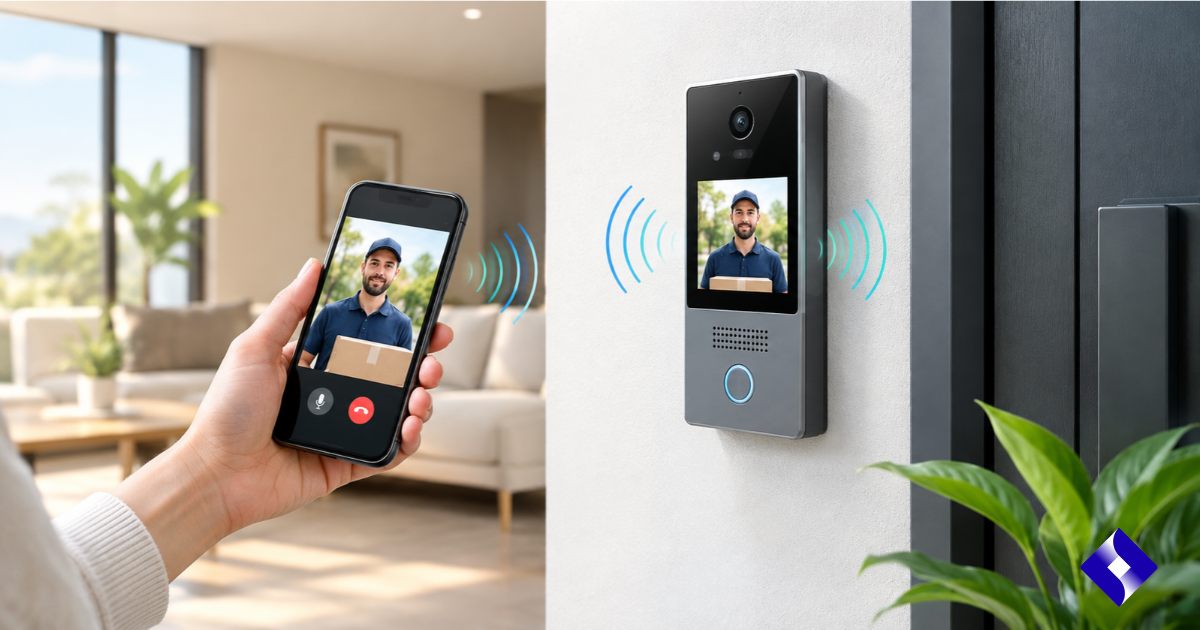
In the audio-only configuration, the resident can speak to the visitor. With a compatible video door entry system, the resident can also view the camera feed from the outdoor station.
Video availability depends on the installed devices. A two-wire connection alone does not guarantee that every indoor device supports video.
Step 4: The resident controls access.
Where an electric door release is installed and configured correctly, the resident can operate it using the indoor station.
The release mechanism must be compatible with the relevant control equipment. Its electrical supply and wiring requirements should be checked separately rather than assuming it is identical to the intercom bus.
Step 5: The system returns to standby.
After the conversation ends, the communication session closes and the system remains available for subsequent calls.
In larger installations, call handling and system capacity depend on the specific configuration, interfaces, and connected devices.
Flexible system configuration
A notable feature of 2Voice is its ability to support different installation arrangements.
A small residential property may only require one outdoor station and one indoor monitor. A large apartment building may require multiple entrances, multiple risers, and additional distribution equipment.
This flexibility makes proper system planning essential. Installers should calculate device capacity, cable length, and electrical requirements before selecting components.
Benefits of 2Voice Technology in Modern Buildings
Reduced wiring complexity
Traditional intercom systems can involve multiple conductors, especially when multiple apartments and video functions are involved.
A two-wire architecture can simplify cable routing and reduce the number of individual connections required for supporting communication functions.
Practical savings depend on the building’s existing infrastructure, cable condition, and required accessories.
Potential benefits during renovation
Replacing an old intercom system can be difficult when the cables are connected inside walls or run through inaccessible areas.
2Voice can allow for the reuse of suitable existing cabling, reducing the need for disruption to construction work.
However, existing wiring should be assessed according to Urmet specifications. Cable type, conductor condition, length and system topology can affect whether reuse is technically acceptable.
Centralized visitor communication
In apartment buildings, a shared entry system allows residents to manage visitors without having to physically travel to the main entrance.
Video-equipped stations can provide additional visual information before a resident makes a decision whether to grant access.
However, a video intercom should not be considered a complete security system. Proper locks, access policies, lighting, and other security measures may also be required to protect the building.
Scalability within supported limits.
A building’s communication needs may change when apartments are renovated or additional interior equipment is introduced.
2Voice provides different components for different system configurations, but expansion is subject to the capabilities of the installed equipment.
Adding more devices without checking power capacity, addressing, and system limitations can cause communication problems.
2 Common applications of voice technology
Apartment buildings and residential complexes
Multi-family residential properties are among the most relevant applications.
A shared entrance panel can communicate with individually addressed apartment stations, allowing residents to respond to visitors and operate entrance door releases where configured.
Single family home
Smaller properties can use compatible 2Voice kits to connect the front door panel to an internal handset or monitor.
For example, Urmet’s Mikra2 and Mìro kits combine an outdoor video entry panel, an indoor monitor and a compatible power supply.
Offices and mixed-use properties
Some office buildings and mixed-use developments can also benefit from structured visitor communication.
However, the suitability of a specific 2Voice configuration depends on the desired number of users, entry and access control functions.
Buildings with complex security requirements may require additional equipment or a different system architecture.
2Voice vs. Traditional Intercom Systems: What’s the Difference?
While both approaches support visitor communication, the underlying wiring and configuration methods can differ significantly.
| Feature | 2 Voice System | Traditional analog intercom |
| Communication architecture | Digital two-wire bus | Often multiwire analog |
| Audio communication | Supported | Supported |
| Video communication | Supported with compatible devices | Depends on the system. |
| Apartment addressing | Configured by compatible system devices. | Depends on the wiring and design. |
| Wiring complexity | Possibly easy | Can grow with system size. |
| Smartphone integration | Available with selected accessories. | Depends on the product. |
| Compatibility | Urmet 2Voice Ecosystem | Varies by manufacturer and quality. |
The comparison is general. Some modern analog and alternative digital systems also offer simplified wiring and advanced functionality.
Is 2Voice like an IP intercom?
No. A 2Voice installation is not automatically an IP-based intercom system.
2Voice uses its proprietary two-wire communication architecture, while a typical IP intercom communicates via Ethernet or other IP network.
Urmet also provides gateway equipment that can connect compatible 2Voice installations to its IPerCom IP system. Such integration requires appropriate hardware and configuration.
This distinction matters when planning remote access, network integration, or future building upgrades.
Installation requirements and important considerations
Proper installation is essential for reliable communication. Even a well-designed intercom system can experience problems if its cabling, power supply, or addressing is incorrect.
Check the cable type and distance.
The first consideration is whether the proposed cable meets the manufacturer’s requirements.
Armit says that a basic 2Voice system using dedicated cable 1083/92 can have a distance of up to 200 meters between the outdoor station and the power supply, and another 200 meters between the power supply and the last indoor station.
More extensive configurations with appropriate interface and wiring arrangements can achieve greater distances. These figures are configuration specific and should not be considered universal limits.
Select compatible power supplies.
2Voice systems require power equipment designed for the respective installation.
Urmet offers models dedicated to power supplies, including the 1083/20 series. Electrical ratings and installation requirements vary by component.
Use of an unsuitable supply may cause unstable operation or damage. Mains power installation should be completed by suitably qualified personnel.
Configure indoor station addresses.
In buildings with multiple apartments, each indoor station must be configured according to the approved system design.
Incorrect addressing may result in calls reaching the wrong apartment or failing to reach any device.
Urmet’s technical support documentation includes guidance on DIP switch positions, calling multiple devices, and system programming.
Verify existing wiring before reuse.
Reusing existing cables can reduce installation work, but this is not always possible.
Before proceeding, the installer must assess the cable’s continuity, insulation condition, routing, permitted length, and suitability for the selected system topology.
Uncertified wiring should never be considered compatible because it contains two conductors.
Common 2Voice Intercom Problems and How to Fix Them
Intercom malfunctions are not always caused by faulty equipment. Many problems arise from incorrect configuration, poor connections, or problems with the power supply.
1. Indoor monitor does not respond
A monitor that fails to respond may have a power, wiring, or configuration problem.
Start by identifying whether the problem affects one apartment or several devices. A fault affecting an entire section of the building may indicate a problem with the distribution or supply above.
The relevant installation manual should be used to determine the correct diagnostic procedure.
2. Calls reach the wrong apartment.
Incorrect device addressing is a possible cause of incorrect direct calls.
An installer should check the configured apartment identifiers, DIP switch settings and associated entrance panel programming.
Configuration changes should be documented to avoid creating additional addressing conflicts.
3. Video is missing but audio works.
If the audio connection works normally but the screen remains blank, the problem may involve the outdoor camera, indoor monitor, video-capable components, or the installation’s wiring.
Check if the error occurs at every indoor station or just one location.
This difference helps determine whether the problem is related to an individual device or a shared part of the system.
4. Door release does not work
A working conversation does not necessarily mean that the electric door release circuit is working properly.
Possible causes include incorrect configuration, faulty release mechanism, bad wiring or unsuitable electrical connections.
Because access control circuits can affect building security and safe entry, testing and repairs should follow the manufacturer’s instructions.
5. Intermittent communication
It can sometimes be difficult to diagnose call failures or communication disruptions.
Possible causes include poor electrical connections, poor cabling, excessive cable length or problems affecting the distribution equipment.
Armat’s troubleshooting guidance recommends checking the system configuration and isolating sections of the installation to locate faults. Electrical testing should be performed by a qualified technician.
Advantages and disadvantages of 2Voice technology
Understanding the benefits and limitations helps property owners make informed decisions before replacing or upgrading an intercom system.
| Profession | Cons |
| The two-wire architecture can simplify installation. | Compatible proprietary equipment is required. |
| Supports audio and video door entry. | Not every device supports every function. |
| Suitable for various residential configurations | Complex installations require careful planning. |
| May allow reuse of suitable existing cables. | Existing cables must meet technical specifications. |
| Optional smartphone forwarding is available. | Additional accessories may be required. |
| Supports multi-apartment arrangements. | Incorrect addressing can cause call failure. |
When does 2Voice make sense?
This system may be suitable when a building requires a structured solution for door entry, especially where a compatible two-wire infrastructure already exists.
This may also be relevant when replacing an old multi-apartment intercom without extensive new cabling.
However, the decision should be based on technical survey and not on the assumption that two-wire devices are always cheaper or easier to install.
Frequently Asked Questions
1. What is 2Voice trademark IT technology used for?
2Voice is used for audio and video door entry communication in compatible residential and other building installations. It allows residents to communicate with visitors and, where configured, operates an electric entrance door.
2. What exactly is the 2Voice technology?
2Voice is a proprietary digital intercom technology developed by Urmet that uses a two-wire system for audio, video, and door-entry communication. It is commonly used in residential and multi-apartment buildings to manage visitor communication and access.
3. Which trademark classes cover this type of IT technology?
Under the Nice Classification system, Class 9 generally covers electronic communication equipment and downloadable software, while Class 42 covers software development and technology services. Class 38 may also apply when the business provides telecommunications services.
4. Can another IT company register a product named ‘2Voice’?
Another company may face trademark objections if its proposed use of “2Voice” conflicts with existing trademark rights or creates consumer confusion. Registration depends on the jurisdiction, relevant goods or services, and existing registrations.
5. What is the general process to register a technology trademark?
The process typically involves conducting a trademark search, identifying the appropriate classes, preparing an application, and submitting it to the relevant trademark office. The application then undergoes examination and, depending on the jurisdiction, publication and possible opposition before registration.
Conclusion
2Voice technology provides a streamlined approach to digital door entry communication using a proprietary two-wire bus system. Its primary purpose is to connect entry panels, indoor stations, and auxiliary devices while reducing the wiring complexity associated with some traditional installations.
For residential buildings, its practical value lies in visitor communication, synchronized video monitoring and controlled internal access. It can also offer useful options when renovating existing intercom infrastructure.
However, the two-wire architecture does not eliminate the need for proper engineering. Cable specifications, electrical capacity, device compatibility, and system configuration are important considerations.
Anyone researching 2voice trademark it technology should start by identifying the building’s communication needs and examining the relevant Urmet technical documentation. This approach provides a more reliable basis for selecting, installing or maintaining a modern intercom system.
Key Takeaways
- 2Voice is a proprietary Armatec technology , not a universal two-wire intercom standard.
- It uses a two-wire bus architecture for communication between compatible door entry components.
- Audio, video and door release functions depend on the installed equipment and configuration.
- This technology can support single-family homes and multi-apartment buildings.
- Suitable existing cables can sometimes be reused after technical evaluation.
- Smartphone forwarding is optional and requires compatible additional equipment.
- Correct device addressing, cable selection and power supply design are essential for reliable operation.
- Professional installation and troubleshooting is appropriate for complex or electrically sensitive systems.