

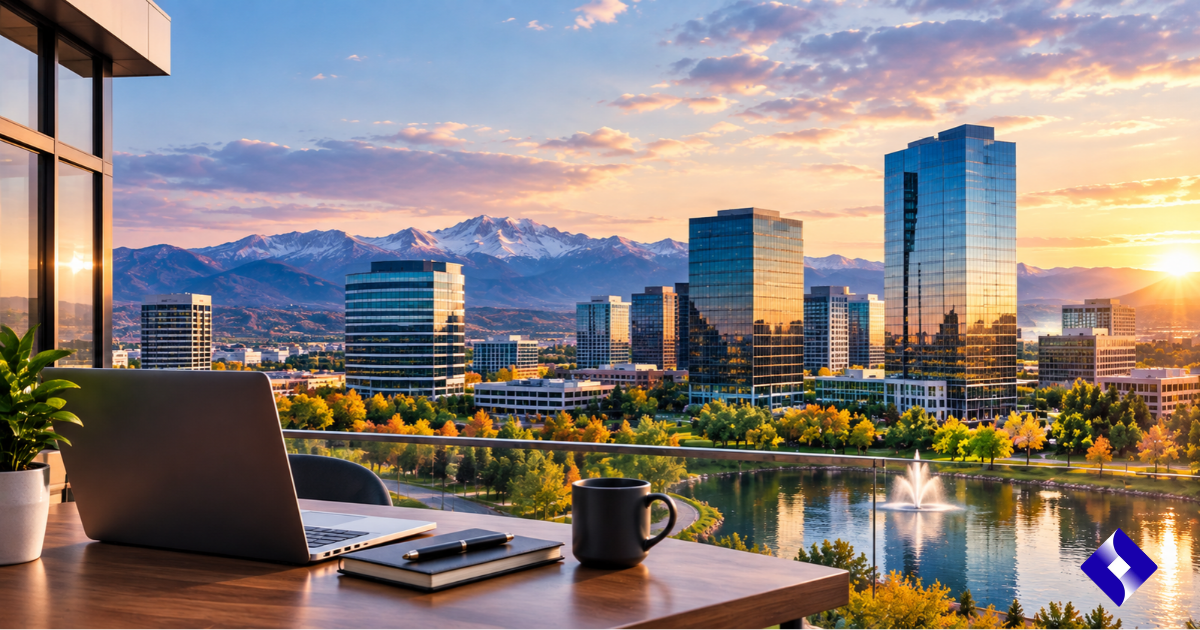

The Denver Tech Center, or simply “DTC.” The name may make it sound like a single technology campus, but the area is much more than that. It has become one of the major employment and business districts in the Denver metropolitan area, surrounded by offices, hotels, restaurants, transportation connections, residential communities, and everyday services.
Located primarily along the Interstate 25 corridor south of central Denver, the Denver Tech Center connects several key parts of the metropolitan area. Its location near major highways and rail transportation makes it convenient not only for businesses but also for employees, residents, visitors, and people traveling between Denver and its southern suburbs.
Understanding what the Denver Tech Center is can therefore help anyone who is working nearby, commuting from Southeast Denver, moving to the area, or just trying to understand how the Denver metro area is developing.
What is the Denver Tech Center?
The Denver Tech Center is a large commercial and employment district located southeast of downtown Denver. Most of the district is associated with Greenwood Village, although the greater part of the DTC area extends within the municipal boundaries.
The district began to develop in the early 1960s. According to Greenwood Village historical records, businessman and engineer George Wallace originally acquired about 40 acres of land and developed the idea of creating a suburban office park where employment, open space, and other uses could coexist.
This concept expanded considerably in the following decades.
Greenwood Village planning documents state that the Denver Technological Center was built on about 40 acres in 1962 and later expanded to more than 870 acres. The same documents describe portions of the DTC in both Greenwood Village and the city and county of Denver.
Today, the name Denver Tech Center is often used more broadly when people refer to the surrounding Southeast Denver business corridor.
| DTC Overview | What does this mean? |
| Common name | Denver Tech Center or DTC |
| General location | Southeast Denver Metropolitan Area |
| Main road crossing | Interstate 25 |
| Actual development | In the early 1960s |
| Original concept | Planned suburban employment and office district |
| Modern character | Offices, businesses, transportation, dining, hotels and nearby residential areas |
| Regional role | Major employment and commercial center serving south metro Denver |
Where is the Denver Tech Center located?
One reason the area is important is its location.
The Denver Tech Center sits southeast of downtown Denver along the I-25 corridor. Greenwood Village is just south of Denver and is a key part of the broader DTC business district. This location places the district between central Denver and the rapidly developing communities to the south.
This position gives people access to many parts of the metro without requiring each trip to go directly through the city.
The surrounding area includes communities connected to Greenwood Village and the broader Southeast Metropolitan Corridor, with major roads providing routes to Centennial, Lone Tree, Aurora and other parts of the region.
For travelers, location is one of the defining features of DTC.
Why was the Denver Tech Center built?
The original idea behind the DTC was different from incorporating another group of office buildings.
The historical account of Greenwood Village states that George Wallace envisioned a place where people could work, live, and play in a planned environment. Landscaping and open space were important elements of the early development concept.
This planning philosophy reflects a broader change occurring in American metropolitan areas during the second half of the twentieth century.
Employment was no longer concentrated exclusively in traditional central business districts. New highway networks allowed large workplaces to develop outside city centers, closer to sprawling suburban communities.
The Denver Tech Center became part of this transformation in the Denver area.
Over time, new offices, transportation infrastructure, and supporting businesses developed around the district, gradually transforming the area into a major economic hub rather than an isolated office park.
Why is the Denver Tech Center important to Denver’s economy?
The easiest answer is employment.
A large number of companies and workplaces make DTC a prime destination for workers in the Denver metropolitan area.
Greenwood Village describes itself as an economic leader within South Metro Denver and identifies businesses operating in and around its major commercial developments, including Denver Tech Center, Greenwood Plaza and Village Center.
This creates an interesting feature of the area: its daytime activity is much greater than its resident population alone would suggest.
Greenwood Village is reported to have approximately 15,691 residents but the daytime business community population is approximately 38,500 people.
This difference shows how employment strengthens daily activities in the area.
The workers arriving each morning also create demand for restaurants, transportation, professional services, hotels, retail businesses, and other support services.
Therefore, economic influence extends beyond the companies occupying office buildings.
How does the Denver Tech Center affect the wider metro area?
A major employment district changes how people move through the city.
Instead of everyone flocking to Downtown Denver, the DTC provides another major employment destination to the south.
This creates what urban planners sometimes describe as a multi-center metropolitan area: people can live in one suburb, work in another business district, shop elsewhere, and only occasionally commute into the city center.
The Denver Tech Center contributes to this pattern.
For example, someone living south of Denver can access a large number of employers without having to travel all the way to the central business district.
Similarly, companies located in the DTC can reach workers from both Denver and the south suburban community.
Transportation is a big part of the importance of DTC.
Transportation has played a significant role in the development of the area.
Interstate 25 passes directly through Greenwood Village and serves as Colorado’s primary north-south highway corridor. Nearby I-225 provides another connection to the northeast metro area and eventually to I-70.
Rail transportation also helps connect surrounding business districts.
Greenwood Village identifies three light rail stations within its boundaries: Village Center, Orchard Station and Arapahoe at Dayton Station.
This combination of highway and rail access is especially important because thousands of people travel to the area for work.
| Transport feature | Why does this matter? |
| Interstate 25 | Provides a direct north-south route through the Denver metro area. |
| Interstate 225 nearby | Connects the southeast area to Aurora and northeast Denver. |
| Light rail | Provides passengers with an alternative to driving. |
| Arapahoe in the village center | DTC and a significant portion of the Greenwood Village area operate. |
| Orchard Station | Provides additional access along the I-25 business corridor. |
| Dayton Station | Connects the area near the I-225 corridor. |
| Nearest Centennial Airport | Supports access to regional general aviation. |
Transportation planning has been part of the region’s development for decades.
Before light rail expanded into the area, Greenwood Village and neighboring organizations operated a circulator service designed to connect workers to businesses around the DTC and Greenwood Plaza. Historical city records show that the service carried more than 135,000 riders during its first year and continued until the arrival of rail service in 2006.
Is the Denver Tech Center just for technology companies?
No
This is one of the most common misunderstandings caused by the name.
Although “Tech Center” is part of its identity, the DTC should not be thought of as just a technology district.
The modern business community includes organizations from many industries and professional fields. Greenwood Village’s economic development information, for example, identifies companies such as Empower, Fidelity Investments, Coe Bank, Merrick & Company, and Red Robin among the businesses in the community.
Therefore, the area functions more like a large diverse business district than a specialized technology campus.
This distinction is useful for job seekers and people researching the area because employment opportunities are not limited to software or engineering.
What is this around the Denver Tech Center?
The role of DTC is different from the traditional city of Denver.
Instead of densely packed blocks of the city dominated by old high-rise buildings, much of the area developed around office campuses, landscaped properties, wide streets, and planned commercial developments.
At the same time, the district is no longer just a collection of offices.
Restaurants, hotels, services, and nearby residential areas support the large number of people who work and travel to the area daily.
This mix can be especially useful for professionals who want employment opportunities outside the city while remaining connected to the wider metropolitan area.
How is Denver Tech Center different from Downtown Denver?
Both areas are major employment centers, but their physical environments and locations are different.
| Denver Tech Center | Downtown Denver |
| Located southeast of central Denver. | Located in the heart of Denver. |
| Strongly connected to I-25. | Dense street and transit network |
| Largely developed as a suburban business district | Developed as the city’s historic central business district |
| Office campuses and planned commercial areas are common. | High-rise offices and dense mixed-use blocks are common. |
| Convenient for many South Metro commuters | Central location for the wider city |
| Serves as an additional regional employment center. | Serves as Denver’s traditional urban center. |
The two areas do not necessarily compete with each other. Instead, they play different roles in the metropolitan economy.
Having multiple employment centers can reduce the need for every worker and company to locate in the same city center.
Why is the area constantly increasing?
Location has been one of the strongest factors.
The Denver Tech Center sits along a major transportation corridor while remaining close to established suburban communities. This combination enables the area to access a broad labor pool.
Its long-term planning also played a significant role in its development.
The original vision emphasized commercial development as well as landscaping and open space, while later transportation investments improved accessibility for workers and visitors.
As the southern Denver metro area expanded, the district became increasingly well-positioned between Denver itself and the growing communities to the south.
This relationship continues to make the area relevant decades after its original development.
What should someone know before visiting the Denver Tech Center?
The first thing to understand is that DTC is an area rather than a single building or attraction.
If someone tells you that a meeting, office, or hotel is “in the Denver Tech Center,” it’s important to check the exact address. Locations can be spread out over a relatively large business district.
Transportation choices also depend on the specific destination.
Some locations may be convenient for light rail, while other locations are easier to reach by car or require other connections once you arrive at the station.
Traffic conditions around I-25 can also affect travel times, especially during normal commute times.
For first-time visitors, knowing the specific street, nearest station, and expected travel route can make navigating the area much easier.
Why the Denver Tech Center matters in the Denver metro area.
The Denver Tech Center becomes clear when looking beyond its name.
What began as a concept for an office development of about 40 acres in the early 1960s has evolved into a major commercial district along one of Colorado’s most important transportation corridors.
Today, his role extends beyond the office space.
It provides jobs, supports surrounding businesses, connects workers from multiple communities and provides the Denver metropolitan area with another important economic hub outside of the traditional city center.
For residents, workers, and visitors, understanding the DTC also makes it easier to understand the geography of Southeast Denver. It explains why so much transportation, commercial development, and daily commute activity is concentrated along this section of the I-25 corridor.
Ultimately, the Denver Tech Center is important because it demonstrates how the Denver metro area has evolved from a primarily downtown hub to a larger network of interconnected employment, residential, and commercial districts.
Frequently Asked Questions
What companies are in the Denver Tech Center?
The Denver Tech Center and its surrounding Greenwood Village area are home to major employers such as Empower, Fidelity Investments, Coe Bank, Merrick & Company, and Charter Communications.
What is the Denver Tech Center?
The Denver Tech Center is a major business and employment district in southeast metro Denver, known for its offices, professional services, transportation access, hotels, restaurants, and nearby residential areas.
What types of jobs are there in the Denver Tech Center?
Jobs in and around the DTC span finance, insurance, professional and technical services, information technology, real estate, healthcare, retail, hospitality, and administrative services.
What to do in the Denver Tech Center area?
Visitors can explore local restaurants, parks, shopping areas, hotels, and nearby entertainment venues using convenient road and light rail connections to reach other parts of Denver.
Why are people moving out of Denver?
Reasons vary by home, but common factors may include housing costs, changes in work arrangements, lifestyle preferences, taxes, and the search for more space or lower living costs in surrounding communities.
Who is the largest employer in Denver?
There is no single, consistent answer because employer rankings change over time and depend on whether public or private employers are included. Denver’s largest employers have historically included major healthcare systems, retailers, government agencies, and educational institutions.