

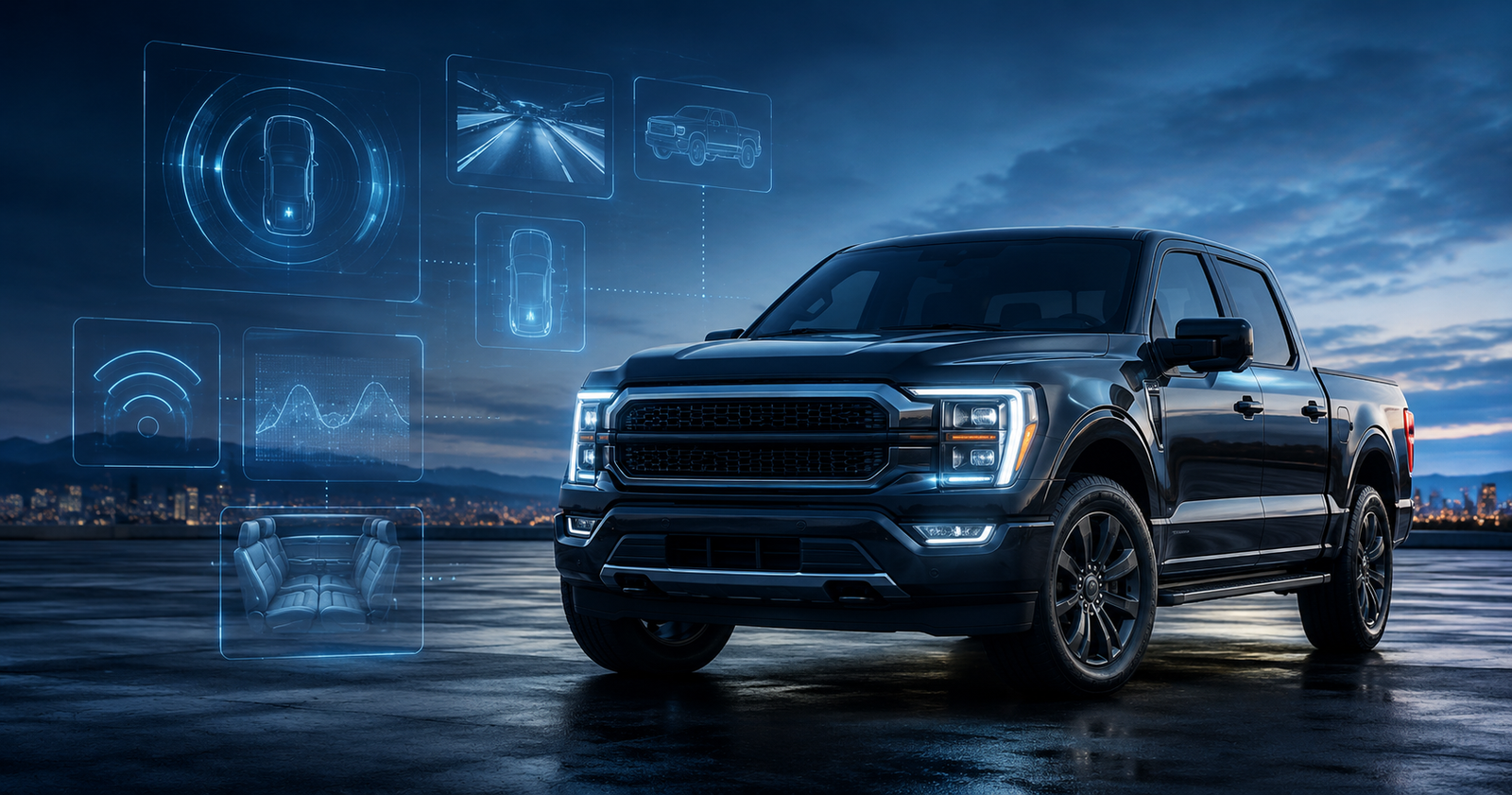

Pickup truck technology has changed considerably. Features that once centered mainly on entertainment and navigation now help drivers stay connected, manage trailers, monitor the road, and handle everyday tasks from behind the wheel.
The 2026 F-150 smart tech features reflect that shift. The truck combines a 12-inch center display and SYNC 4 with available connected services, driver-assistance systems, towing technology, and other tools designed to make a large pickup easier to live with.
But having more technology does not automatically make a truck more useful. Drivers need to understand what these systems actually do, which ones matter in everyday situations, and which features depend on the trim or equipment selected.
This guide breaks down the technology in practical terms.
What Are the Main 2026 F-150 Smart Tech Features?
The 2026 Ford F-150 spreads its technology across several areas rather than relying on one large technology package. Connectivity and infotainment handle everyday digital tasks, driver-assistance technology supports awareness on the road, and specialized towing systems address situations unique to truck owners.
Here is a quick overview.
| Technology | What It Does | Why Drivers May Find It Useful |
| 12-inch center display | Provides access to vehicle and infotainment functions | Creates a central location for commonly used controls |
| SYNC 4 | Manages connected infotainment functions | Makes phone, media, and vehicle features easier to access |
| Wireless smartphone integration | Connects compatible phones without a cable | Reduces the need to plug in a phone for routine use |
| Ford Connectivity Package | Adds connected services on equipped trucks | Supports navigation, Wi-Fi, and compatible connected apps |
| Ford Co-Pilot360 technology | Groups driver-assistance technologies | Supports driver awareness in everyday traffic |
| BlueCruise | Provides available hands-free highway assistance | Can reduce some of the workload of highway driving |
| Pro Trailer Hitch Assist | Helps with trailer hitch alignment | Addresses one of the trickier parts of connecting a trailer |
| Pro Trailer Backup Assist | Assists while reversing with a trailer | Can make trailer positioning easier to manage |
| Connected Navigation | Provides connected routing information | Can account for traffic and other changing road conditions |
| Software updates | Allows compatible software improvements | Helps supported systems receive updates over time |
Not every feature is standard on every 2026 F-150. Availability can change according to trim, package and configuration, so buyers should verify the equipment on the specific truck they are considering.
A 12-Inch Screen Makes Technology Easier to Reach
One of the most noticeable pieces of technology inside the 2026 F-150 is its 12-inch center touchscreen.
Ford lists the 12-inch capacitive touchscreen and SYNC 4 as standard even on the 2026 F-150 XL. That matters because useful infotainment technology is not restricted entirely to higher trims.
A larger display has a straightforward benefit: information can be presented in a format that is easier to see and interact with. Instead of treating the screen as an oversized entertainment system, it is better to think of it as the control center for many of the truck’s connected functions.
For someone moving from an older pickup, this may be one of the biggest differences in the everyday driving experience.
SYNC 4 Handles the Connected Side of the Truck
SYNC 4 sits at the center of many of the F-150’s digital functions.
It supports compatible smartphone connectivity, voice functions and access to connected services. Ford also supports wireless Apple CarPlay and Android Auto compatibility through SYNC 4, allowing drivers to use many familiar phone functions without connecting a cable.
That can solve a small but common problem: getting into the truck for a short journey and having to plug in a phone simply to access familiar apps or functions.
| SYNC 4 Function | Everyday Use |
| Wireless phone integration | Access compatible smartphone functions without routinely plugging in |
| Voice functionality | Perform supported tasks with less touchscreen interaction |
| Connected services | Access supported online vehicle functions |
| Navigation integration | View compatible route guidance on the center screen |
| Software updates | Receive supported system improvements without traditional update methods |
The value here is less about having another screen in the cabin and more about reducing friction between the driver’s phone, vehicle, and frequently used digital services.
What Does the Ford Connectivity Package Add?
Connectivity goes beyond pairing a smartphone.
The available Ford Connectivity Package on the 2026 F-150 can bring together features such as a 4G/5G Wi-Fi hot spot, connected maps and compatible entertainment or voice services, depending on trim and equipment.
Ford says the hot spot can connect as many as 10 devices within 50 feet of the vehicle. This could be particularly useful for passengers, families or people who use their truck around a jobsite.
The available connected maps can also provide information such as live traffic and real-time weather.
Some connected functions require an included period, trial, plan, or subscription, so drivers should distinguish between hardware installed in the truck and services that remain active indefinitely.
Can the 2026 F-150 Help With Highway Driving?
One of the more advanced available technologies is Ford BlueCruise.
BlueCruise is designed to provide hands-free highway driving assistance on designated compatible roads, which Ford calls Hands-Free Blue Zones.
The important word is assistance.
BlueCruise is a Level 2 driver-assistance system, not autonomous driving. The person behind the wheel still needs to watch the road, remain attentive, and be prepared to take control when necessary.
For drivers who spend considerable time traveling on compatible highways, the system may reduce some of the repetitive workload associated with longer trips.
Ford has also continued updating BlueCruise through software development. This demonstrates another important change in modern truck ownership: some vehicle technology can evolve after the vehicle leaves the dealership.
Ford Co-Pilot360 Supports Everyday Driver Awareness
Not every useful smart feature needs to take over a major driving task.
Some of the most practical technologies operate more quietly in the background. Ford Co-Pilot360 technology brings together driver-assistance functions intended to support awareness and help drivers respond to certain road situations.
For example, Ford lists Pre-Collision Assist with Automatic Emergency Braking, Forward Collision Warning and a Lane-Keeping System among the standard comfort and convenience features of the 2026 F-150 XL.
These systems should not be treated as substitutes for careful driving. Their role is to provide additional assistance.
That distinction is especially important when comparing modern driver technology. A feature can be useful without making the vehicle self-driving.
How Does the 2026 F-150 Make Towing Easier?
This is where the F-150’s technology becomes particularly truck-specific.
A generic infotainment feature can be useful in almost any vehicle. Trailer assistance, however, addresses problems pickup drivers actually encounter.
Available Pro Trailer Hitch Assist is designed to help when aligning the truck with a trailer hitch. Available Pro Trailer Backup Assist provides assistance when backing a connected trailer.
Ford’s 2026 F-150 XLT, for example, offers these towing technologies depending on configuration.
| Towing Technology | Problem It Addresses |
| Pro Trailer Hitch Assist | Lining the truck up with a trailer |
| Pro Trailer Backup Assist | Controlling direction while reversing a trailer |
| Trailer Reverse Guidance | Improving information available while backing |
| Connected Navigation with trailer routing | Planning routes that better account for a trailer |
For occasional towers, these technologies can help make unfamiliar maneuvers more manageable. Experienced towers may appreciate them for a different reason: convenience.
Either way, towing technology is arguably one of the clearest examples of smart features being designed around how an F-150 is actually used.
Connected Navigation Goes Beyond Basic Directions
Many drivers already have navigation on their phones, so built-in navigation needs to offer more than a simple map to remain useful.
Ford’s Connected Navigation can provide real-time traffic information and routing assistance. Its towing capabilities are especially relevant to F-150 owners.
Ford says its Smart Towing functionality can factor a trailer profile’s size and weight into routing. That can help drivers avoid unsuitable situations such as low bridges, weight restrictions, narrow roads, or difficult turns.
That is a meaningful distinction between ordinary phone navigation and navigation designed around a working pickup.
Instead of answering only, “How do I get there?” the system can help address the more relevant towing question: “How should I get there with this trailer?”
Can the F-150 Work as a Mobile Wi-Fi Hotspot?
Yes, appropriately equipped 2026 F-150 models support a Wi-Fi hotspot.
This feature can be more useful in a pickup than it initially sounds.
A truck may spend time at campsites, worksites, parking areas, or other locations where occupants need internet access away from a conventional home or office connection. Supporting multiple devices can make the truck a temporary connectivity hub for passengers or work equipment.
Drivers should remember that connected services can have plan requirements and coverage limitations. A Wi-Fi hotspot is useful, but it does not mean the vehicle creates an internet connection where cellular service is unavailable.
Software Updates Change How Drivers Think About Vehicle Technology
Modern vehicles increasingly behave like connected electronic devices in one important respect: software does not necessarily remain frozen at the version installed when the vehicle was built.
Ford supports over-the-air software updates for compatible vehicle systems.
That means certain improvements can be delivered without using the same process that would traditionally require a service visit.
The advantage is convenience, but there is another benefit: drivers should evaluate a modern truck partly by its software ecosystem, not simply by the hardware visible on the day of purchase.
Ford’s continued BlueCruise updates illustrate how software can improve supported functionality over time.
Smart Security Extends Beyond the Key Fob
Connected technology can also play a role when the truck is parked.
Ford lists the Ford Security Package as available for the 2026 F-150.
Its supported functions include Theft Alerts, Start Inhibit, and Stolen Vehicle Services.
Theft Alerts can provide notifications through the Ford app for certain detected events, such as potential cabin intrusion or an unexpected location change.
This is another example of why “smart technology” should not be understood only as dashboard gadgets. Some connected features are intended to remain useful after the driver has walked away from the truck.
Ford states that the Security Package is included for a limited initial period on select models before requiring a paid plan, so owners should check current terms when evaluating the feature.
Which Smart Features Are Most Useful for Different Drivers?
There is no single technology that every F-150 owner needs equally.
A better way to evaluate the 2026 F-150 smart tech features is to start with the situations in which the truck will actually be used.
| Type of Driver | Technology Worth Considering |
| Daily commuter | SYNC 4, smartphone integration, driver-assistance features |
| Frequent highway traveler | BlueCruise, Connected Navigation |
| Regular trailer user | Pro Trailer Hitch Assist, Pro Trailer Backup Assist, trailer routing |
| Jobsite user | Wi-Fi connectivity, center display, connected services |
| Family road-trip driver | Wi-Fi hotspot, navigation, smartphone connectivity |
| Driver concerned about vehicle security | Ford Security Package and connected alerts |
This approach can prevent buyers from paying attention only to the longest equipment list.
A feature is valuable when it solves a problem you regularly have.
Are All 2026 F-150 Technology Features Standard?
No.
This is one of the most important things to understand before comparing trucks.
Some technology is widely available across the lineup, while advanced systems may require a particular trim, package, configuration, or active connected-service plan.
The XL, for instance, already includes a 12-inch touchscreen, SYNC 4 and several driver-assistance technologies. Moving through the range introduces access to additional equipment and configurations.
Higher trims can also add technology such as a head-up display, wireless charging, and more advanced convenience equipment.
Therefore, two trucks carrying the same 2026 F-150 name can have noticeably different technology.
What Should You Check Before Choosing a 2026 F-150?
Instead of asking which F-150 has “the most technology,” drivers may get a better result by checking how each feature fits their routine.
| Question to Ask | Why It Matters |
| Is the feature standard or optional? | Prevents assumptions based on general model information |
| Does it require a specific package? | Some technologies are tied to particular configurations |
| Is there an ongoing subscription? | Connected functionality may have costs after an included period |
| Will I actually use it regularly? | More technology does not automatically mean better value |
| Does it help with towing or work? | Truck-specific features may provide greater practical benefit |
| Does it require cellular connectivity? | Some connected functions depend on network availability |
| Which trim includes the features I need? | Technology availability varies across the lineup |
Doing this before focusing on trim badges can make the comparison considerably easier.
Are the 2026 F-150 Smart Tech Features Worth Paying Attention To?
Yes, but primarily when they address a real driving or ownership need.
The strongest part of the F-150’s technology approach is not simply the number of digital features available. It is the variety of situations those technologies address.
SYNC 4 and smartphone integration can simplify daily connectivity. Driver-assistance systems can support awareness. BlueCruise addresses long stretches of compatible highway driving. Trailer technology focuses on hitching and reversing. Connected Navigation can become more useful when a trailer changes the route requirements.
That is a more practical way to judge modern vehicle technology.
Final Thoughts
The 2026 F-150 smart tech features show how pickup technology is moving beyond entertainment and convenience.
Today’s systems can play a role in connectivity, highway driving, towing, navigation, security, and everyday vehicle operation.
Still, the smartest feature is not necessarily the most advanced one.
A driver who regularly pulls a trailer may get far more value from trailer-assistance technology than an entertainment feature. Someone with a long highway commute may care more about BlueCruise. A contractor may place greater importance on connectivity around a worksite.
Understanding those differences makes it easier to separate genuinely useful technology from features that simply sound impressive on a specification sheet.
Before choosing a particular 2026 F-150, check the exact trim, package, service requirements, and feature availability. That way, the technology you choose matches how you actually intend to use the truck.
The factual feature details above were checked against Ford’s current 2026 F-150 information. Ford confirms the 12-inch touchscreen and SYNC 4 on the XL, available BlueCruise and towing assistance on the XLT, connected-service options for 2026 models, and Security Package availability for the 2026 F-150. citeturn0search3turn0search6turn0search1turn0search5
Read more: Droven io Best Tech Tools for Developers: How to Choose the Right Tools for Your Workflow