


Introduction
Painting a lacrosse field accurately involves much more than simply following the outer boundary. The playing areas, midfield markings, restricted areas, substitution zones, and other lines must conform to the rules of the competition in question.
Traditionally, sports field maintenance workers perform this task using measuring tapes, string, stakes, spray markers, and hand-held paint sprayers. The method works, but marking a field from scratch can require considerable measurements and repeated checks.
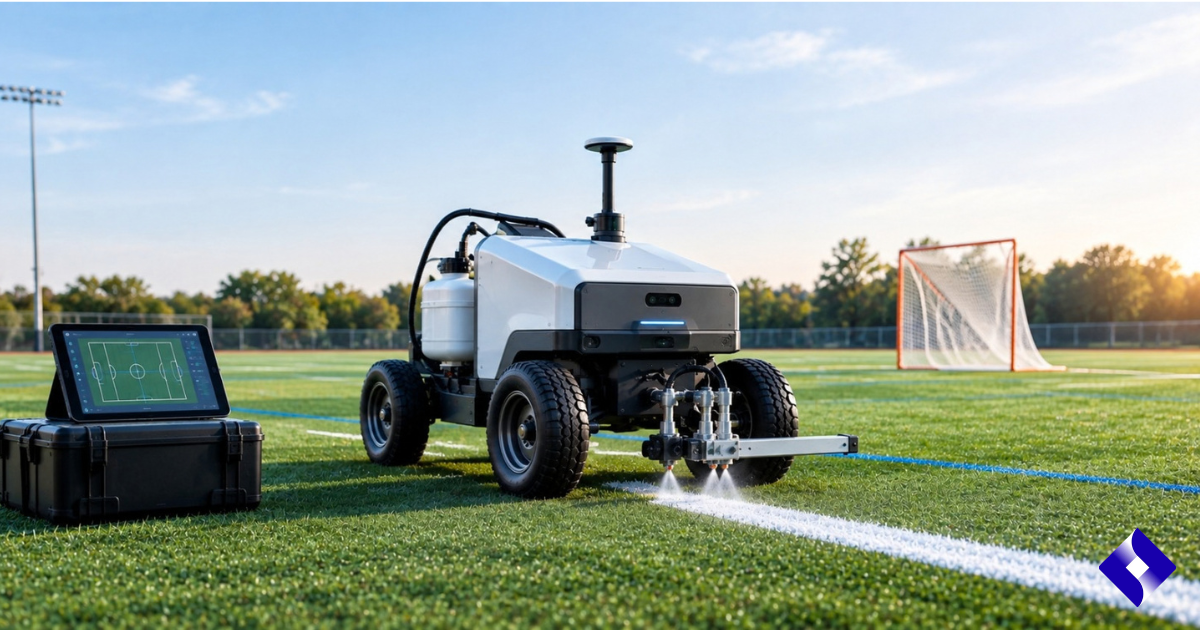
A robot designed to paint lacrosse fields takes a different approach. Instead of relying primarily on physical measuring tools, it follows a digital layout of the field and uses satellite positioning to navigate the turf.
Modern systems can store multiple sports field templates, repeat previously saved designs, and automatically control where the painting begins and ends. This makes robotic line marking particularly attractive for schools, universities, municipalities, clubs, and sports complexes that manage multiple fields.
This guide explains how the technology works, how to configure a robot, the level of accuracy users can expect, what its cost might be, and how it integrates into daily on-site maintenance.
Table of Contents
- What is a robot for painting lacrosse fields?
- How robotic lacrosse field painting works
- How to set up a robot to paint lacrosse fields.
- How accurate are field painting robots?
- Lacrosse field dimensions and templates
- Main features
- How much does a robot for painting lacrosse fields cost?
- Everyday uses
- Benefits
- Advantages and disadvantages
- What can affect performance?
- Is this robot suitable for any installation?
- Frequently Asked Questions
- Conclusion
What is a robot for painting lacrosse fields?
A lacrosse field painting robot is an autonomous or semi-autonomous machine designed to mark the lines of a sports field according to a digital design.
Most current systems use high-precision GNSS or GPS positioning instead of requiring an operator to physically measure each line. Some systems use an RTK-GNSS correction system, which improves positioning far beyond conventional consumer GPS.
The operator typically selects the appropriate lacrosse stencil using a tablet or app. Once the field’s location and orientation are set, the machine calculates its route and moves across the playing surface while operating its paint sprayer.
The same device is often capable of marking multiple sports. Current commercial platforms include templates for lacrosse, soccer, American football, rugby, baseball, track and field, and other activities. TinyMobileRobots, for example, currently includes templates for men’s, women’s, youth, unified, and other lacrosse among its compatible designs.
How does a robot work to paint lacrosse fields?
Although the software and hardware vary between manufacturers, the basic process is similar.
1. A digital field design is selected.
The operator begins by selecting a field template.
In lacrosse, this step is important because there is no universal design for all versions of the game. Men’s lacrosse, women’s lacrosse, youth competitions, Sixes, and locally modified fields can all have different dimensions and markings.
Many systems also allow the operator to modify the dimensions instead of using only a fixed template.
2. The field is digitally positioned.
The system needs to know exactly where the land is located within the property.
According to the machine, the operator can identify reference points, corners, a center line, or other known positions. Once the terrain is aligned, its location can usually be saved for future work.
This is especially useful when repainting.
Instead of remeasuring the entire area next week, the team can reload the previously saved design.
3. The robot is guided by satellite positioning.
Professional line marking robots typically use precision satellite navigation.
For example, the current specification for Turf Tank Two includes RTK-GNSS with a local base station , while TinyMobileRobots includes satellite-based positioning in its current machines.
The robot continuously compares its actual location with the digital route it must follow.
Its drive motors then make corrections in the direction to keep the machine on the intended path.
4. The paint is applied automatically.
Once the machine reaches a line, its spraying system applies the paint as the robot moves along.
The software determines when spraying should start and stop. Therefore, the operator does not have to manually activate the nozzle at every intersection, corner, fold, or boundary.
Spray height, nozzle type, paint flow rate, and travel speed can also affect the appearance of the final line.
5. The robot completes the planned route.
The machine continues the digital process until the required markings have been painted.
Although the driving process is automated, the operator still has responsibilities. They must inspect the terrain for players, equipment, holes, temporary obstacles, vehicles, irrigation equipment, and anything else that might interfere with the course.
Therefore, a field marking robot should be considered an automated tool for land maintenance, rather than an unattended machine that requires no supervision.
How to set up a robot to paint lacrosse fields.
The initial setup requires more thought than simply placing the robot on the lawn and pressing the start button.
A reliable workflow typically follows these steps.
| Preparation stage | What the operator does | Why is it important? |
| Inspect the field | Check the terrain, obstacles, and boundaries. | Avoid interruptions and design errors. |
| Confirm rules | Identify the applicable lacrosse format | Ensure that the correct dimensions are used. |
| Choose a template | Select the design for men, women, youth, or other. | Establish the digital geometry |
| Position field | Establish reference points or field orientation | Determine where the marks will appear. |
| Check dimensions | Check the length, width, and any special markings. | Avoid painting the wrong design. |
| Prepare the paint | Fill the tank and inspect the nozzle. | It helps produce uniform lines |
| Confirm satellite signal | Allow the positioning system to establish accuracy | Necessary for reliable navigation |
| Trial alignment | Inspect a reference point before fully marking it. | It provides a final verification. |
| Start work | Allow the robot to follow its route | Automated dialing begins |
| Inspect the completed field | Control lines, intersections, and special areas | Confirm that the field is ready |
The initial design of a new field deserves the utmost attention. Once the geometry and position are verified and saved, routine repainting is considerably simplified.
How accurate is a robot that paints lacrosse fields?
Accuracy is one of the main reasons why facilities consider robotic line marking, but the claims should be interpreted with caution.
Professional systems that use RTK positioning can operate with centimeter-level accuracy under suitable conditions.
For example, TinyMobileRobots currently specifies a positioning accuracy of 1 to 2 cm, or approximately 0.4 to 0.8 inches, for its Sport model.
That does not mean that all robots from all manufacturers always stay within the same tolerance.
Actual results may be influenced by satellite visibility, machine calibration, terrain, surrounding structures, turf conditions, wheel traction, positioning technology, and the quality of the original field setup.
Why accuracy is particularly important in lacrosse
A lacrosse field contains more than just long, straight sidelines.
Folds, center marks, circles, dashed lines, restriction areas, replacement areas, and other geometric elements must be correctly positioned.
Small measurement errors can become apparent when several points depend on each other. An incorrect reference point at the start of a manual layout can influence subsequent marks.
Digital designs reduce the need for repetitive manual measurements, although the template itself must still conform to current standards.
The dimensions of lacrosse fields are not all the same.
A common mistake is to assume that all lacrosse fields should use identical markings.
That is not the case.
For example, the current World Lacrosse Sixes rules specify a rectangular field 70 meters long by 36 meters wide for recognized World Lacrosse competitions. The rules also specify line widths and positioning requirements.
Meanwhile, the current diagram of the women’s lacrosse field from World Lacrosse shows a playing area approximately 91.4 to 100 meters long and 50 to 55 meters wide , along with its own set of markings and dimensions.
These differences demonstrate why the operator should never select a generic “lacrosse” design without confirming the competition standard.
The person in charge of the school or sports facilities must determine if the field must comply with the following:
- World Lacrosse Rules
- NCAA Requirements
- NFHS Requirements
- Youth League Specifications
- local association regulations
- A modified recreational design
The robot improves execution. It doesn’t decide which rules apply.
Main features of a robot for painting lacrosse fields.
Precision satellite navigation
The RTK-GNSS positioning system or a comparable high-precision positioning system allows the machine to follow digital coordinates more accurately than standard consumer navigation.
Pre-loaded field templates
Sports libraries reduce the need to manually create each field from scratch.
Useful systems should provide the exact lacrosse formats required by the installation, rather than simply advertising “lacrosse support”.
Custom field dimensions
Not all facilities have a space that complies with current regulations.
The ability to customize the size allows operators to adapt the layout to youth programs, training spaces, shared facilities, or local competition rules.
Saved field locations
Once a field has been correctly positioned, its digital location can be stored.
This makes repainting considerably easier, as the operator does not need to rebuild the entire design every time the paint fades.
Automatic paint control
The robot activates and deactivates the paint flow according to its route.
This improves uniformity at corners, gaps, intersections, and other planned transitions.
Adjustable spray system
Nozzle selection, spray height, speed, and paint settings allow the operator to control the appearance of the finishing line.
Control via tablet or app
Most current systems use a tablet or mobile interface for task selection, field positioning, customization, and machine monitoring.
Multi-sport capability
This function is especially valuable for university campuses and municipal sports facilities.
The same machine can be used for lacrosse during one season and for soccer, American football, rugby, or other activities at different times.
How much does a robot for painting lacrosse fields cost?
There is no single standard price.
The total cost depends on the robot, software license, support package, positioning equipment, included templates, training, service contract, painting requirements, and whether the equipment is purchased, financed, rented, or obtained through a subscription.
As of September 2026, published market examples place outright ownership of professional robotic field marking equipment in the low five-figure range up to approximately $50,000 , depending on the equipment and package. A current pricing study lists examples ranging from approximately $21,750 to $55,000 for different TinyLineMarker configurations, while other manufacturers use quote-based or subscription-based pricing.
Turf Tank, for example, currently promotes Basic, Plus, and Pro subscription packages instead of displaying a single US subscription price on its public packages page. Hardware, ranking equipment, software updates, training, and different levels of support may be included depending on the plan.
Therefore, buyers should compare the total cost of ownership , not just the price of the machine.
Costs to consider
| Cost area | Questions to ask |
| Robot | Is it purchased, rented, or subscription-based? |
| Software | Is there an annual license fee? |
| Templates | Are lacrosse designs included? |
| GNSS Equipment | Is a base station or correction service required? |
| Training | Is operator training included? |
| Support | What happens when technical assistance is needed? |
| Paint | Is it necessary to use approved or trademarked paint? |
| Maintenance | Are the pumps, nozzles, and wear parts covered? |
| Batteries | How many are included and what is the replacement cost? |
| Connectivity | Does the system require mobile phone or internet service? |
A cheaper purchase may end up being more expensive if essential software and service fees are excluded.
Conversely, a higher-priced subscription may include maintenance, hardware replacement, training, upgrades, and technical support.
What about robotic exterior painting services?
Buying a robot is not the only option.
Some contractors offer robotic line marking as a service, which can be useful for installations that only need occasional marking.
As a current example in the US, SnapLine lists a price of $299 for a lacrosse field , including paint and supplies, with shipping charged separately. This is the current rate from an individual provider, not a standard industry price.
A service model can be an option to consider when a facility needs a precise initial design, but does not cover enough ground to justify the purchase of equipment.
Everyday uses of robots for painting lacrosse fields
Initial site design
Creating a field from an unmarked surface generally requires the most measurements.
A robotic system can apply a pre-configured digital layout once the operator establishes the location and orientation of the terrain.
Routine repainting
This is one of the most practical applications.
Once the coordinates are stored, the robot can return to the same digital design when the lines begin to fade.
Seasonal changes in the terrain
Shared facilities often change sports frequently.
A single playing surface can be used for lacrosse one season and soccer or American football the next. Multi-sport robot libraries can simplify these transitions.
Youth and modified fields
Often, smaller designs can be created by adjusting a standard template or selecting a suitable youthful setting.
Practice areas
Training fields do not always require the same markings as those used on a competition surface.
Custom dimensions can be useful for drills, reduced playing areas, grids, and training zones.
Sports complexes with multiple fields
The economic situation changes when ground maintenance teams are responsible for numerous playing surfaces.
Once multiple field positions are stored, operators can switch jobs without having to physically measure each field from scratch.
Benefits of using a robot to paint lacrosse fields.
Less manual measurement
Manual layouts usually require adhesive tapes, stakes, and strings.
Digital positioning shifts much of the measurement work to software.
Repeatable field placement
Saving a correctly positioned field allows future markers to follow the same digital coordinates.
This is especially useful for repainting over the course of a season.
Consistent geometry
The machines are very suitable for repeating straight lines, circles, and other predefined shapes.
This can reduce variations caused by different staff members plotting the same field.
Reduction of manual labor
Although the operator still needs to set up and monitor the equipment, they do not have to manually push the painting machine along each line.
The time saved can be used for mowing the lawn, watering, repairing surfaces, preparing goals, cleaning, installing equipment, or other ground maintenance tasks.
Easier multi-sport management
A digital template library allows the same hardware to be used in different sports.
This can be more valuable to a school or a municipality than to an organization that maintains a single sports field.
Simpler repainting
Once the location is stored, operators can reload the same field instead of rebuilding the geometry from scratch.
Advantages and disadvantages
| Advantages | Disadvantages |
| With professional systems it is possible to achieve centimeter-level precision. | Significant initial or subscription cost |
| Reduce manual measurement | The operators still need training. |
| It facilitates the repetition of designs | Satellite conditions may affect positioning. |
| Useful for multiple sports | Not all packages include all templates. |
| It can reduce the work of manual marking. | The painting systems still require cleaning and maintenance. |
| Produces repeatable geometry | An incorrect digital configuration can still produce an incorrect field. |
| Useful for large field inventories. | Smaller facilities may not use it enough to justify owning it. |
| Saved designs simplify repainting. | Trees, structures, and difficult terrain can complicate the operation. |
What factors can affect the performance of a field painting robot?
Robotic marking of sports fields is a precise technology, but it still works in a real outdoor environment.
Trees and buildings
Satellite-based equipment needs reliable positioning data.
Dense vegetation, stadium structures, nearby buildings, fences, and other obstacles can make positioning difficult, depending on the system.
Some manufacturers have developed filtering or correction technologies specifically to improve performance in harsh environments. However, during a demonstration, it is important to assess the site conditions.
Uneven terrain
Deep ruts, holes, steep transitions, muddy terrain, and poor traction can all affect the robot’s physical path.
Precise coordinates cannot fully compensate for wheel slippage or the machine’s inability to traverse the surface correctly.
Incorrect field configuration
A robot can accurately reproduce a misplaced template.
Therefore, confirming the dimensions of the land, the orientation, the setbacks, the objectives and the rules that govern it is essential before carrying out the first complete painting.
Paint preparation
Poor paint mixing, clogged nozzles, inadequate viscosity, worn spray components, or incorrect settings can reduce line quality, even if navigation is accurate.
Climate and turf conditions
Wind can influence the pulverized material.
Wet grass, very long grass, uneven mowing, or extreme ground conditions can also affect the final appearance.
Operators must follow the paint manufacturer’s instructions regarding temperature, humidity, drying time, and surface compatibility.
Robotic painting vs. manual marking of lacrosse fields
The choice is not simply a contest between “old” and “new” technology.
Manual field marking remains practical for many facilities.
| Factor | Manual method | Robotic method |
| Initial cost of the equipment | Lower | Higher |
| Initial measurement | It requires a lot of labor | Digital assistance |
| Operator labor | Higher | Lower yourself during painting |
| Repeatability | It depends on the reference points and the staff. | Stored digital designs |
| Learning curve | Familiar tools | Robot software and training |
| I work in multiple fields | More physical configuration | It’s easier once the designs are stored. |
| Custom changes | Manual measurement | Software based on capable systems |
| technological dependence | Low | Higher |
| Best fit | Low-volume installations | Repeated or multi-field operations |
A facility that performs maintenance on a single field several times a year may reach a different conclusion than a university or parks department responsible for dozens of playing surfaces.
Is a robot worth it for painting lacrosse fields?
The answer depends mainly on the volume of fieldwork and labor requirements.
A grounds maintenance department that manages multiple lacrosse fields, in addition to soccer and football fields, has more opportunities to use the machine. Repeated layouts across a large sports complex can make saved coordinates and multi-sport templates especially useful.
For a small organization that only maintains a field occasionally, the purchase of a professional robotic scoreboard may be difficult to justify on purely economic grounds.
In that situation, hiring a company specializing in robotic marking for the initial design or sharing equipment between different facilities may be more practical.
Before you buy, calculate:
Current annual labor hours + current painting costs + external contractor costs + field design time + projected robot operating costs.
Then, compare those figures over several years.
This approach provides a much more realistic answer than relying solely on the percentage of savings advertised by the manufacturer.
What to consider before choosing a robot for painting fields
Facilities that evaluate equipment should focus on practical requirements rather than just the main specifications.
Ask the supplier to demonstrate the robot on your property whenever possible.
Pay special attention to:
- Required lacrosse templates
- Positioning accuracy
- Performance near buildings and trees
- Compatible with natural grass and synthetic turf
- Custom field dimensions
- Repainting capability
- Paint compatibility
- Battery life
- Shipping weight
- Paint tank size
- Software fees
- Connectivity requirements
- Warranty conditions
- Training
- Technical support
- Availability of spare parts
- Data storage and field backups
- Multisport support
Also ask what happens if the facility changes its field layout in the future.
Software flexibility can be just as important as hardware specifications.
Frequently Asked Questions
1. What is a robot for painting lacrosse fields?
A lacrosse field painting robot is an automatic sports line marker that follows a digitally defined field design using high-precision positioning technology. It moves across the field and automatically controls its painting system to create the lacrosse lines.
2. How accurate is a field painting robot?
Professional RTK-GNSS systems can provide centimeter-level positioning accuracy. For example, a current commercial system specifies an accuracy of approximately 1-2 cm, although actual performance depends on the equipment, satellite conditions, terrain, and proper configuration.
3. Can a robot paint both men’s and women’s lacrosse fields?
Yes, provided the software includes the appropriate templates. Some commercial systems currently offer designs for men’s, women’s, youth, and unified lacrosse. Always confirm the exact regulations required before painting.
4. Does the robot need GPS?
Most current autonomous robots for marking sports lines rely on satellite positioning, commonly GNSS or RTK-GNSS. Specific correction methods vary; some use local base stations, while others employ different correction technologies.
5. Can a robot repaint an existing lacrosse field?
Yes. The repaint function is one of the most useful, as it allows you to store and reuse the coordinates of an existing field. The operator can retrieve the saved layout instead of having to manually measure the entire field again.
6. How much does a robot for painting lacrosse fields cost?
Professional systems can cost anywhere from a few hundred dollars to tens of thousands, while other manufacturers use subscription or budget-based pricing. Buyers should also consider software, training, GNSS services, maintenance, painting, and support, rather than just comparing hardware prices.
7. Can a robot mark other sports fields?
Generally, yes. Multi-sport platforms are typically compatible with fields for soccer, American football, lacrosse, rugby, baseball, track and field, and other sports. The available templates depend on the model and software.
8. Does a robot for painting sports fields completely replace grounds maintenance staff?
No. It automates navigation and line drawing, but staff are still needed to prepare the field, choose and verify designs, prepare the paint, supervise operation, inspect results, clean equipment, and maintain the playing surface.
Also Read:Coffee Robot Brands Compared: Exploring Cafe X, Artly, Rozum, KUKA, and Other Industry Competitors
Conclusion
A robot for painting lacrosse fields transforms one of the most dimensionally precise field maintenance tasks into a virtually digital process. Once the correct field dimensions and position are established, precision satellite navigation allows the machine to follow the planned geometry and automatically control the paint application.
This technology is especially useful for repetitive marking. Instead of rebuilding side lines, folds, circles, and other elements every time the paint fades, maintenance crews can revert to a saved field design.
However, automation does not eliminate the need for expert field management. Operators must still select the correct lacrosse rules, inspect the dimensions, prepare the playing surface, maintain the irrigation system, and verify that the markings are correct.
Cost is also a significant factor. Professional line marking robots represent a considerable expense in equipment or subscription, and the economic justification becomes stronger as the number of marking fields and jobs increases.